

104
4 Standard Model Measurements
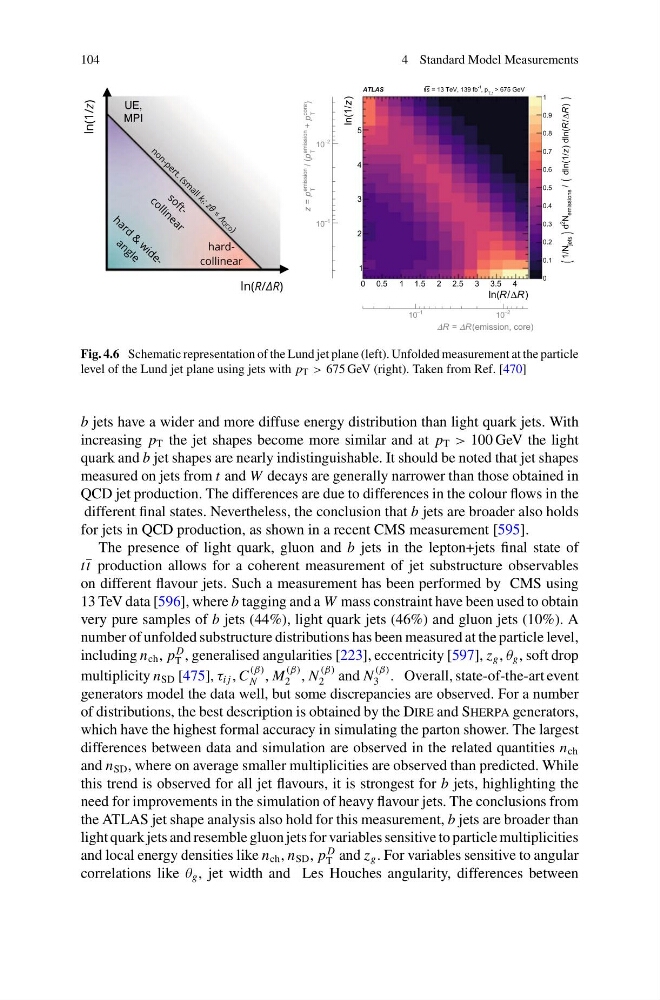
Fig. 4.6 Schematic representation of the Lund jet plane (left). Unfolded measurement at the particle
level of the Lund jet plane using jets with p T > 675 GeV (right). Taken from Ref. [470]
b jets have a wider and more diffuse energy distribution than light quark jets. With
increasing p T the jet shapes become more similar and at p T > 100 GeV the light
quark and b jet shapes are nearly indistinguishable. It should be noted that jet shapes
measured on jets from t and W decays are generally narrower than those obtained in
QCD jet production. The differences are due to differences in the colour flows in the
different final states. Nevertheless, the conclusion that b jets are broader also holds
for jets in QCD production, as shown in a recent CMS measurement [595].
The presence of light quark, gluon and b jets in the lepton+jets final state of
tt production allows for a coherent measurement of jet substructure observables
on different flavour jets. Such a measurement has been performed by CMS using
13 TeV data [596], where b tagging and a W mass constraint have been used to obtain
very pure samples of b jets (44%), light quark jets (46%) and gluon jets (10%). A
number of unfolded substructure distributions has been measured at the particle level,
including n ch , p
D
T , generalised angularities [223], eccentricity [597], z g , θ g , soft drop
multiplicity n SD [475], τ i j , C
(β)
N , M
(β)
2 , N
(β)
2 and N
(β)
3 . Overall, state-of-the-art event
generators model the data well, but some discrepancies are observed. For a number
of distributions, the best description is obtained by the Dire and Sherpa generators,
which have the highest formal accuracy in simulating the parton shower. The largest
differences between data and simulation are observed in the related quantities n ch
and n SD , where on average smaller multiplicities are observed than predicted. While
this trend is observed for all jet flavours, it is strongest for b jets, highlighting the
need for improvements in the simulation of heavy flavour jets. The conclusions from
the ATLAS jet shape analysis also hold for this measurement, b jets are broader than
light quark jets and resemble gluon jets for variables sensitive to particle multiplicities
and local energy densities like n ch , n SD , p
D
T and z g . For variables sensitive to angular
correlations like θ g , jet width and Les Houches angularity, differences between
4 Standard Model Measurements
Fig. 4.6 Schematic representation of the Lund jet plane (left). Unfolded measurement at the particle
level of the Lund jet plane using jets with p T > 675 GeV (right). Taken from Ref. [470]
b jets have a wider and more diffuse energy distribution than light quark jets. With
increasing p T the jet shapes become more similar and at p T > 100 GeV the light
quark and b jet shapes are nearly indistinguishable. It should be noted that jet shapes
measured on jets from t and W decays are generally narrower than those obtained in
QCD jet production. The differences are due to differences in the colour flows in the
different final states. Nevertheless, the conclusion that b jets are broader also holds
for jets in QCD production, as shown in a recent CMS measurement [595].
The presence of light quark, gluon and b jets in the lepton+jets final state of
tt production allows for a coherent measurement of jet substructure observables
on different flavour jets. Such a measurement has been performed by CMS using
13 TeV data [596], where b tagging and a W mass constraint have been used to obtain
very pure samples of b jets (44%), light quark jets (46%) and gluon jets (10%). A
number of unfolded substructure distributions has been measured at the particle level,
including n ch , p
D
T , generalised angularities [223], eccentricity [597], z g , θ g , soft drop
multiplicity n SD [475], τ i j , C
(β)
N , M
(β)
2 , N
(β)
2 and N
(β)
3 . Overall, state-of-the-art event
generators model the data well, but some discrepancies are observed. For a number
of distributions, the best description is obtained by the Dire and Sherpa generators,
which have the highest formal accuracy in simulating the parton shower. The largest
differences between data and simulation are observed in the related quantities n ch
and n SD , where on average smaller multiplicities are observed than predicted. While
this trend is observed for all jet flavours, it is strongest for b jets, highlighting the
need for improvements in the simulation of heavy flavour jets. The conclusions from
the ATLAS jet shape analysis also hold for this measurement, b jets are broader than
light quark jets and resemble gluon jets for variables sensitive to particle multiplicities
and local energy densities like n ch , n SD , p
D
T and z g . For variables sensitive to angular
correlations like θ g , jet width and Les Houches angularity, differences between