

4.1 Measurements of Jet Substructure Observables
101
〉
charged
n
〈
0
5
10
15
20
25
30
ATLAS
> 0.5 GeV
track
T
p
| < 2.1
jet
T
η
|
-1
L dt = 20.3 fb
∫
= 8 TeV
s
(with stat. uncertainty)
Data
syst. uncert.
⊕
stat.
Data
2.6.3 EE3 CTEQ6L1
Herwig++
2.7.1 EE5 CTEQ6L1
Herwig++
.175 AU2 CT10
Pythia 8
.186 A14 NNPDF2.3
Pythia 8
.186 Monash NNPDF2.3
Pythia 8
.428 P2012 CTEQ6L1
Pythia 6
.428 P2012 RadHi
Pythia 6
.428 P2012 RadLo
Pythia 6
[GeV]
T
Jet p
0
500
1000
1500
Data/Model
0.8
1
1.2
0
20
40
60
ch
n
0
0.1
0.2
0.3
0.4
0.5
ch
) dN / dn
jet
(1/N
ATLAS
-1
= 13 TeV, 33 fb
s
/ GeV < 1000
T
900 < Jet p
Topic 1 Data
Topic 2 Data
Topic 1 Pythia 8.186 A14
Topic 2 Pythia 8.186 A14
Quarks Pythia 8.186 A14
Gluons Pythia 8.186 A14
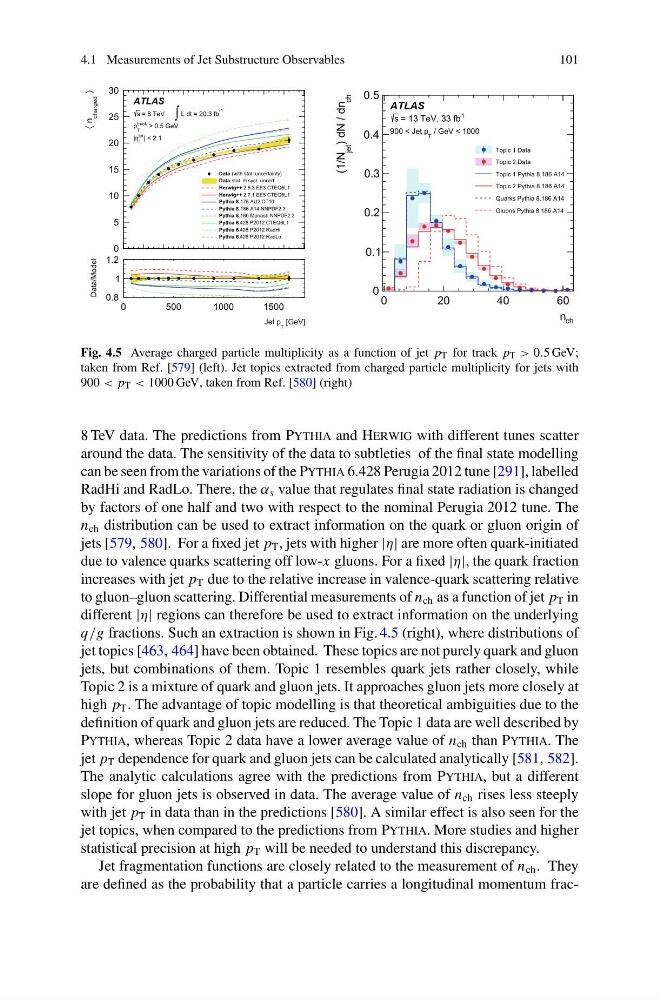
Fig. 4.5 Average charged particle multiplicity as a function of jet p T for track p T > 0.5 GeV;
taken from Ref. [579] (left). Jet topics extracted from charged particle multiplicity for jets with
900 < p T < 1000 GeV, taken from Ref. [580] (right)
8 TeV data. The predictions from Pythia and Herwig with different tunes scatter
around the data. The sensitivity of the data to subtleties of the final state modelling
can be seen from the variations of the Pythia 6.428 Perugia 2012 tune [291], labelled
RadHi and RadLo. There, the α S value that regulates final state radiation is changed
by factors of one half and two with respect to the nominal Perugia 2012 tune. The
n ch distribution can be used to extract information on the quark or gluon origin of
jets [579, 580]. For a fixed jet p T , jets with higher |η| are more often quark-initiated
due to valence quarks scattering off low-x gluons. For a fixed |η|, the quark fraction
increases with jet p T due to the relative increase in valence-quark scattering relative
to gluon–gluon scattering. Differential measurements of n ch as a function of jet p T in
different |η| regions can therefore be used to extract information on the underlying
q/g fractions. Such an extraction is shown in Fig. 4.5 (right), where distributions of
jet topics [463, 464] have been obtained. These topics are not purely quark and gluon
jets, but combinations of them. Topic 1 resembles quark jets rather closely, while
Topic 2 is a mixture of quark and gluon jets. It approaches gluon jets more closely at
high p T . The advantage of topic modelling is that theoretical ambiguities due to the
definition of quark and gluon jets are reduced. The Topic 1 data are well described by
Pythia, whereas Topic 2 data have a lower average value of n ch than Pythia. The
jet p T dependence for quark and gluon jets can be calculated analytically [581, 582].
The analytic calculations agree with the predictions from Pythia, but a different
slope for gluon jets is observed in data. The average value of n ch rises less steeply
with jet p T in data than in the predictions [580]. A similar effect is also seen for the
jet topics, when compared to the predictions from Pythia. More studies and higher
statistical precision at high p T will be needed to understand this discrepancy.
Jet fragmentation functions are closely related to the measurement of n ch . They
are defined as the probability that a particle carries a longitudinal momentum frac-
101
〉
charged
n
〈
0
5
10
15
20
25
30
ATLAS
> 0.5 GeV
track
T
p
| < 2.1
jet
T
η
|
-1
L dt = 20.3 fb
∫
= 8 TeV
s
(with stat. uncertainty)
Data
syst. uncert.
⊕
stat.
Data
2.6.3 EE3 CTEQ6L1
Herwig++
2.7.1 EE5 CTEQ6L1
Herwig++
.175 AU2 CT10
Pythia 8
.186 A14 NNPDF2.3
Pythia 8
.186 Monash NNPDF2.3
Pythia 8
.428 P2012 CTEQ6L1
Pythia 6
.428 P2012 RadHi
Pythia 6
.428 P2012 RadLo
Pythia 6
[GeV]
T
Jet p
0
500
1000
1500
Data/Model
0.8
1
1.2
0
20
40
60
ch
n
0
0.1
0.2
0.3
0.4
0.5
ch
) dN / dn
jet
(1/N
ATLAS
-1
= 13 TeV, 33 fb
s
/ GeV < 1000
T
900 < Jet p
Topic 1 Data
Topic 2 Data
Topic 1 Pythia 8.186 A14
Topic 2 Pythia 8.186 A14
Quarks Pythia 8.186 A14
Gluons Pythia 8.186 A14
Fig. 4.5 Average charged particle multiplicity as a function of jet p T for track p T > 0.5 GeV;
taken from Ref. [579] (left). Jet topics extracted from charged particle multiplicity for jets with
900 < p T < 1000 GeV, taken from Ref. [580] (right)
8 TeV data. The predictions from Pythia and Herwig with different tunes scatter
around the data. The sensitivity of the data to subtleties of the final state modelling
can be seen from the variations of the Pythia 6.428 Perugia 2012 tune [291], labelled
RadHi and RadLo. There, the α S value that regulates final state radiation is changed
by factors of one half and two with respect to the nominal Perugia 2012 tune. The
n ch distribution can be used to extract information on the quark or gluon origin of
jets [579, 580]. For a fixed jet p T , jets with higher |η| are more often quark-initiated
due to valence quarks scattering off low-x gluons. For a fixed |η|, the quark fraction
increases with jet p T due to the relative increase in valence-quark scattering relative
to gluon–gluon scattering. Differential measurements of n ch as a function of jet p T in
different |η| regions can therefore be used to extract information on the underlying
q/g fractions. Such an extraction is shown in Fig. 4.5 (right), where distributions of
jet topics [463, 464] have been obtained. These topics are not purely quark and gluon
jets, but combinations of them. Topic 1 resembles quark jets rather closely, while
Topic 2 is a mixture of quark and gluon jets. It approaches gluon jets more closely at
high p T . The advantage of topic modelling is that theoretical ambiguities due to the
definition of quark and gluon jets are reduced. The Topic 1 data are well described by
Pythia, whereas Topic 2 data have a lower average value of n ch than Pythia. The
jet p T dependence for quark and gluon jets can be calculated analytically [581, 582].
The analytic calculations agree with the predictions from Pythia, but a different
slope for gluon jets is observed in data. The average value of n ch rises less steeply
with jet p T in data than in the predictions [580]. A similar effect is also seen for the
jet topics, when compared to the predictions from Pythia. More studies and higher
statistical precision at high p T will be needed to understand this discrepancy.
Jet fragmentation functions are closely related to the measurement of n ch . They
are defined as the probability that a particle carries a longitudinal momentum frac-