

4.1 Measurements of Jet Substructure Observables
99
[GeV]
m
Events / 20 GeV
0
500
1000
1500
2000
2500
3000
3500
Data
t
t
Single t
W+jets
Total unc.
(13 TeV)
-1
35.9 fb
CMS
1.2
=
jet
XCone, R
0.4
=
sub
3, R
=
sub
N
400 GeV
>
T
p
[GeV]
jet
m
0
100
200
300
400
500
Data / MC
0.5
1
1.5
Total unc.
Stat. unc.
mass
GeV
1
jet
m
d
σ
d
σ
1
Data
= 169.5 GeV
t
m
= 172.5 GeV
t
m
= 175.5 GeV
t
m
CMS
(13 TeV)
-1
35.9 fb
0
0.01
0.02
0.03
0.04
GeV
jet
m
120
140
160
180
200
220
Data
Theory
0.5
1
1.5
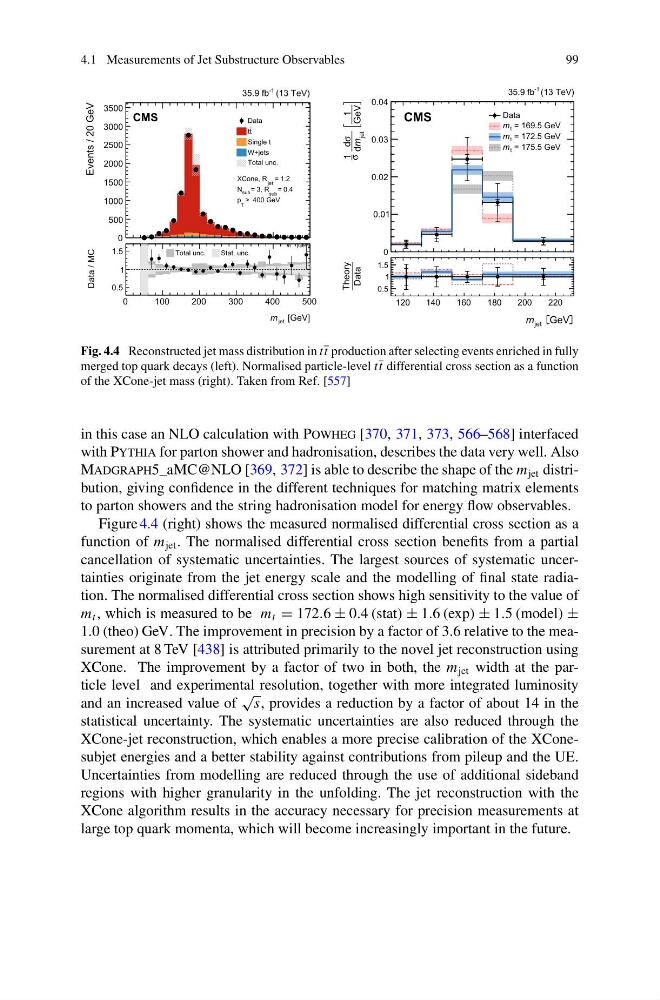
Fig. 4.4 Reconstructed jet mass distribution in tt production after selecting events enriched in fully
merged top quark decays (left). Normalised particle-level tt differential cross section as a function
of the XCone-jet mass (right). Taken from Ref. [557]
in this case an NLO calculation with Powheg [370, 371, 373, 566–568] interfaced
with Pythia for parton shower and hadronisation, describes the data very well. Also
Madgraph5_aMC@NLO [369, 372] is able to describe the shape of the m jet distribution, giving confidence in the different techniques for matching matrix elements
to parton showers and the string hadronisation model for energy flow observables.
Figure 4.4 (right) shows the measured normalised differential cross section as a
function of m jet . The normalised differential cross section benefits from a partial
cancellation of systematic uncertainties. The largest sources of systematic uncertainties originate from the jet energy scale and the modelling of final state radiation. The normalised differential cross section shows high sensitivity to the value of
m t , which is measured to be m t = 172.6 ± 0.4 (stat) ± 1.6 (exp) ± 1.5 (model) ±
1.0 (theo) GeV. The improvement in precision by a factor of 3.6 relative to the measurement at 8 TeV [438] is attributed primarily to the novel jet reconstruction using
XCone. The improvement by a factor of two in both, the m jet width at the particle level and experimental resolution, together with more integrated luminosity
and an increased value of
√
s, provides a reduction by a factor of about 14 in the
statistical uncertainty. The systematic uncertainties are also reduced through the
XCone-jet reconstruction, which enables a more precise calibration of the XConesubjet energies and a better stability against contributions from pileup and the UE.
Uncertainties from modelling are reduced through the use of additional sideband
regions with higher granularity in the unfolding. The jet reconstruction with the
XCone algorithm results in the accuracy necessary for precision measurements at
large top quark momenta, which will become increasingly important in the future.
99
[GeV]
m
Events / 20 GeV
0
500
1000
1500
2000
2500
3000
3500
Data
t
t
Single t
W+jets
Total unc.
(13 TeV)
-1
35.9 fb
CMS
1.2
=
jet
XCone, R
0.4
=
sub
3, R
=
sub
N
400 GeV
>
T
p
[GeV]
jet
m
0
100
200
300
400
500
Data / MC
0.5
1
1.5
Total unc.
Stat. unc.
mass
GeV
1
jet
m
d
σ
d
σ
1
Data
= 169.5 GeV
t
m
= 172.5 GeV
t
m
= 175.5 GeV
t
m
CMS
(13 TeV)
-1
35.9 fb
0
0.01
0.02
0.03
0.04
GeV
jet
m
120
140
160
180
200
220
Data
Theory
0.5
1
1.5
Fig. 4.4 Reconstructed jet mass distribution in tt production after selecting events enriched in fully
merged top quark decays (left). Normalised particle-level tt differential cross section as a function
of the XCone-jet mass (right). Taken from Ref. [557]
in this case an NLO calculation with Powheg [370, 371, 373, 566–568] interfaced
with Pythia for parton shower and hadronisation, describes the data very well. Also
Madgraph5_aMC@NLO [369, 372] is able to describe the shape of the m jet distribution, giving confidence in the different techniques for matching matrix elements
to parton showers and the string hadronisation model for energy flow observables.
Figure 4.4 (right) shows the measured normalised differential cross section as a
function of m jet . The normalised differential cross section benefits from a partial
cancellation of systematic uncertainties. The largest sources of systematic uncertainties originate from the jet energy scale and the modelling of final state radiation. The normalised differential cross section shows high sensitivity to the value of
m t , which is measured to be m t = 172.6 ± 0.4 (stat) ± 1.6 (exp) ± 1.5 (model) ±
1.0 (theo) GeV. The improvement in precision by a factor of 3.6 relative to the measurement at 8 TeV [438] is attributed primarily to the novel jet reconstruction using
XCone. The improvement by a factor of two in both, the m jet width at the particle level and experimental resolution, together with more integrated luminosity
and an increased value of
√
s, provides a reduction by a factor of about 14 in the
statistical uncertainty. The systematic uncertainties are also reduced through the
XCone-jet reconstruction, which enables a more precise calibration of the XConesubjet energies and a better stability against contributions from pileup and the UE.
Uncertainties from modelling are reduced through the use of additional sideband
regions with higher granularity in the unfolding. The jet reconstruction with the
XCone algorithm results in the accuracy necessary for precision measurements at
large top quark momenta, which will become increasingly important in the future.