

3.5 Jet Substructure Tagging
89
[GeV]
m
Probe jet
Events
0
2000
4000
6000
8000
10000
12000
Data
merged top
t
t
semimerged top
t
t
unmerged top
t
t
Single top merged top
Single top semimerged top
Single top unmerged top
W+Jets
Z+Jets
QCD
Total unc.
> 300 GeV
T
p
(13 TeV)
-1
59.7 fb
CMS
Preliminary
[GeV]
SD
m
Probe jet
0
100
200
300
400
500
Data / MC
0.5
1
1.5
[GeV]
m
Probe jet
Events
0
200
400
600
800
1000
1200
1400
1600
Data
merged top
t
t
semimerged top
t
t
unmerged top
t
t
Single top merged top
Single top semimerged top
Single top unmerged top
W+Jets
Z+Jets
QCD
Total unc.
> 300 GeV
T
p
(13 TeV)
-1
59.7 fb
CMS
Preliminary
[GeV]
SD
m
Probe jet
0
100
200
300
400
500
Data / MC
0.5
1
1.5
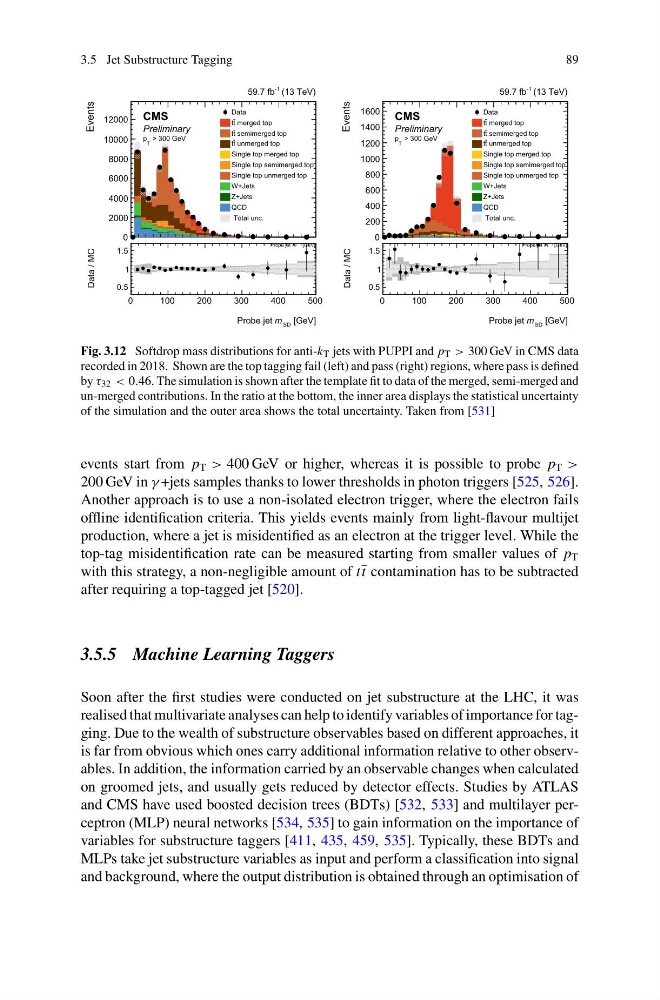
Fig. 3.12 Softdrop mass distributions for anti-k T jets with PUPPI and p T > 300 GeV in CMS data
recorded in 2018. Shown are the top tagging fail (left) and pass (right) regions, where pass is defined
by τ 32 < 0.46. The simulation is shown after the template fit to data of the merged, semi-merged and
un-merged contributions. In the ratio at the bottom, the inner area displays the statistical uncertainty
of the simulation and the outer area shows the total uncertainty. Taken from [531]
events start from p T > 400 GeV or higher, whereas it is possible to probe p T >
200 GeV in γ +jets samples thanks to lower thresholds in photon triggers [525, 526].
Another approach is to use a non-isolated electron trigger, where the electron fails
offline identification criteria. This yields events mainly from light-flavour multijet
production, where a jet is misidentified as an electron at the trigger level. While the
top-tag misidentification rate can be measured starting from smaller values of p T
with this strategy, a non-negligible amount of tt contamination has to be subtracted
after requiring a top-tagged jet [520].
3.5.5 Machine Learning Taggers
Soon after the first studies were conducted on jet substructure at the LHC, it was
realised that multivariate analyses can help to identify variables of importance for tagging. Due to the wealth of substructure observables based on different approaches, it
is far from obvious which ones carry additional information relative to other observables. In addition, the information carried by an observable changes when calculated
on groomed jets, and usually gets reduced by detector effects. Studies by ATLAS
and CMS have used boosted decision trees (BDTs) [532, 533] and multilayer perceptron (MLP) neural networks [534, 535] to gain information on the importance of
variables for substructure taggers [411, 435, 459, 535]. Typically, these BDTs and
MLPs take jet substructure variables as input and perform a classification into signal
and background, where the output distribution is obtained through an optimisation of
89
[GeV]
m
Probe jet
Events
0
2000
4000
6000
8000
10000
12000
Data
merged top
t
t
semimerged top
t
t
unmerged top
t
t
Single top merged top
Single top semimerged top
Single top unmerged top
W+Jets
Z+Jets
QCD
Total unc.
> 300 GeV
T
p
(13 TeV)
-1
59.7 fb
CMS
Preliminary
[GeV]
SD
m
Probe jet
0
100
200
300
400
500
Data / MC
0.5
1
1.5
[GeV]
m
Probe jet
Events
0
200
400
600
800
1000
1200
1400
1600
Data
merged top
t
t
semimerged top
t
t
unmerged top
t
t
Single top merged top
Single top semimerged top
Single top unmerged top
W+Jets
Z+Jets
QCD
Total unc.
> 300 GeV
T
p
(13 TeV)
-1
59.7 fb
CMS
Preliminary
[GeV]
SD
m
Probe jet
0
100
200
300
400
500
Data / MC
0.5
1
1.5
Fig. 3.12 Softdrop mass distributions for anti-k T jets with PUPPI and p T > 300 GeV in CMS data
recorded in 2018. Shown are the top tagging fail (left) and pass (right) regions, where pass is defined
by τ 32 < 0.46. The simulation is shown after the template fit to data of the merged, semi-merged and
un-merged contributions. In the ratio at the bottom, the inner area displays the statistical uncertainty
of the simulation and the outer area shows the total uncertainty. Taken from [531]
events start from p T > 400 GeV or higher, whereas it is possible to probe p T >
200 GeV in γ +jets samples thanks to lower thresholds in photon triggers [525, 526].
Another approach is to use a non-isolated electron trigger, where the electron fails
offline identification criteria. This yields events mainly from light-flavour multijet
production, where a jet is misidentified as an electron at the trigger level. While the
top-tag misidentification rate can be measured starting from smaller values of p T
with this strategy, a non-negligible amount of tt contamination has to be subtracted
after requiring a top-tagged jet [520].
3.5.5 Machine Learning Taggers
Soon after the first studies were conducted on jet substructure at the LHC, it was
realised that multivariate analyses can help to identify variables of importance for tagging. Due to the wealth of substructure observables based on different approaches, it
is far from obvious which ones carry additional information relative to other observables. In addition, the information carried by an observable changes when calculated
on groomed jets, and usually gets reduced by detector effects. Studies by ATLAS
and CMS have used boosted decision trees (BDTs) [532, 533] and multilayer perceptron (MLP) neural networks [534, 535] to gain information on the importance of
variables for substructure taggers [411, 435, 459, 535]. Typically, these BDTs and
MLPs take jet substructure variables as input and perform a classification into signal
and background, where the output distribution is obtained through an optimisation of