

3.5 Jet Substructure Tagging
87
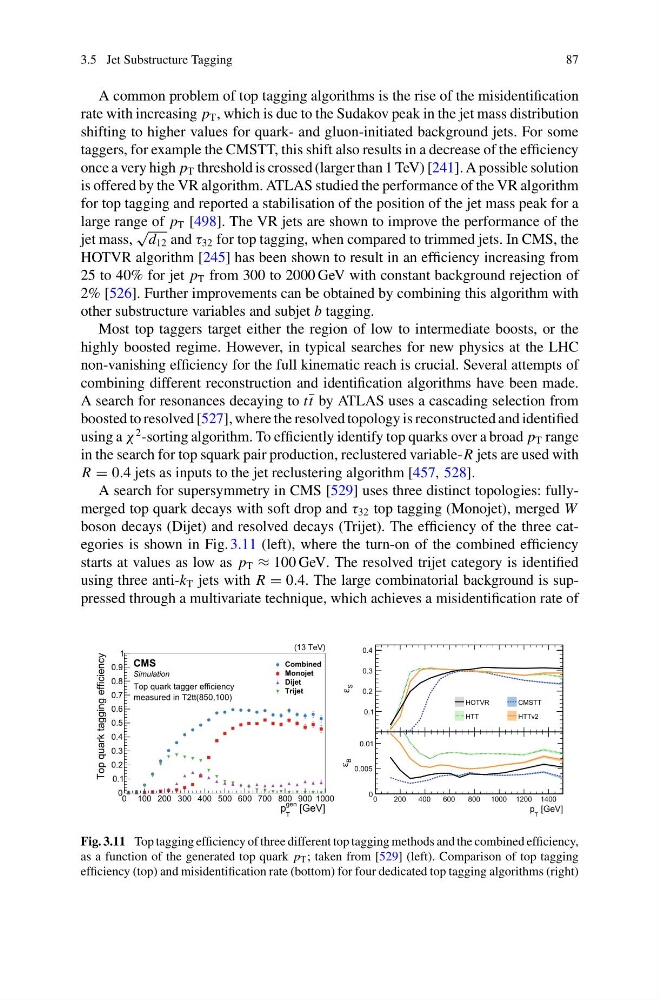
A common problem of top tagging algorithms is the rise of the misidentification
rate with increasing p T , which is due to the Sudakov peak in the jet mass distribution
shifting to higher values for quark- and gluon-initiated background jets. For some
taggers, for example the CMSTT, this shift also results in a decrease of the efficiency
once a very high p T threshold is crossed (larger than 1 TeV) [241]. A possible solution
is offered by the VR algorithm. ATLAS studied the performance of the VR algorithm
for top tagging and reported a stabilisation of the position of the jet mass peak for a
large range of p T [498]. The VR jets are shown to improve the performance of the
jet mass,
√
d 12 and τ 32 for top tagging, when compared to trimmed jets. In CMS, the
HOTVR algorithm [245] has been shown to result in an efficiency increasing from
25 to 40% for jet p T from 300 to 2000 GeV with constant background rejection of
2% [526]. Further improvements can be obtained by combining this algorithm with
other substructure variables and subjet b tagging.
Most top taggers target either the region of low to intermediate boosts, or the
highly boosted regime. However, in typical searches for new physics at the LHC
non-vanishing efficiency for the full kinematic reach is crucial. Several attempts of
combining different reconstruction and identification algorithms have been made.
A search for resonances decaying to tt by ATLAS uses a cascading selection from
boosted to resolved [527], where the resolved topology is reconstructed and identified
using a χ
2 -sorting algorithm. To efficiently identify top quarks over a broad p T range
in the search for top squark pair production, reclustered variable-R jets are used with
R = 0.4 jets as inputs to the jet reclustering algorithm [457, 528].
A search for supersymmetry in CMS [529] uses three distinct topologies: fullymerged top quark decays with soft drop and τ 32 top tagging (Monojet), merged W
boson decays (Dijet) and resolved decays (Trijet). The efficiency of the three categories is shown in Fig. 3.11 (left), where the turn-on of the combined efficiency
starts at values as low as p T ≈ 100 GeV. The resolved trijet category is identified
using three anti-k T jets with R = 0.4. The large combinatorial background is suppressed through a multivariate technique, which achieves a misidentification rate of
[GeV]
gen
T
p
0 100 200 300 400 500 600 700 800 900 1000
Top quark tagging efficiency
0
0.1
0.2
0.3
0.4
0.5
0.6
0.7
0.8
0.9
1
Combined
Monojet
Dijet
Trijet
(13 TeV)
CMS
Simulation
measured in T2tt(850,100)
Top quark tagger efficiency
0
2 0 0
4 0 0
600
800 1000 1200 1400
[GeV]
T
p
0.1
0.2
0.3
0.4
S
ε
HOTVR
CMSTT
HTT
HTTv2
0
200
400
600
800 1000 1200 1400
[GeV]
T
p
0
0.005
0.01
B
ε
Fig. 3.11 Top tagging efficiency of three different top tagging methods and the combined efficiency,
as a function of the generated top quark p T ; taken from [529] (left). Comparison of top tagging
efficiency (top) and misidentification rate (bottom) for four dedicated top tagging algorithms (right)
87
A common problem of top tagging algorithms is the rise of the misidentification
rate with increasing p T , which is due to the Sudakov peak in the jet mass distribution
shifting to higher values for quark- and gluon-initiated background jets. For some
taggers, for example the CMSTT, this shift also results in a decrease of the efficiency
once a very high p T threshold is crossed (larger than 1 TeV) [241]. A possible solution
is offered by the VR algorithm. ATLAS studied the performance of the VR algorithm
for top tagging and reported a stabilisation of the position of the jet mass peak for a
large range of p T [498]. The VR jets are shown to improve the performance of the
jet mass,
√
d 12 and τ 32 for top tagging, when compared to trimmed jets. In CMS, the
HOTVR algorithm [245] has been shown to result in an efficiency increasing from
25 to 40% for jet p T from 300 to 2000 GeV with constant background rejection of
2% [526]. Further improvements can be obtained by combining this algorithm with
other substructure variables and subjet b tagging.
Most top taggers target either the region of low to intermediate boosts, or the
highly boosted regime. However, in typical searches for new physics at the LHC
non-vanishing efficiency for the full kinematic reach is crucial. Several attempts of
combining different reconstruction and identification algorithms have been made.
A search for resonances decaying to tt by ATLAS uses a cascading selection from
boosted to resolved [527], where the resolved topology is reconstructed and identified
using a χ
2 -sorting algorithm. To efficiently identify top quarks over a broad p T range
in the search for top squark pair production, reclustered variable-R jets are used with
R = 0.4 jets as inputs to the jet reclustering algorithm [457, 528].
A search for supersymmetry in CMS [529] uses three distinct topologies: fullymerged top quark decays with soft drop and τ 32 top tagging (Monojet), merged W
boson decays (Dijet) and resolved decays (Trijet). The efficiency of the three categories is shown in Fig. 3.11 (left), where the turn-on of the combined efficiency
starts at values as low as p T ≈ 100 GeV. The resolved trijet category is identified
using three anti-k T jets with R = 0.4. The large combinatorial background is suppressed through a multivariate technique, which achieves a misidentification rate of
[GeV]
gen
T
p
0 100 200 300 400 500 600 700 800 900 1000
Top quark tagging efficiency
0
0.1
0.2
0.3
0.4
0.5
0.6
0.7
0.8
0.9
1
Combined
Monojet
Dijet
Trijet
(13 TeV)
CMS
Simulation
measured in T2tt(850,100)
Top quark tagger efficiency
0
2 0 0
4 0 0
600
800 1000 1200 1400
[GeV]
T
p
0.1
0.2
0.3
0.4
S
ε
HOTVR
CMSTT
HTT
HTTv2
0
200
400
600
800 1000 1200 1400
[GeV]
T
p
0
0.005
0.01
B
ε
Fig. 3.11 Top tagging efficiency of three different top tagging methods and the combined efficiency,
as a function of the generated top quark p T ; taken from [529] (left). Comparison of top tagging
efficiency (top) and misidentification rate (bottom) for four dedicated top tagging algorithms (right)