

18
2 Introduction to Machine Learning
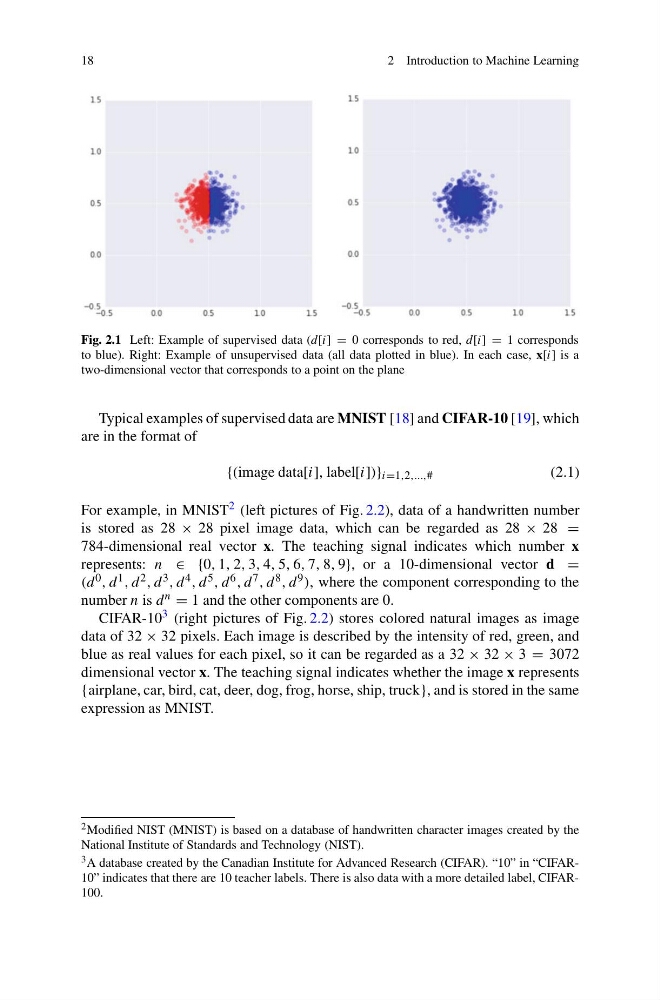
Fig. 2.1 Left: Example of supervised data (d[i] = 0 corresponds to red, d[i] = 1 corresponds
to blue). Right: Example of unsupervised data (all data plotted in blue). In each case, x[i] is a
two-dimensional vector that corresponds to a point on the plane
Typical examples of supervised data are MNIST [18] and CIFAR-10 [19], which
are in the format of
{(image data[i], label[i])} i=1,2,...,#
(2.1)
For example, in MNIST 2 (left pictures of Fig. 2.2), data of a handwritten number
is stored as 28 × 28 pixel image data, which can be regarded as 28 × 28 =
784-dimensional real vector x. The teaching signal indicates which number x
represents: n ∈ {0, 1, 2, 3, 4, 5, 6, 7, 8, 9}, or a 10-dimensional vector d =
(d 0 , d 1 , d 2 , d 3 , d 4 , d 5 , d 6 , d 7 , d 8 , d 9 ), where the component corresponding to the
number n is d n = 1 and the other components are 0.
CIFAR-10 3 (right pictures of Fig. 2.2) stores colored natural images as image
data of 32 × 32 pixels. Each image is described by the intensity of red, green, and
blue as real values for each pixel, so it can be regarded as a 32 × 32 × 3 = 3072
dimensional vector x. The teaching signal indicates whether the image x represents
{airplane, car, bird, cat, deer, dog, frog, horse, ship, truck}, and is stored in the same
expression as MNIST.
2 Modified NIST (MNIST) is based on a database of handwritten character images created by the
National Institute of Standards and Technology (NIST).
3 A database created by the Canadian Institute for Advanced Research (CIFAR). “10” in “CIFAR10” indicates that there are 10 teacher labels. There is also data with a more detailed label, CIFAR100.
2 Introduction to Machine Learning
Fig. 2.1 Left: Example of supervised data (d[i] = 0 corresponds to red, d[i] = 1 corresponds
to blue). Right: Example of unsupervised data (all data plotted in blue). In each case, x[i] is a
two-dimensional vector that corresponds to a point on the plane
Typical examples of supervised data are MNIST [18] and CIFAR-10 [19], which
are in the format of
{(image data[i], label[i])} i=1,2,...,#
(2.1)
For example, in MNIST 2 (left pictures of Fig. 2.2), data of a handwritten number
is stored as 28 × 28 pixel image data, which can be regarded as 28 × 28 =
784-dimensional real vector x. The teaching signal indicates which number x
represents: n ∈ {0, 1, 2, 3, 4, 5, 6, 7, 8, 9}, or a 10-dimensional vector d =
(d 0 , d 1 , d 2 , d 3 , d 4 , d 5 , d 6 , d 7 , d 8 , d 9 ), where the component corresponding to the
number n is d n = 1 and the other components are 0.
CIFAR-10 3 (right pictures of Fig. 2.2) stores colored natural images as image
data of 32 × 32 pixels. Each image is described by the intensity of red, green, and
blue as real values for each pixel, so it can be regarded as a 32 × 32 × 3 = 3072
dimensional vector x. The teaching signal indicates whether the image x represents
{airplane, car, bird, cat, deer, dog, frog, horse, ship, truck}, and is stored in the same
expression as MNIST.
2 Modified NIST (MNIST) is based on a database of handwritten character images created by the
National Institute of Standards and Technology (NIST).
3 A database created by the Canadian Institute for Advanced Research (CIFAR). “10” in “CIFAR10” indicates that there are 10 teacher labels. There is also data with a more detailed label, CIFAR100.