

170
11 Quantum Manybody Systems, Tensor Networks and Neural Networks
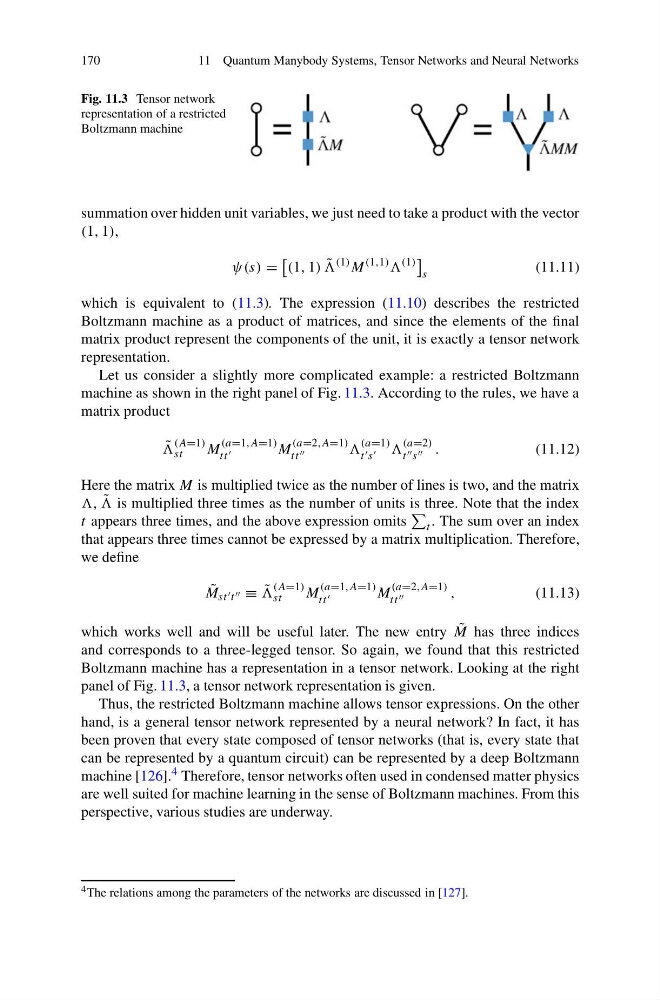
Fig. 11.3 Tensor network
representation of a restricted
Boltzmann machine
summation over hidden unit variables, we just need to take a product with the vector
(1, 1),
ψ(s) =
(1, 1) ˜
(1) M
(1,1)
(1)
s
(11.11)
which is equivalent to (11.3). The expression (11.10) describes the restricted
Boltzmann machine as a product of matrices, and since the elements of the final
matrix product represent the components of the unit, it is exactly a tensor network
representation.
Let us consider a slightly more complicated example: a restricted Boltzmann
machine as shown in the right panel of Fig. 11.3. According to the rules, we have a
matrix product
˜
(A=1)
st
M
(a=1,A=1)
tt
M
(a=2,A=1)
tt
(a=1)
t s
(a=2)
t s .
(11.12)
Here the matrix M is multiplied twice as the number of lines is two, and the matrix
˜
is multiplied three times as the number of units is three. Note that the index
t appears three times, and the above expression omits
t . The sum over an index
that appears three times cannot be expressed by a matrix multiplication. Therefore,
we define
˜
M st t ≡ ˜
(A=1)
st
M
(a=1,A=1)
tt
M
(a=2,A=1)
tt
,
(11.13)
which works well and will be useful later. The new entry ˜
M has three indices
and corresponds to a three-legged tensor. So again, we found that this restricted
Boltzmann machine has a representation in a tensor network. Looking at the right
panel of Fig. 11.3, a tensor network representation is given.
Thus, the restricted Boltzmann machine allows tensor expressions. On the other
hand, is a general tensor network represented by a neural network? In fact, it has
been proven that every state composed of tensor networks (that is, every state that
can be represented by a quantum circuit) can be represented by a deep Boltzmann
machine [126]. 4 Therefore, tensor networks often used in condensed matter physics
are well suited for machine learning in the sense of Boltzmann machines. From this
perspective, various studies are underway.
4 The relations among the parameters of the networks are discussed in [127].
11 Quantum Manybody Systems, Tensor Networks and Neural Networks
Fig. 11.3 Tensor network
representation of a restricted
Boltzmann machine
summation over hidden unit variables, we just need to take a product with the vector
(1, 1),
ψ(s) =
(1, 1) ˜
(1) M
(1,1)
(1)
s
(11.11)
which is equivalent to (11.3). The expression (11.10) describes the restricted
Boltzmann machine as a product of matrices, and since the elements of the final
matrix product represent the components of the unit, it is exactly a tensor network
representation.
Let us consider a slightly more complicated example: a restricted Boltzmann
machine as shown in the right panel of Fig. 11.3. According to the rules, we have a
matrix product
˜
(A=1)
st
M
(a=1,A=1)
tt
M
(a=2,A=1)
tt
(a=1)
t s
(a=2)
t s .
(11.12)
Here the matrix M is multiplied twice as the number of lines is two, and the matrix
˜
is multiplied three times as the number of units is three. Note that the index
t appears three times, and the above expression omits
t . The sum over an index
that appears three times cannot be expressed by a matrix multiplication. Therefore,
we define
˜
M st t ≡ ˜
(A=1)
st
M
(a=1,A=1)
tt
M
(a=2,A=1)
tt
,
(11.13)
which works well and will be useful later. The new entry ˜
M has three indices
and corresponds to a three-legged tensor. So again, we found that this restricted
Boltzmann machine has a representation in a tensor network. Looking at the right
panel of Fig. 11.3, a tensor network representation is given.
Thus, the restricted Boltzmann machine allows tensor expressions. On the other
hand, is a general tensor network represented by a neural network? In fact, it has
been proven that every state composed of tensor networks (that is, every state that
can be represented by a quantum circuit) can be represented by a deep Boltzmann
machine [126]. 4 Therefore, tensor networks often used in condensed matter physics
are well suited for machine learning in the sense of Boltzmann machines. From this
perspective, various studies are underway.
4 The relations among the parameters of the networks are discussed in [127].