

10.1 Hopfield Model and Spinglass
159
Unlike the connection of neurons in the brain, the connection between neurons is
assumed to be bidirectional. This emphasizes the similarity with spin systems.
Now, in order to see the relationship with the spinglass, redefine the degrees of
freedom as follows:
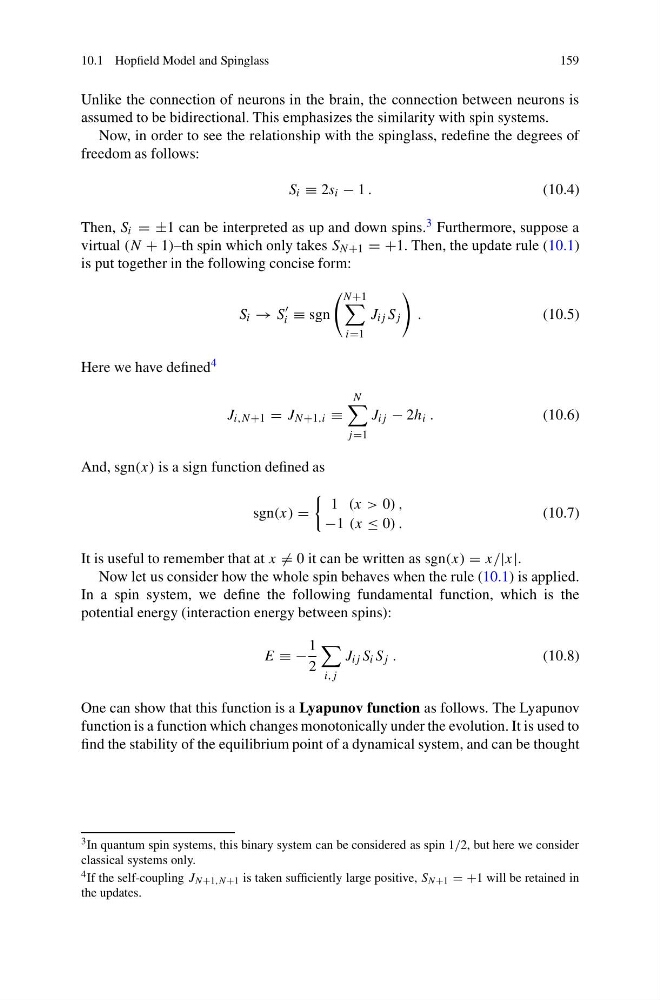
S i ≡ 2s i − 1 .
(10.4)
Then, S i = ±1 can be interpreted as up and down spins. 3 Furthermore, suppose a
virtual (N + 1)–th spin which only takes S N+1 = +1. Then, the update rule (10.1)
is put together in the following concise form:
S i → S
i ≡ sgn
N+1
i=1
J ij S j
.
(10.5)
Here we have defined 4
J i,N+1 = J N+1,i ≡
N
j =1
J ij − 2h i .
(10.6)
And, sgn(x) is a sign function defined as
sgn(x) =
1 (x > 0) ,
−1 (x ≤ 0) .
(10.7)
It is useful to remember that at x = 0 it can be written as sgn(x) = x/|x|.
Now let us consider how the whole spin behaves when the rule (10.1) is applied.
In a spin system, we define the following fundamental function, which is the
potential energy (interaction energy between spins):
E ≡ −
1
2
i,j
J ij S i S j .
(10.8)
One can show that this function is a Lyapunov function as follows. The Lyapunov
function is a function which changes monotonically under the evolution. It is used to
find the stability of the equilibrium point of a dynamical system, and can be thought
3 In quantum spin systems, this binary system can be considered as spin 1/2, but here we consider
classical systems only.
4 If the self-coupling J N+1,N+1 is taken sufficiently large positive, S N+1 = +1 will be retained in
the updates.
159
Unlike the connection of neurons in the brain, the connection between neurons is
assumed to be bidirectional. This emphasizes the similarity with spin systems.
Now, in order to see the relationship with the spinglass, redefine the degrees of
freedom as follows:
S i ≡ 2s i − 1 .
(10.4)
Then, S i = ±1 can be interpreted as up and down spins. 3 Furthermore, suppose a
virtual (N + 1)–th spin which only takes S N+1 = +1. Then, the update rule (10.1)
is put together in the following concise form:
S i → S
i ≡ sgn
N+1
i=1
J ij S j
.
(10.5)
Here we have defined 4
J i,N+1 = J N+1,i ≡
N
j =1
J ij − 2h i .
(10.6)
And, sgn(x) is a sign function defined as
sgn(x) =
1 (x > 0) ,
−1 (x ≤ 0) .
(10.7)
It is useful to remember that at x = 0 it can be written as sgn(x) = x/|x|.
Now let us consider how the whole spin behaves when the rule (10.1) is applied.
In a spin system, we define the following fundamental function, which is the
potential energy (interaction energy between spins):
E ≡ −
1
2
i,j
J ij S i S j .
(10.8)
One can show that this function is a Lyapunov function as follows. The Lyapunov
function is a function which changes monotonically under the evolution. It is used to
find the stability of the equilibrium point of a dynamical system, and can be thought
3 In quantum spin systems, this binary system can be considered as spin 1/2, but here we consider
classical systems only.
4 If the self-coupling J N+1,N+1 is taken sufficiently large positive, S N+1 = +1 will be retained in
the updates.