

140
8 Detection of Phase Transition by Machines
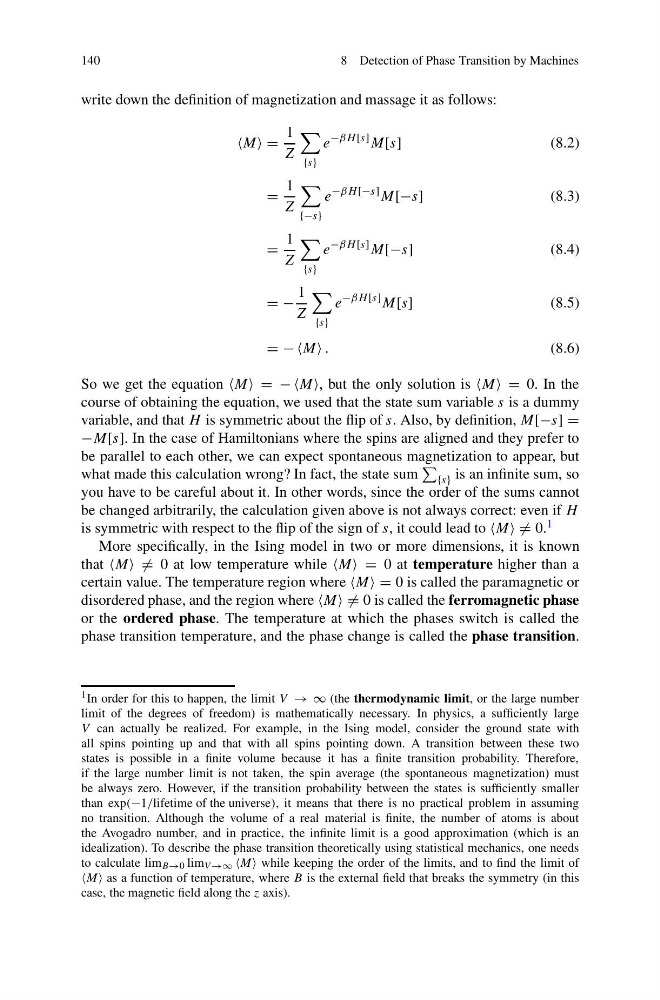
write down the definition of magnetization and massage it as follows:
M =
1
Z
{s}
e
−βH [s] M[s]
(8.2)
=
1
Z
{−s}
e
−βH [−s] M[−s]
(8.3)
=
1
Z
{s}
e
−βH [s] M[−s]
(8.4)
= −
1
Z
{s}
e
−βH [s] M[s]
(8.5)
= − M .
(8.6)
So we get the equation M = − M, but the only solution is M = 0. In the
course of obtaining the equation, we used that the state sum variable s is a dummy
variable, and that H is symmetric about the flip of s. Also, by definition, M[−s] =
−M[s]. In the case of Hamiltonians where the spins are aligned and they prefer to
be parallel to each other, we can expect spontaneous magnetization to appear, but
what made this calculation wrong? In fact, the state sum
{s} is an infinite sum, so
you have to be careful about it. In other words, since the order of the sums cannot
be changed arbitrarily, the calculation given above is not always correct: even if H
is symmetric with respect to the flip of the sign of s, it could lead to M = 0. 1
More specifically, in the Ising model in two or more dimensions, it is known
that M = 0 at low temperature while M = 0 at temperature higher than a
certain value. The temperature region where M = 0 is called the paramagnetic or
disordered phase, and the region where M = 0 is called the ferromagnetic phase
or the ordered phase. The temperature at which the phases switch is called the
phase transition temperature, and the phase change is called the phase transition.
1 In order for this to happen, the limit V → ∞ (the thermodynamic limit, or the large number
limit of the degrees of freedom) is mathematically necessary. In physics, a sufficiently large
V can actually be realized. For example, in the Ising model, consider the ground state with
all spins pointing up and that with all spins pointing down. A transition between these two
states is possible in a finite volume because it has a finite transition probability. Therefore,
if the large number limit is not taken, the spin average (the spontaneous magnetization) must
be always zero. However, if the transition probability between the states is sufficiently smaller
than exp(−1/lifetime of the universe), it means that there is no practical problem in assuming
no transition. Although the volume of a real material is finite, the number of atoms is about
the Avogadro number, and in practice, the infinite limit is a good approximation (which is an
idealization). To describe the phase transition theoretically using statistical mechanics, one needs
to calculate lim B→0 lim V →∞ M while keeping the order of the limits, and to find the limit of
M as a function of temperature, where B is the external field that breaks the symmetry (in this
case, the magnetic field along the z axis).
8 Detection of Phase Transition by Machines
write down the definition of magnetization and massage it as follows:
M =
1
Z
{s}
e
−βH [s] M[s]
(8.2)
=
1
Z
{−s}
e
−βH [−s] M[−s]
(8.3)
=
1
Z
{s}
e
−βH [s] M[−s]
(8.4)
= −
1
Z
{s}
e
−βH [s] M[s]
(8.5)
= − M .
(8.6)
So we get the equation M = − M, but the only solution is M = 0. In the
course of obtaining the equation, we used that the state sum variable s is a dummy
variable, and that H is symmetric about the flip of s. Also, by definition, M[−s] =
−M[s]. In the case of Hamiltonians where the spins are aligned and they prefer to
be parallel to each other, we can expect spontaneous magnetization to appear, but
what made this calculation wrong? In fact, the state sum
{s} is an infinite sum, so
you have to be careful about it. In other words, since the order of the sums cannot
be changed arbitrarily, the calculation given above is not always correct: even if H
is symmetric with respect to the flip of the sign of s, it could lead to M = 0. 1
More specifically, in the Ising model in two or more dimensions, it is known
that M = 0 at low temperature while M = 0 at temperature higher than a
certain value. The temperature region where M = 0 is called the paramagnetic or
disordered phase, and the region where M = 0 is called the ferromagnetic phase
or the ordered phase. The temperature at which the phases switch is called the
phase transition temperature, and the phase change is called the phase transition.
1 In order for this to happen, the limit V → ∞ (the thermodynamic limit, or the large number
limit of the degrees of freedom) is mathematically necessary. In physics, a sufficiently large
V can actually be realized. For example, in the Ising model, consider the ground state with
all spins pointing up and that with all spins pointing down. A transition between these two
states is possible in a finite volume because it has a finite transition probability. Therefore,
if the large number limit is not taken, the spin average (the spontaneous magnetization) must
be always zero. However, if the transition probability between the states is sufficiently smaller
than exp(−1/lifetime of the universe), it means that there is no practical problem in assuming
no transition. Although the volume of a real material is finite, the number of atoms is about
the Avogadro number, and in practice, the infinite limit is a good approximation (which is an
idealization). To describe the phase transition theoretically using statistical mechanics, one needs
to calculate lim B→0 lim V →∞ M while keeping the order of the limits, and to find the limit of
M as a function of temperature, where B is the external field that breaks the symmetry (in this
case, the magnetic field along the z axis).