

6.3 Generative Adversarial Network
115
So we find
V D (G
∗ , D
∗ ) ≥
dx Q G ∗ (x)
D
∗ (x) + max(0, m − D
∗ (x))
=m−D ∗ (x)
= m.
(6.67)
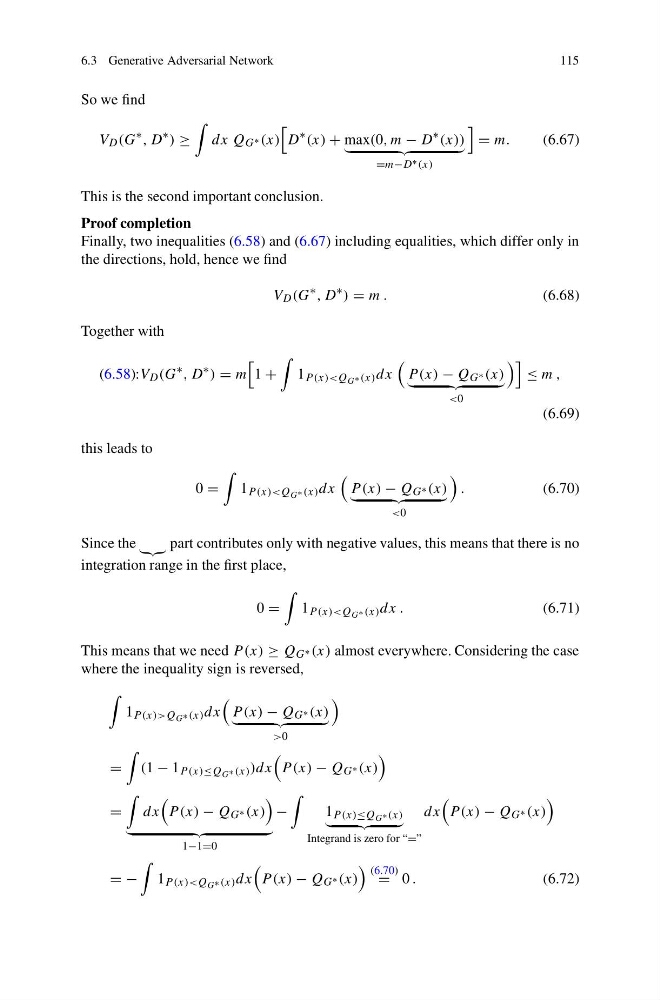
This is the second important conclusion.
Proof completion
Finally, two inequalities (6.58) and (6.67) including equalities, which differ only in
the directions, hold, hence we find
V D (G
∗ , D
∗ ) = m .
(6.68)
Together with
(6.58):V D (G
∗ , D
∗ ) = m
1 +
1 P (x) P (x) − Q G ∗ (x)
<0
≤ m ,
(6.69)
this leads to
0 =
1 P (x) P (x) − Q G ∗ (x)
<0
.
(6.70)
Since the part contributes only with negative values, this means that there is no
integration range in the first place,
0 =
1 P (x) (6.71)
This means that we need P (x) ≥ Q G ∗ (x) almost everywhere. Considering the case
where the inequality sign is reversed,
1 P (x)>Q G ∗ (x) dx
P (x) − Q G ∗ (x)
>0
=
(1 − 1 P (x)≤Q G ∗ (x) )dx
P (x) − Q G ∗ (x)
=
dx
P (x) − Q G ∗ (x)
1−1=0
−
1 P (x)≤Q G ∗ (x)
Integrand is zero for “=”
dx
P (x) − Q G ∗ (x)
= −
1 P (x) P (x) − Q G ∗ (x)
(6.70)
= 0 .
(6.72)
115
So we find
V D (G
∗ , D
∗ ) ≥
dx Q G ∗ (x)
D
∗ (x) + max(0, m − D
∗ (x))
=m−D ∗ (x)
= m.
(6.67)
This is the second important conclusion.
Proof completion
Finally, two inequalities (6.58) and (6.67) including equalities, which differ only in
the directions, hold, hence we find
V D (G
∗ , D
∗ ) = m .
(6.68)
Together with
(6.58):V D (G
∗ , D
∗ ) = m
1 +
1 P (x) P (x) − Q G ∗ (x)
<0
≤ m ,
(6.69)
this leads to
0 =
1 P (x) P (x) − Q G ∗ (x)
<0
.
(6.70)
Since the part contributes only with negative values, this means that there is no
integration range in the first place,
0 =
1 P (x) (6.71)
This means that we need P (x) ≥ Q G ∗ (x) almost everywhere. Considering the case
where the inequality sign is reversed,
1 P (x)>Q G ∗ (x) dx
P (x) − Q G ∗ (x)
>0
=
(1 − 1 P (x)≤Q G ∗ (x) )dx
P (x) − Q G ∗ (x)
=
dx
P (x) − Q G ∗ (x)
1−1=0
−
1 P (x)≤Q G ∗ (x)
Integrand is zero for “=”
dx
P (x) − Q G ∗ (x)
= −
1 P (x) P (x) − Q G ∗ (x)
(6.70)
= 0 .
(6.72)