

61
data inventory was available), as well as on the forecast of potential technological
and efficiency improvements up to a 2030 horizon. Results are presented through
different angles, in terms of function unit selection and allocation procedures, in
order to understand how background assumptions and methodological choices constrain the overall LCA results.
6.3.1 Description of the Case Study and its Scenarios
Brazil is an important World player in the ethanol market, being the second largest
producer after the USA. Nearly 9.67 million hectares were dedicated to sugarcane
farming, producing around 25.7 million m
3
of ethanol (MAPA 2011a). While the
production of sugarcane ethanol is a well-known and optimized process, significant
gains can be achieved by enhancing the efficiency recovery of its byproducts,
bagasse, and straw. In this view, a baseline scenario and two alternative scenario
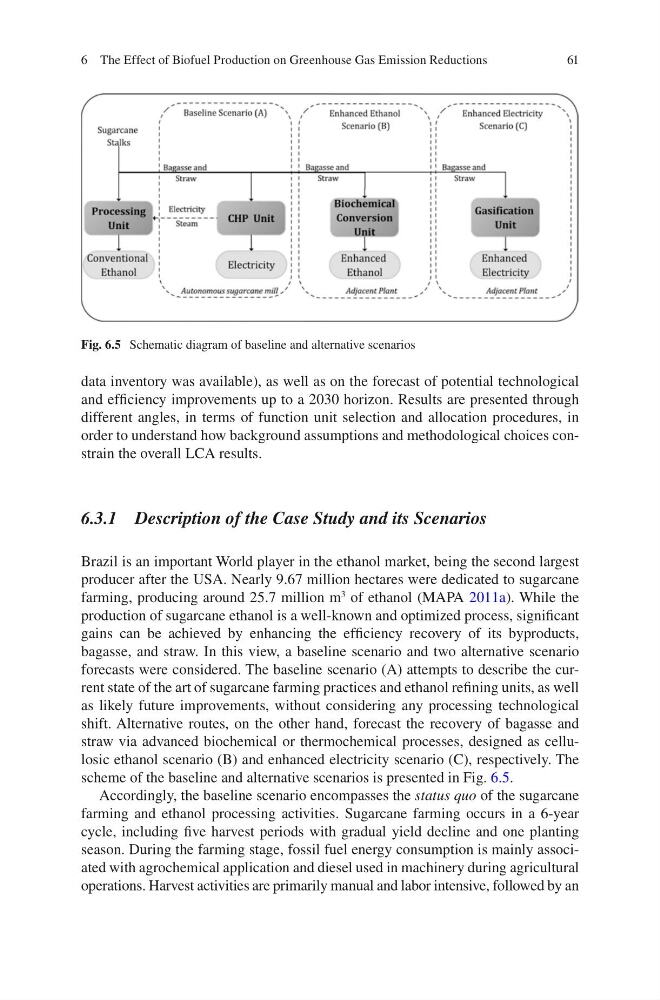
forecasts were considered. The baseline scenario (A) attempts to describe the current state of the art of sugarcane farming practices and ethanol refining units, as well
as likely future improvements, without considering any processing technological
shift. Alternative routes, on the other hand, forecast the recovery of bagasse and
straw via advanced biochemical or thermochemical processes, designed as cellulosic ethanol scenario (B) and enhanced electricity scenario (C), respectively. The
scheme of the baseline and alternative scenarios is presented in Fig. 6.5.
Accordingly, the baseline scenario encompasses the status quo of the sugarcane
farming and ethanol processing activities. Sugarcane farming occurs in a 6-year
cycle, including five harvest periods with gradual yield decline and one planting
season. During the farming stage, fossil fuel energy consumption is mainly associated with agrochemical application and diesel used in machinery during agricultural
operations. Harvest activities are primarily manual and labor intensive, followed by an
Fig. 6.5 Schematic diagram of baseline and alternative scenarios
6 The Effect of Biofuel Production on Greenhouse Gas Emission Reductions
data inventory was available), as well as on the forecast of potential technological
and efficiency improvements up to a 2030 horizon. Results are presented through
different angles, in terms of function unit selection and allocation procedures, in
order to understand how background assumptions and methodological choices constrain the overall LCA results.
6.3.1 Description of the Case Study and its Scenarios
Brazil is an important World player in the ethanol market, being the second largest
producer after the USA. Nearly 9.67 million hectares were dedicated to sugarcane
farming, producing around 25.7 million m
3
of ethanol (MAPA 2011a). While the
production of sugarcane ethanol is a well-known and optimized process, significant
gains can be achieved by enhancing the efficiency recovery of its byproducts,
bagasse, and straw. In this view, a baseline scenario and two alternative scenario
forecasts were considered. The baseline scenario (A) attempts to describe the current state of the art of sugarcane farming practices and ethanol refining units, as well
as likely future improvements, without considering any processing technological
shift. Alternative routes, on the other hand, forecast the recovery of bagasse and
straw via advanced biochemical or thermochemical processes, designed as cellulosic ethanol scenario (B) and enhanced electricity scenario (C), respectively. The
scheme of the baseline and alternative scenarios is presented in Fig. 6.5.
Accordingly, the baseline scenario encompasses the status quo of the sugarcane
farming and ethanol processing activities. Sugarcane farming occurs in a 6-year
cycle, including five harvest periods with gradual yield decline and one planting
season. During the farming stage, fossil fuel energy consumption is mainly associated with agrochemical application and diesel used in machinery during agricultural
operations. Harvest activities are primarily manual and labor intensive, followed by an
Fig. 6.5 Schematic diagram of baseline and alternative scenarios
6 The Effect of Biofuel Production on Greenhouse Gas Emission Reductions