

59
fuel. As a result, the environmental loading per unit of energy for the biofuel produced may be smaller in the conventional process than in the innovative process. In
other words, the innovative process can produce more biofuel, but environmental
load per unit fuel increases.
Not readily biodegradable materials such as wooden stems are decomposed by
pretreatment and then converted in the so-called second-generation biofuel production. As a result, residues used for process energy in the first-generation biofuel
process are reduced in the second-generation process. Apparently environmental
loading per amount of biofuels is larger, though yield of biofuels from the energy
crop is high in the second-generation process. This is the controversial issue of the
functional unit.
6.2.3 The Necessity of Localized LCA
Discussions of how local characteristics are included in LCAs and whether they
should be included involve profound questions. Universal evaluations irrespective
of location are often pursued in manufacturing LCA. Moreover, because the components and materials used in ordinary industrial processes are distributed all over the
world, it is not practical to identify the production locations and include local characteristics of the production locations in LCAs. Therefore, it is appropriate to use
global average values.
With biofuels, however, long-distance transportation of energy crops is not practical, and all stages up to production are carried out in the region of cultivation.
Therefore, the environmental loading associated with biofuel production is affected
by the characteristics of each region. First of all, the selection and growth yield
of an energy crop greatly depends on the climate of a region. Sugarcane, cassava,
oil palm, and similar crops grow in tropical regions, while other energy crops are
A
B
A
Q
P
Equal
Function
Solid waste
disposal
No recycle
With recycle
Virgin
resources
Compost
Chemical
fertilizer
Landfill
Waste
Waste
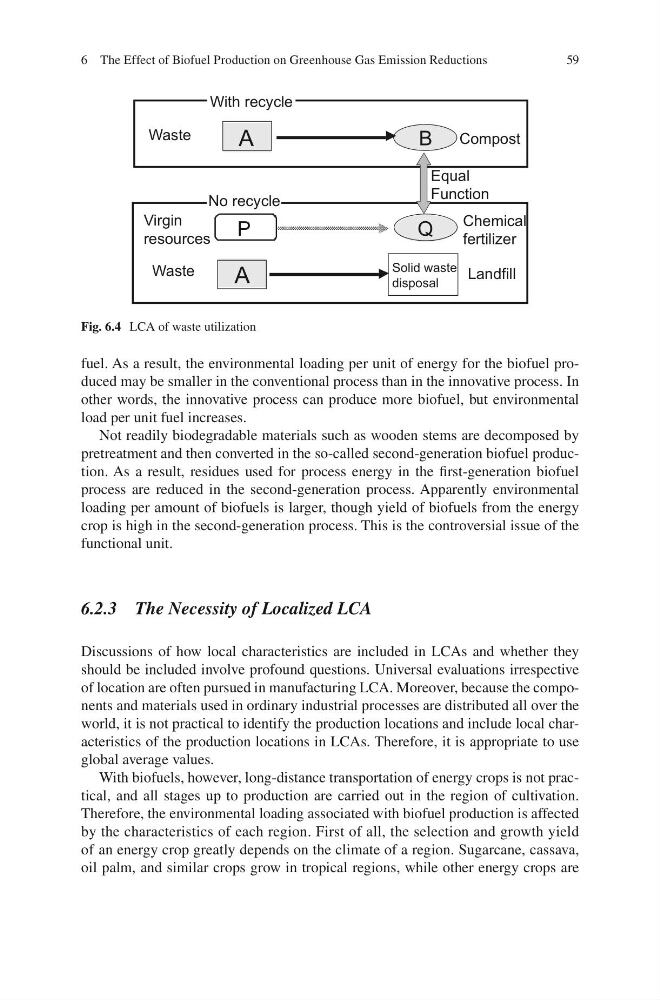
Fig. 6.4 LCA of waste utilization
6 The Effect of Biofuel Production on Greenhouse Gas Emission Reductions
fuel. As a result, the environmental loading per unit of energy for the biofuel produced may be smaller in the conventional process than in the innovative process. In
other words, the innovative process can produce more biofuel, but environmental
load per unit fuel increases.
Not readily biodegradable materials such as wooden stems are decomposed by
pretreatment and then converted in the so-called second-generation biofuel production. As a result, residues used for process energy in the first-generation biofuel
process are reduced in the second-generation process. Apparently environmental
loading per amount of biofuels is larger, though yield of biofuels from the energy
crop is high in the second-generation process. This is the controversial issue of the
functional unit.
6.2.3 The Necessity of Localized LCA
Discussions of how local characteristics are included in LCAs and whether they
should be included involve profound questions. Universal evaluations irrespective
of location are often pursued in manufacturing LCA. Moreover, because the components and materials used in ordinary industrial processes are distributed all over the
world, it is not practical to identify the production locations and include local characteristics of the production locations in LCAs. Therefore, it is appropriate to use
global average values.
With biofuels, however, long-distance transportation of energy crops is not practical, and all stages up to production are carried out in the region of cultivation.
Therefore, the environmental loading associated with biofuel production is affected
by the characteristics of each region. First of all, the selection and growth yield
of an energy crop greatly depends on the climate of a region. Sugarcane, cassava,
oil palm, and similar crops grow in tropical regions, while other energy crops are
A
B
A
Q
P
Equal
Function
Solid waste
disposal
No recycle
With recycle
Virgin
resources
Compost
Chemical
fertilizer
Landfill
Waste
Waste
Fig. 6.4 LCA of waste utilization
6 The Effect of Biofuel Production on Greenhouse Gas Emission Reductions