

263
(Fig. 15.10b). In general, a dependency on the imported biofuel or a self-sufficiency
in biofuel production has an influence on the level of EF total .
This assessment model can provide not only the overall ecological footprint for
each case but also a detailed breakdown of EF cf , EF harvest , and EF water . This allows us
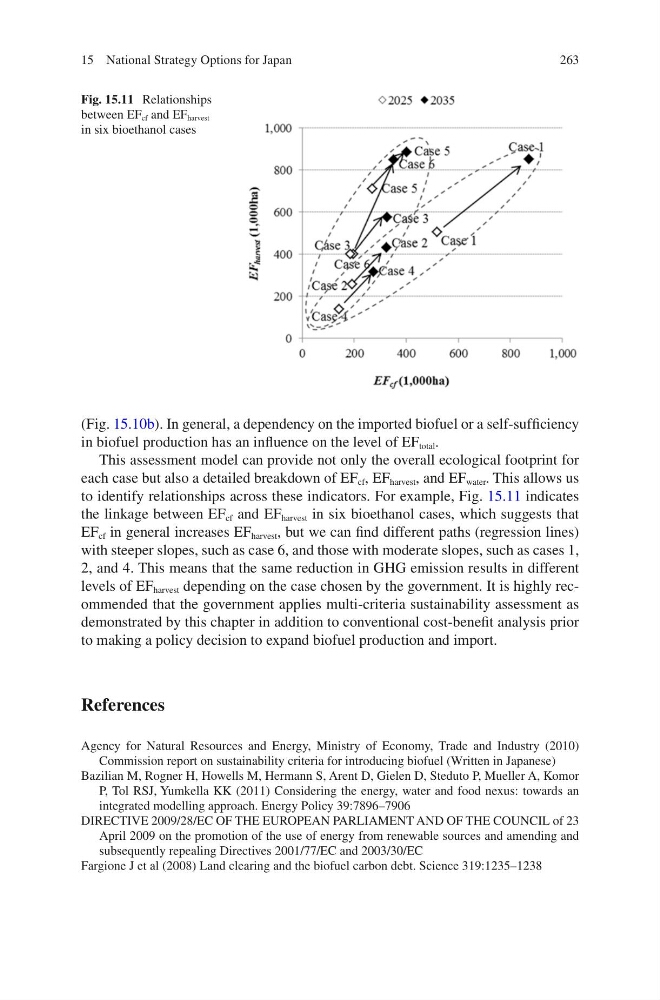
to identify relationships across these indicators. For example, Fig. 15.11 indicates
the linkage between EF cf and EF harvest in six bioethanol cases, which suggests that
EF cf in general increases EF harvest , but we can find different paths (regression lines)
with steeper slopes, such as case 6, and those with moderate slopes, such as cases 1,
2, and 4. This means that the same reduction in GHG emission results in different
levels of EF harvest depending on the case chosen by the government. It is highly recommended that the government applies multi-criteria sustainability assessment as
demonstrated by this chapter in addition to conventional cost-benefit analysis prior
to making a policy decision to expand biofuel production and import.
References
Agency for Natural Resources and Energy, Ministry of Economy, Trade and Industry (2010)
Commission report on sustainability criteria for introducing biofuel (Written in Japanese)
Bazilian M, Rogner H, Howells M, Hermann S, Arent D, Gielen D, Steduto P, Mueller A, Komor
P, Tol RSJ, Yumkella KK (2011) Considering the energy, water and food nexus: towards an
integrated modelling approach. Energy Policy 39:7896–7906
DIRECTIVE 2009/28/EC OF THE EUROPEAN PARLIAMENT AND OF THE COUNCIL of 23
April 2009 on the promotion of the use of energy from renewable sources and amending and
subsequently repealing Directives 2001/77/EC and 2003/30/EC
Fargione J et al (2008) Land clearing and the biofuel carbon debt. Science 319:1235–1238
Fig. 15.11 Relationships
between EF cf and EF harvest
in six bioethanol cases
15 National Strategy Options for Japan
(Fig. 15.10b). In general, a dependency on the imported biofuel or a self-sufficiency
in biofuel production has an influence on the level of EF total .
This assessment model can provide not only the overall ecological footprint for
each case but also a detailed breakdown of EF cf , EF harvest , and EF water . This allows us
to identify relationships across these indicators. For example, Fig. 15.11 indicates
the linkage between EF cf and EF harvest in six bioethanol cases, which suggests that
EF cf in general increases EF harvest , but we can find different paths (regression lines)
with steeper slopes, such as case 6, and those with moderate slopes, such as cases 1,
2, and 4. This means that the same reduction in GHG emission results in different
levels of EF harvest depending on the case chosen by the government. It is highly recommended that the government applies multi-criteria sustainability assessment as
demonstrated by this chapter in addition to conventional cost-benefit analysis prior
to making a policy decision to expand biofuel production and import.
References
Agency for Natural Resources and Energy, Ministry of Economy, Trade and Industry (2010)
Commission report on sustainability criteria for introducing biofuel (Written in Japanese)
Bazilian M, Rogner H, Howells M, Hermann S, Arent D, Gielen D, Steduto P, Mueller A, Komor
P, Tol RSJ, Yumkella KK (2011) Considering the energy, water and food nexus: towards an
integrated modelling approach. Energy Policy 39:7896–7906
DIRECTIVE 2009/28/EC OF THE EUROPEAN PARLIAMENT AND OF THE COUNCIL of 23
April 2009 on the promotion of the use of energy from renewable sources and amending and
subsequently repealing Directives 2001/77/EC and 2003/30/EC
Fargione J et al (2008) Land clearing and the biofuel carbon debt. Science 319:1235–1238
Fig. 15.11 Relationships
between EF cf and EF harvest
in six bioethanol cases
15 National Strategy Options for Japan