

235
with strong biofuel mandates but inadequate domestic production are likely to
attract imports unless domestic producers are granted trade protection. Conversely,
in this situation, if trade protection for domestic producers is strong enough, then
the biofuel mandate would remain unmet if the domestic producers can or will not
increase production.
Some countries, such as the USA or Brazil, may at times export some biofuels
which cannot be absorbed into their domestic markets, but the available quantities
are not likely to be enough to enable major increases in biofuel utilization mandates
in many countries simultaneously. Moreover, the US could alternate from being a
net exporter to a net importer, so export volumes could be unstable. The EU and
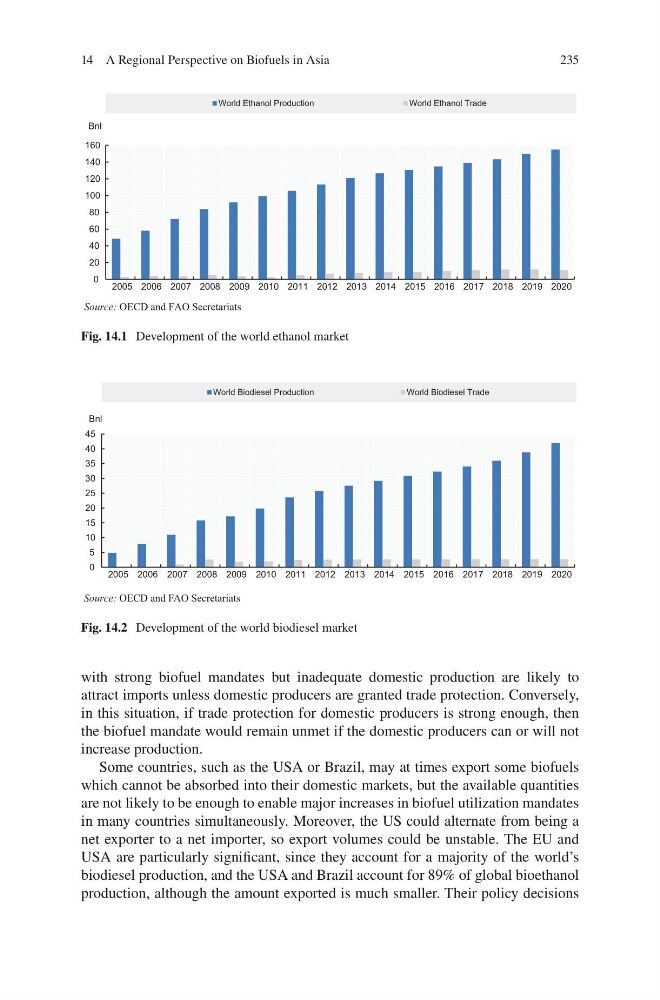
USA are particularly significant, since they account for a majority of the world’s
biodiesel production, and the USA and Brazil account for 89% of global bioethanol
production, although the amount exported is much smaller. Their policy decisions
Source: OECD and FAO Secretariats
0
20
40
60
80
100
120
140
160
2005 2006 2007 2008 2009 2010 2011 2012 2013 2014 2015 2016 2017 2018 2019 2020
World Ethanol Production
World Ethanol Trade
Bnl
Fig. 14.1 Development of the world ethanol market
Source: OECD and FAO Secretariats
0
5
10
15
20
25
30
35
40
45
2005 2006 2007 2008 2009 2010 2011 2012 2013 2014 2015 2016 2017 2018 2019 2020
World Biodiesel Production
World Biodiesel Trade
Bnl
Fig. 14.2 Development of the world biodiesel market
14 A Regional Perspective on Biofuels in Asia
with strong biofuel mandates but inadequate domestic production are likely to
attract imports unless domestic producers are granted trade protection. Conversely,
in this situation, if trade protection for domestic producers is strong enough, then
the biofuel mandate would remain unmet if the domestic producers can or will not
increase production.
Some countries, such as the USA or Brazil, may at times export some biofuels
which cannot be absorbed into their domestic markets, but the available quantities
are not likely to be enough to enable major increases in biofuel utilization mandates
in many countries simultaneously. Moreover, the US could alternate from being a
net exporter to a net importer, so export volumes could be unstable. The EU and
USA are particularly significant, since they account for a majority of the world’s
biodiesel production, and the USA and Brazil account for 89% of global bioethanol
production, although the amount exported is much smaller. Their policy decisions
Source: OECD and FAO Secretariats
0
20
40
60
80
100
120
140
160
2005 2006 2007 2008 2009 2010 2011 2012 2013 2014 2015 2016 2017 2018 2019 2020
World Ethanol Production
World Ethanol Trade
Bnl
Fig. 14.1 Development of the world ethanol market
Source: OECD and FAO Secretariats
0
5
10
15
20
25
30
35
40
45
2005 2006 2007 2008 2009 2010 2011 2012 2013 2014 2015 2016 2017 2018 2019 2020
World Biodiesel Production
World Biodiesel Trade
Bnl
Fig. 14.2 Development of the world biodiesel market
14 A Regional Perspective on Biofuels in Asia