

159
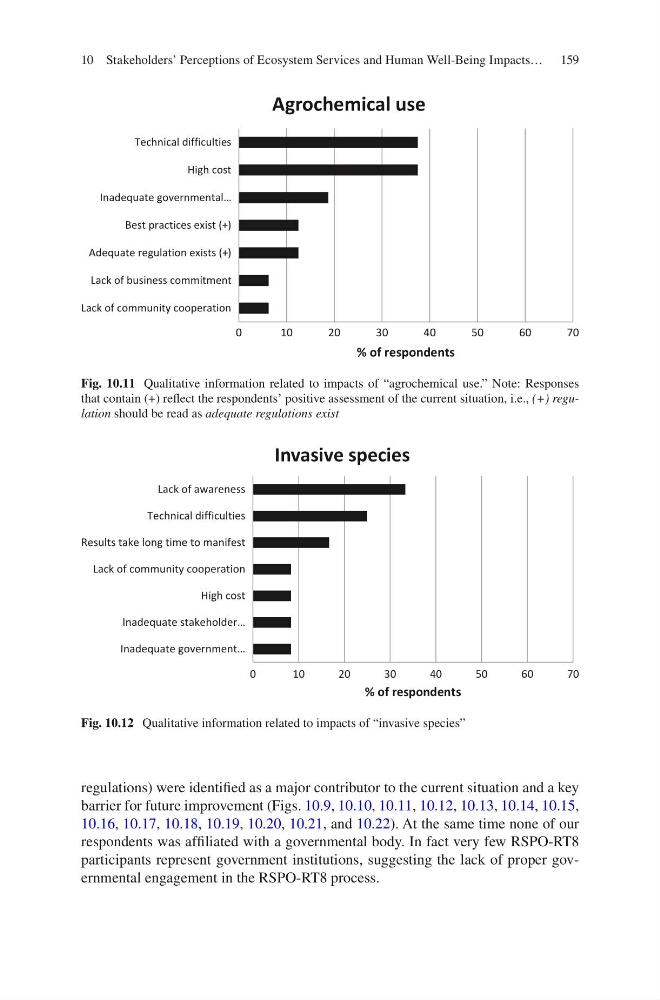
regulations) were identified as a major contributor to the current situation and a key
barrier for future improvement (Figs. 10.9, 10.10, 10.11, 10.12, 10.13, 10.14, 10.15,
10.16, 10.17, 10.18, 10.19, 10.20, 10.21, and 10.22). At the same time none of our
respondents was affiliated with a governmental body. In fact very few RSPO-RT8
participants represent government institutions, suggesting the lack of proper governmental engagement in the RSPO-RT8 process.
0
1 0
2 0
3 0
4 0
5 0
6 0
7 0
Lack of community cooperation
Lack of business commitment
Adequate regulation exists (+)
Best practices exist (+)
Inadequate governmental…
High cost
Technical difficulties
% of respondents
Agrochemical use
Fig. 10.11 Qualitative information related to impacts of “agrochemical use.” Note: Responses
that contain (+) reflect the respondents’ positive assessment of the current situation, i.e., (+) regulation should be read as adequate regulations exist
0
1 0
2 0
3 0
4 0
5 0
6 0
7 0
Inadequate government…
Inadequate stakeholder…
High cost
Lack of community cooperation
Results take long time to manifest
Technical difficulties
Lack of awareness
% of respondents
Invasive species
Fig. 10.12 Qualitative information related to impacts of “invasive species”
10 Stakeholders’ Perceptions of Ecosystem Services and Human Well-Being Impacts…
regulations) were identified as a major contributor to the current situation and a key
barrier for future improvement (Figs. 10.9, 10.10, 10.11, 10.12, 10.13, 10.14, 10.15,
10.16, 10.17, 10.18, 10.19, 10.20, 10.21, and 10.22). At the same time none of our
respondents was affiliated with a governmental body. In fact very few RSPO-RT8
participants represent government institutions, suggesting the lack of proper governmental engagement in the RSPO-RT8 process.
0
1 0
2 0
3 0
4 0
5 0
6 0
7 0
Lack of community cooperation
Lack of business commitment
Adequate regulation exists (+)
Best practices exist (+)
Inadequate governmental…
High cost
Technical difficulties
% of respondents
Agrochemical use
Fig. 10.11 Qualitative information related to impacts of “agrochemical use.” Note: Responses
that contain (+) reflect the respondents’ positive assessment of the current situation, i.e., (+) regulation should be read as adequate regulations exist
0
1 0
2 0
3 0
4 0
5 0
6 0
7 0
Inadequate government…
Inadequate stakeholder…
High cost
Lack of community cooperation
Results take long time to manifest
Technical difficulties
Lack of awareness
% of respondents
Invasive species
Fig. 10.12 Qualitative information related to impacts of “invasive species”
10 Stakeholders’ Perceptions of Ecosystem Services and Human Well-Being Impacts…