

135
and local communities (plasma schemes).
2
There have been two main types of
plasma schemes, the PIR Trans schemes (nucleus-community plantation), which
target individual farmers, and the KKPA schemes, which target cooperative farmers.
Lately there have other types of land-leasing agreements such as the kemitraan
schemes and the plantation revitalization schemes (McCarthy et al. 2012a).
Despite some differences, these schemes stipulate that the palm fruit produced in
the land “leased” by local communities has to be sold to the private company with
which the local community has made the arrangement (McCarthy 2010; McCarthy
et al. 2012a). In return, the company provides all necessary inputs and knowledge
for oil palm cultivation. Such schemes determine to a large extent the productivity
targets, and as an extension the production practices employed (e.g., fertilizer use).
As a result these plasma agreements can be viewed as a major determinant of the
local environmental and socioeconomics impacts of oil palm in Indonesia.
Currently palm oil is mostly absorbed by the food industry, a trend that is likely
to continue in the short-to-medium term.
3
However in the late 2000s, palm oil was
considered as a particularly promising feedstock for biodiesel production within the
two countries and abroad. For different reasons, Malaysia and Indonesia took steps
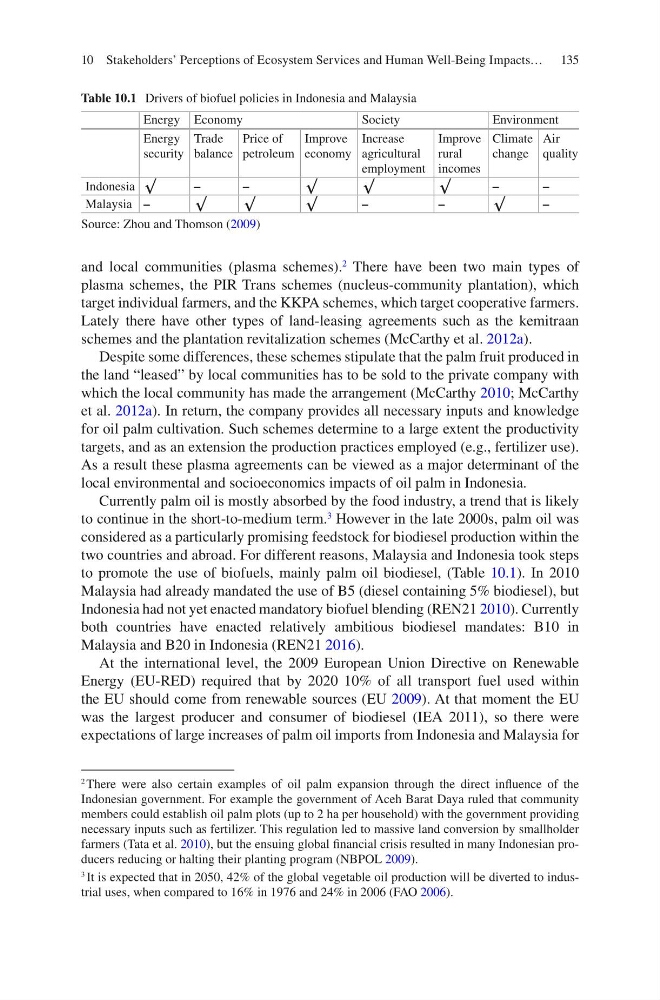
to promote the use of biofuels, mainly palm oil biodiesel, (Table 10.1). In 2010
Malaysia had already mandated the use of B5 (diesel containing 5% biodiesel), but
Indonesia had not yet enacted mandatory biofuel blending (REN21 2010). Currently
both countries have enacted relatively ambitious biodiesel mandates: B10 in
Malaysia and B20 in Indonesia (REN21 2016).
At the international level, the 2009 European Union Directive on Renewable
Energy (EU-RED) required that by 2020 10% of all transport fuel used within
the EU should come from renewable sources (EU 2009). At that moment the EU
was the largest producer and consumer of biodiesel (IEA 2011), so there were
expectations of large increases of palm oil imports from Indonesia and Malaysia for
2 There were also certain examples of oil palm expansion through the direct influence of the
Indonesian government. For example the government of Aceh Barat Daya ruled that community
members could establish oil palm plots (up to 2 ha per household) with the government providing
necessary inputs such as fertilizer. This regulation led to massive land conversion by smallholder
farmers (Tata et al. 2010), but the ensuing global financial crisis resulted in many Indonesian producers reducing or halting their planting program (NBPOL 2009).
3 It is expected that in 2050, 42% of the global vegetable oil production will be diverted to industrial uses, when compared to 16% in 1976 and 24% in 2006 (FAO 2006).
Table 10.1 Drivers of biofuel policies in Indonesia and Malaysia
Energy Economy
Society
Environment
Energy
security
Trade
balance
Price of
petroleum
Improve
economy
Increase
agricultural
employment
Improve
rural
incomes
Climate
change
Air
quality
Indonesia √
–
–
√
√
√
–
–
Malaysia –
√
√
√
–
–
√
–
Source: Zhou and Thomson (2009)
10 Stakeholders’ Perceptions of Ecosystem Services and Human Well-Being Impacts…
and local communities (plasma schemes).
2
There have been two main types of
plasma schemes, the PIR Trans schemes (nucleus-community plantation), which
target individual farmers, and the KKPA schemes, which target cooperative farmers.
Lately there have other types of land-leasing agreements such as the kemitraan
schemes and the plantation revitalization schemes (McCarthy et al. 2012a).
Despite some differences, these schemes stipulate that the palm fruit produced in
the land “leased” by local communities has to be sold to the private company with
which the local community has made the arrangement (McCarthy 2010; McCarthy
et al. 2012a). In return, the company provides all necessary inputs and knowledge
for oil palm cultivation. Such schemes determine to a large extent the productivity
targets, and as an extension the production practices employed (e.g., fertilizer use).
As a result these plasma agreements can be viewed as a major determinant of the
local environmental and socioeconomics impacts of oil palm in Indonesia.
Currently palm oil is mostly absorbed by the food industry, a trend that is likely
to continue in the short-to-medium term.
3
However in the late 2000s, palm oil was
considered as a particularly promising feedstock for biodiesel production within the
two countries and abroad. For different reasons, Malaysia and Indonesia took steps
to promote the use of biofuels, mainly palm oil biodiesel, (Table 10.1). In 2010
Malaysia had already mandated the use of B5 (diesel containing 5% biodiesel), but
Indonesia had not yet enacted mandatory biofuel blending (REN21 2010). Currently
both countries have enacted relatively ambitious biodiesel mandates: B10 in
Malaysia and B20 in Indonesia (REN21 2016).
At the international level, the 2009 European Union Directive on Renewable
Energy (EU-RED) required that by 2020 10% of all transport fuel used within
the EU should come from renewable sources (EU 2009). At that moment the EU
was the largest producer and consumer of biodiesel (IEA 2011), so there were
expectations of large increases of palm oil imports from Indonesia and Malaysia for
2 There were also certain examples of oil palm expansion through the direct influence of the
Indonesian government. For example the government of Aceh Barat Daya ruled that community
members could establish oil palm plots (up to 2 ha per household) with the government providing
necessary inputs such as fertilizer. This regulation led to massive land conversion by smallholder
farmers (Tata et al. 2010), but the ensuing global financial crisis resulted in many Indonesian producers reducing or halting their planting program (NBPOL 2009).
3 It is expected that in 2050, 42% of the global vegetable oil production will be diverted to industrial uses, when compared to 16% in 1976 and 24% in 2006 (FAO 2006).
Table 10.1 Drivers of biofuel policies in Indonesia and Malaysia
Energy Economy
Society
Environment
Energy
security
Trade
balance
Price of
petroleum
Improve
economy
Increase
agricultural
employment
Improve
rural
incomes
Climate
change
Air
quality
Indonesia √
–
–
√
√
√
–
–
Malaysia –
√
√
√
–
–
√
–
Source: Zhou and Thomson (2009)
10 Stakeholders’ Perceptions of Ecosystem Services and Human Well-Being Impacts…