

129
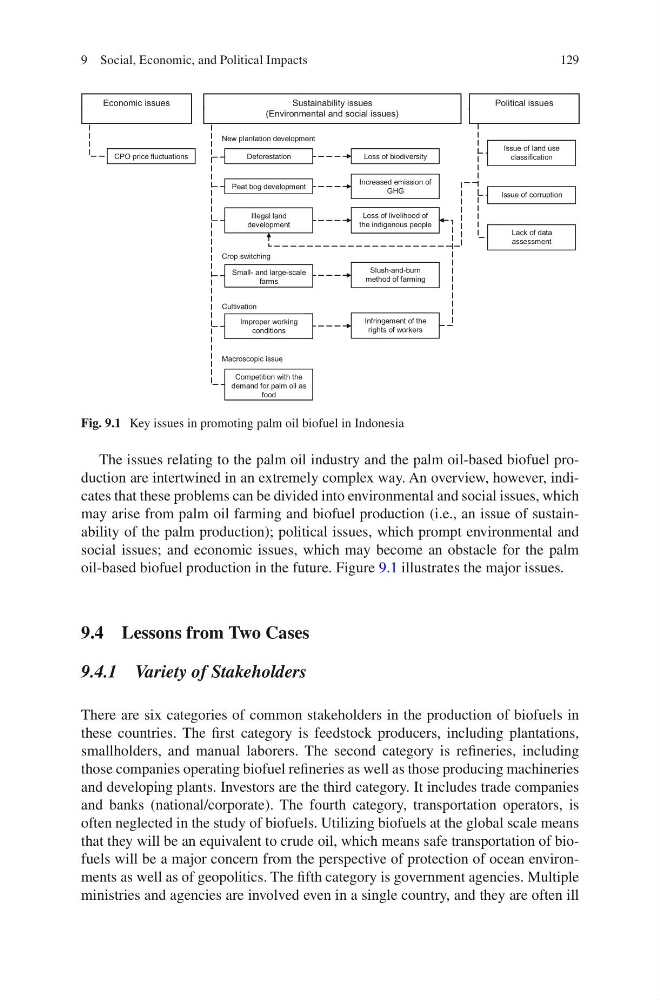
The issues relating to the palm oil industry and the palm oil-based biofuel production are intertwined in an extremely complex way. An overview, however, indicates that these problems can be divided into environmental and social issues, which
may arise from palm oil farming and biofuel production (i.e., an issue of sustainability of the palm production); political issues, which prompt environmental and
social issues; and economic issues, which may become an obstacle for the palm
oil-based biofuel production in the future. Figure 9.1 illustrates the major issues.
9.4 Lessons from Two Cases
9.4.1 Variety of Stakeholders
There are six categories of common stakeholders in the production of biofuels in
these countries. The first category is feedstock producers, including plantations,
smallholders, and manual laborers. The second category is refineries, including
those companies operating biofuel refineries as well as those producing machineries
and developing plants. Investors are the third category. It includes trade companies
and banks (national/corporate). The fourth category, transportation operators, is
often neglected in the study of biofuels. Utilizing biofuels at the global scale means
that they will be an equivalent to crude oil, which means safe transportation of biofuels will be a major concern from the perspective of protection of ocean environments as well as of geopolitics. The fifth category is government agencies. Multiple
ministries and agencies are involved even in a single country, and they are often ill
CPO price fluctuations
New plantation development
Crop switching
Cultivation
Macroscopic issue
Competition with the
demand for palm oil as
food
Loss of biodiversity
Increased emission of
GHG
Loss of livelihood of
the indigenous people
Slush-and-burn
method of farming
Infringement of the
rights of workers
Lack of data
assessment
Economic issues
Sustainability issues
(Environmental and social issues)
Deforestation
Peat bog development
Illegal land
development
Small- and large-scale
farms
Improper working
conditions
Political issues
Issue of land use
classification
Issue of corruption
CPO price fluctuations
New plantation development
Crop switching
Cultivation
Macroscopic issue
Competition with the
demand for palm oil as
food
Loss of biodiversity
Increased emission of
GHG
Loss of livelihood of
the indigenous people
Slush-and-burn
method of farming
Infringement of the
rights of workers
Lack of data
assessment
Economic issues
Sustainability issues
(Environmental and social issues)
Deforestation
Peat bog development
Illegal land
development
Small- and large-scale
farms
Improper working
conditions
Political issues
Issue of land use
classification
Issue of corruption
Fig. 9.1 Key issues in promoting palm oil biofuel in Indonesia
9 Social, Economic, and Political Impacts
The issues relating to the palm oil industry and the palm oil-based biofuel production are intertwined in an extremely complex way. An overview, however, indicates that these problems can be divided into environmental and social issues, which
may arise from palm oil farming and biofuel production (i.e., an issue of sustainability of the palm production); political issues, which prompt environmental and
social issues; and economic issues, which may become an obstacle for the palm
oil-based biofuel production in the future. Figure 9.1 illustrates the major issues.
9.4 Lessons from Two Cases
9.4.1 Variety of Stakeholders
There are six categories of common stakeholders in the production of biofuels in
these countries. The first category is feedstock producers, including plantations,
smallholders, and manual laborers. The second category is refineries, including
those companies operating biofuel refineries as well as those producing machineries
and developing plants. Investors are the third category. It includes trade companies
and banks (national/corporate). The fourth category, transportation operators, is
often neglected in the study of biofuels. Utilizing biofuels at the global scale means
that they will be an equivalent to crude oil, which means safe transportation of biofuels will be a major concern from the perspective of protection of ocean environments as well as of geopolitics. The fifth category is government agencies. Multiple
ministries and agencies are involved even in a single country, and they are often ill
CPO price fluctuations
New plantation development
Crop switching
Cultivation
Macroscopic issue
Competition with the
demand for palm oil as
food
Loss of biodiversity
Increased emission of
GHG
Loss of livelihood of
the indigenous people
Slush-and-burn
method of farming
Infringement of the
rights of workers
Lack of data
assessment
Economic issues
Sustainability issues
(Environmental and social issues)
Deforestation
Peat bog development
Illegal land
development
Small- and large-scale
farms
Improper working
conditions
Political issues
Issue of land use
classification
Issue of corruption
CPO price fluctuations
New plantation development
Crop switching
Cultivation
Macroscopic issue
Competition with the
demand for palm oil as
food
Loss of biodiversity
Increased emission of
GHG
Loss of livelihood of
the indigenous people
Slush-and-burn
method of farming
Infringement of the
rights of workers
Lack of data
assessment
Economic issues
Sustainability issues
(Environmental and social issues)
Deforestation
Peat bog development
Illegal land
development
Small- and large-scale
farms
Improper working
conditions
Political issues
Issue of land use
classification
Issue of corruption
Fig. 9.1 Key issues in promoting palm oil biofuel in Indonesia
9 Social, Economic, and Political Impacts