

102
8.4.2 Overview of Main Biofuel Market Conditions in China
8.4.2.1 Bioethanol
China’s bioethanol production in 2007 was the third largest in the world at 1.33 million tons (Huang et al. 2008). Estimated 2008 production totaled 1.55 million tons,
of which 1.42 million tons of bioethanol were derived from corn and wheat produced at four designated plants operating at almost full capacity (84–100%) (USDA
2008). The remaining 130,000 tons of bioethanol came from cassava whose plant
operates at only 65% of its capacity (USDA 2008).
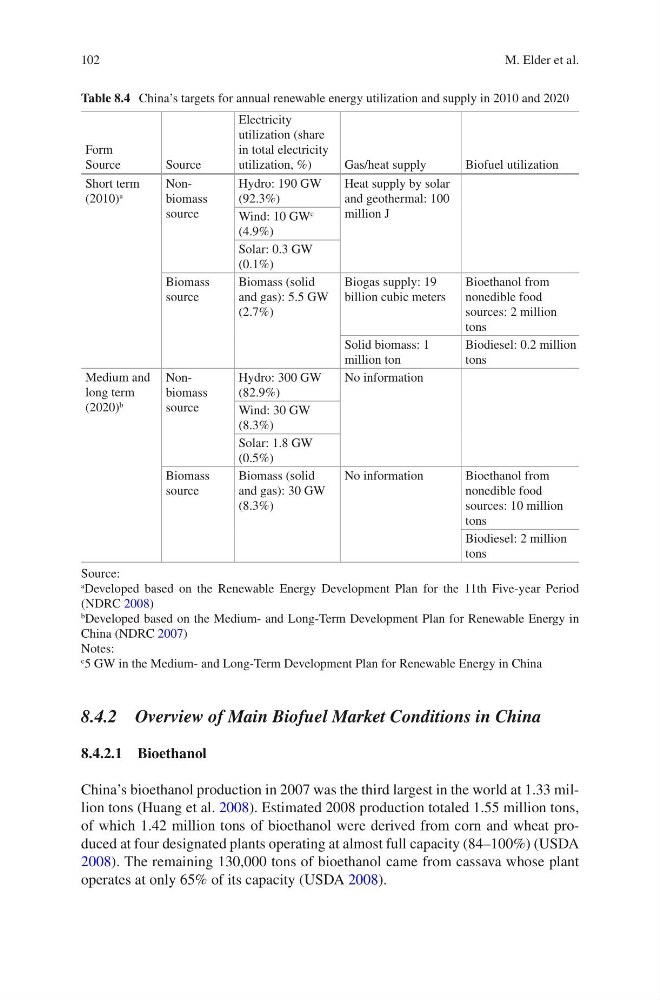
Table 8.4 China’s targets for annual renewable energy utilization and supply in 2010 and 2020
Form
Source
Source
Electricity
utilization (share
in total electricity
utilization, %)
Gas/heat supply
Biofuel utilization
Short term
(2010)
a
Nonbiomass
source
Hydro: 190 GW
(92.3%)
Heat supply by solar
and geothermal: 100
million J
Wind: 10 GW
c
(4.9%)
Solar: 0.3 GW
(0.1%)
Biomass
source
Biomass (solid
and gas): 5.5 GW
(2.7%)
Biogas supply: 19
billion cubic meters
Bioethanol from
nonedible food
sources: 2 million
tons
Solid biomass: 1
million ton
Biodiesel: 0.2 million
tons
Medium and
long term
(2020)
b
Nonbiomass
source
Hydro: 300 GW
(82.9%)
No information
Wind: 30 GW
(8.3%)
Solar: 1.8 GW
(0.5%)
Biomass
source
Biomass (solid
and gas): 30 GW
(8.3%)
No information
Bioethanol from
nonedible food
sources: 10 million
tons
Biodiesel: 2 million
tons
Source:
a
Developed based on the Renewable Energy Development Plan for the 11th Five-year Period
(NDRC 2008)
b
Developed based on the Medium- and Long-Term Development Plan for Renewable Energy in
China (NDRC 2007)
Notes:
c
5 GW in the Medium- and Long-Term Development Plan for Renewable Energy in China
M. Elder et al.
8.4.2 Overview of Main Biofuel Market Conditions in China
8.4.2.1 Bioethanol
China’s bioethanol production in 2007 was the third largest in the world at 1.33 million tons (Huang et al. 2008). Estimated 2008 production totaled 1.55 million tons,
of which 1.42 million tons of bioethanol were derived from corn and wheat produced at four designated plants operating at almost full capacity (84–100%) (USDA
2008). The remaining 130,000 tons of bioethanol came from cassava whose plant
operates at only 65% of its capacity (USDA 2008).
Table 8.4 China’s targets for annual renewable energy utilization and supply in 2010 and 2020
Form
Source
Source
Electricity
utilization (share
in total electricity
utilization, %)
Gas/heat supply
Biofuel utilization
Short term
(2010)
a
Nonbiomass
source
Hydro: 190 GW
(92.3%)
Heat supply by solar
and geothermal: 100
million J
Wind: 10 GW
c
(4.9%)
Solar: 0.3 GW
(0.1%)
Biomass
source
Biomass (solid
and gas): 5.5 GW
(2.7%)
Biogas supply: 19
billion cubic meters
Bioethanol from
nonedible food
sources: 2 million
tons
Solid biomass: 1
million ton
Biodiesel: 0.2 million
tons
Medium and
long term
(2020)
b
Nonbiomass
source
Hydro: 300 GW
(82.9%)
No information
Wind: 30 GW
(8.3%)
Solar: 1.8 GW
(0.5%)
Biomass
source
Biomass (solid
and gas): 30 GW
(8.3%)
No information
Bioethanol from
nonedible food
sources: 10 million
tons
Biodiesel: 2 million
tons
Source:
a
Developed based on the Renewable Energy Development Plan for the 11th Five-year Period
(NDRC 2008)
b
Developed based on the Medium- and Long-Term Development Plan for Renewable Energy in
China (NDRC 2007)
Notes:
c
5 GW in the Medium- and Long-Term Development Plan for Renewable Energy in China
M. Elder et al.