

44
mentation, installation, management, quality assurance (QA), and maintenance are
essential parts of any successful network of sensors.
Prior to the establishment of a new monitoring network in an urban environment,
the following logistical steps should be undertaken:
1. Collect information and consult with experts about the climate observations and
surveying or measuring activities in advance.
2. In the planning phase, write a detailed task list. Determine the aims and tasks of
the measurement program.
3. List the measurement climate elements (see the UHI Assessment Manual,
Chapter 6) and define the technical requirements of measurement as range,
reported resolution, required measurement uncertainty, sensor time constant,
output averaging time, and achievable measurement uncertainty (see the UHI
Assessment Manual, Chapter 7, for a detailed description).
4. Process orders to obtain the most appropriate equipment.
5. Choose the sites and install the equipment.
6. Prepare sensors and data logging and metadata files (see the UHI Assessment
Manual, Chapter 8, for a description of metadata).
7. Record the calibration and maintenance requirements of the climate network.
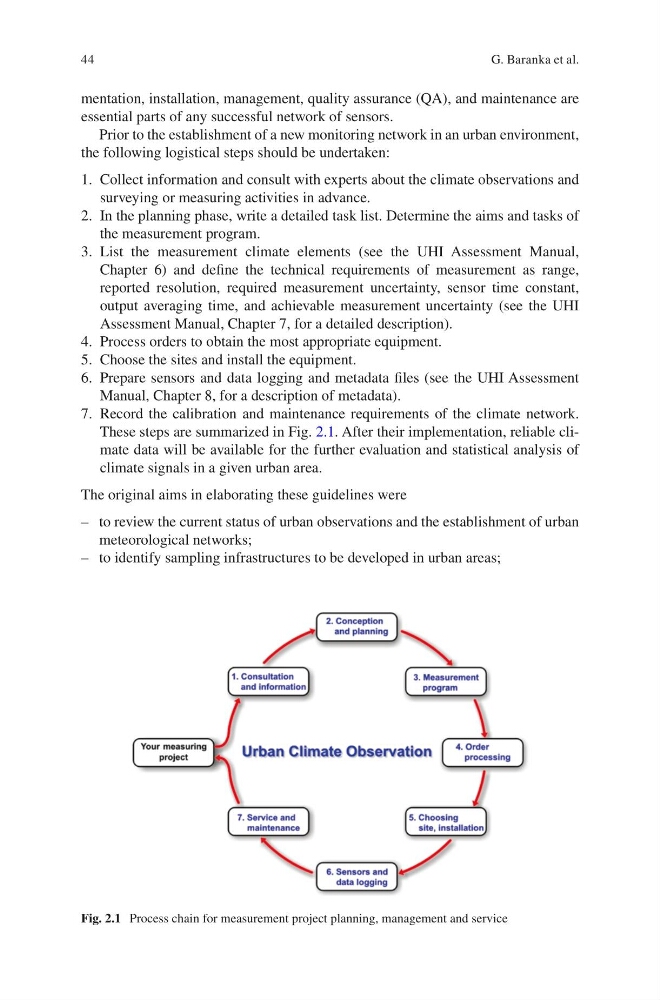
These steps are summarized in Fig. 2.1. After their implementation, reliable climate data will be available for the further evaluation and statistical analysis of
climate signals in a given urban area.
The original aims in elaborating these guidelines were
– to review the current status of urban observations and the establishment of urban
meteorological networks;
– to identify sampling infrastructures to be developed in urban areas;
Fig. 2.1 Process chain for measurement project planning, management and service
G. Baranka et al.
mentation, installation, management, quality assurance (QA), and maintenance are
essential parts of any successful network of sensors.
Prior to the establishment of a new monitoring network in an urban environment,
the following logistical steps should be undertaken:
1. Collect information and consult with experts about the climate observations and
surveying or measuring activities in advance.
2. In the planning phase, write a detailed task list. Determine the aims and tasks of
the measurement program.
3. List the measurement climate elements (see the UHI Assessment Manual,
Chapter 6) and define the technical requirements of measurement as range,
reported resolution, required measurement uncertainty, sensor time constant,
output averaging time, and achievable measurement uncertainty (see the UHI
Assessment Manual, Chapter 7, for a detailed description).
4. Process orders to obtain the most appropriate equipment.
5. Choose the sites and install the equipment.
6. Prepare sensors and data logging and metadata files (see the UHI Assessment
Manual, Chapter 8, for a description of metadata).
7. Record the calibration and maintenance requirements of the climate network.
These steps are summarized in Fig. 2.1. After their implementation, reliable climate data will be available for the further evaluation and statistical analysis of
climate signals in a given urban area.
The original aims in elaborating these guidelines were
– to review the current status of urban observations and the establishment of urban
meteorological networks;
– to identify sampling infrastructures to be developed in urban areas;
Fig. 2.1 Process chain for measurement project planning, management and service
G. Baranka et al.