

19
1.3.3.3.2 Szeged
The meteorological measurements in the inner site of Szeged have started in
May 1998, thus the validation was limited for 1999–2000. Figure 1.9 presents the
monthly average biases of ALADIN-Climate and SURFEX in the two reference
points in this period. The annual cycles of the biases are similar to the result for
Budapest. In general, SURFEX is giving more heat to the temperature fields of
ALADIN-Climate, and due to the representative locations of the reference points
(being in a flat area, and the outer point is situated in natural environment), the inner
site gains larger warming to the extent that the difference between the bias of the
two points almost diminishes. This implies that the monthly average UHI intensity
is positive in all months (Fig. 1.10) and the magnitudes are represented adequately,
as well.
The average annual and daily cycle of UHI simulated by SURFEX in 1991–2000
(Fig. 1.10) follows the theoretical pattern, namely the largest intensity occurs in the
nocturnal hours from May to September with a peak of 1.8–2.2 °C. In contrast, in
the late mornings of summer and autumn the outer point can be warmer than the
inner one, since they warm slowly due to the larger heat capacity of urban surfaces
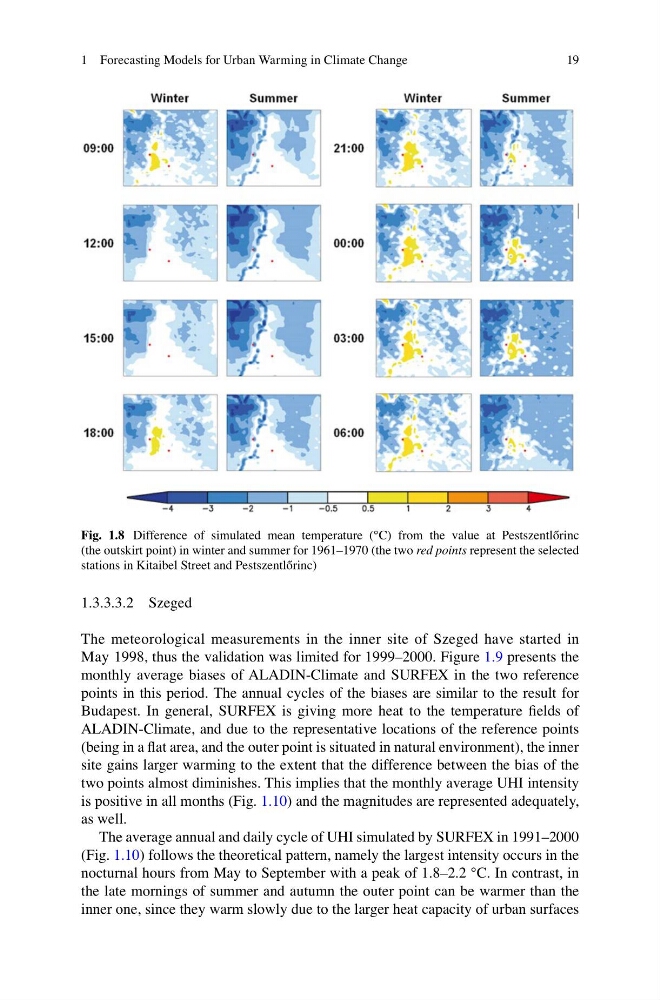
Fig. 1.8 Difference of simulated mean temperature (°C) from the value at Pestszentlőrinc
(the outskirt point) in winter and summer for 1961–1970 (the two red points represent the selected
stations in Kitaibel Street and Pestszentlőrinc)
1 Forecasting Models for Urban Warming in Climate Change
1.3.3.3.2 Szeged
The meteorological measurements in the inner site of Szeged have started in
May 1998, thus the validation was limited for 1999–2000. Figure 1.9 presents the
monthly average biases of ALADIN-Climate and SURFEX in the two reference
points in this period. The annual cycles of the biases are similar to the result for
Budapest. In general, SURFEX is giving more heat to the temperature fields of
ALADIN-Climate, and due to the representative locations of the reference points
(being in a flat area, and the outer point is situated in natural environment), the inner
site gains larger warming to the extent that the difference between the bias of the
two points almost diminishes. This implies that the monthly average UHI intensity
is positive in all months (Fig. 1.10) and the magnitudes are represented adequately,
as well.
The average annual and daily cycle of UHI simulated by SURFEX in 1991–2000
(Fig. 1.10) follows the theoretical pattern, namely the largest intensity occurs in the
nocturnal hours from May to September with a peak of 1.8–2.2 °C. In contrast, in
the late mornings of summer and autumn the outer point can be warmer than the
inner one, since they warm slowly due to the larger heat capacity of urban surfaces
Fig. 1.8 Difference of simulated mean temperature (°C) from the value at Pestszentlőrinc
(the outskirt point) in winter and summer for 1961–1970 (the two red points represent the selected
stations in Kitaibel Street and Pestszentlőrinc)
1 Forecasting Models for Urban Warming in Climate Change