

379
Despite the substantial reduction of the emissions from industrial sources in the past
years, air quality is still influenced by the emissions from automotive traffic, as a
main source of air pollution. In the suburban residential areas air quality is influenced by the emissions from local heating burning solid fuels.
In the agglomeration of Prague the limits for air quality are exceeded, especially
for particular matter PM10, NO2, O3 and benzo(a)pyren. The majority of exceedances is connected with the high traffic loads in Prague, but also with the domestic
heating in family houses in the residential areas in Prague.
The share of mobile sources on the total of PM emissions is more than 85 %, on
the total of NO x ca 75 %. The contribution of the household heating to PM emissions is almost of 16 %.
In the last years the ambient air quality has been improved. The annual limit
concentration NO 2 (40 μg.m
−3 ) has been exceeded only on two traffic monitoring
stations in Prague, however it can be supposed that the exceeding could occur in
other areas with a similar traffic volume.
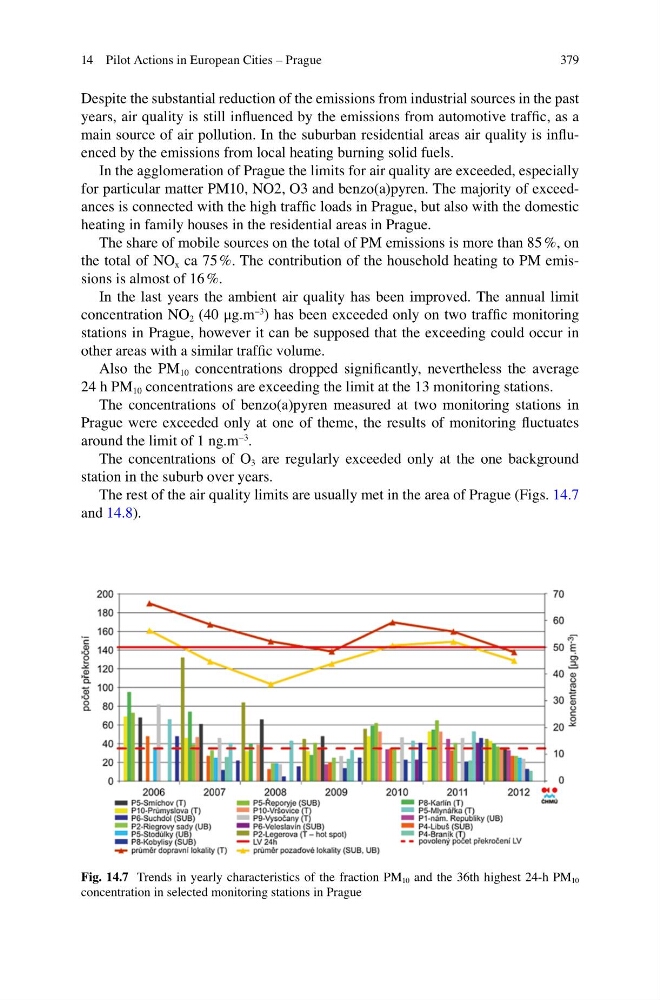
Also the PM 10 concentrations dropped significantly, nevertheless the average
24 h PM 10 concentrations are exceeding the limit at the 13 monitoring stations.
The concentrations of benzo(a)pyren measured at two monitoring stations in
Prague were exceeded only at one of theme, the results of monitoring fluctuates
around the limit of 1 ng.m
−3 .
The concentrations of O 3 are regularly exceeded only at the one background
station in the suburb over years.
The rest of the air quality limits are usually met in the area of Prague (Figs. 14.7
and 14.8).
Fig. 14.7 Trends in yearly characteristics of the fraction PM 10 and the 36th highest 24-h PM 10
concentration in selected monitoring stations in Prague
14 Pilot Actions in European Cities – Prague
Despite the substantial reduction of the emissions from industrial sources in the past
years, air quality is still influenced by the emissions from automotive traffic, as a
main source of air pollution. In the suburban residential areas air quality is influenced by the emissions from local heating burning solid fuels.
In the agglomeration of Prague the limits for air quality are exceeded, especially
for particular matter PM10, NO2, O3 and benzo(a)pyren. The majority of exceedances is connected with the high traffic loads in Prague, but also with the domestic
heating in family houses in the residential areas in Prague.
The share of mobile sources on the total of PM emissions is more than 85 %, on
the total of NO x ca 75 %. The contribution of the household heating to PM emissions is almost of 16 %.
In the last years the ambient air quality has been improved. The annual limit
concentration NO 2 (40 μg.m
−3 ) has been exceeded only on two traffic monitoring
stations in Prague, however it can be supposed that the exceeding could occur in
other areas with a similar traffic volume.
Also the PM 10 concentrations dropped significantly, nevertheless the average
24 h PM 10 concentrations are exceeding the limit at the 13 monitoring stations.
The concentrations of benzo(a)pyren measured at two monitoring stations in
Prague were exceeded only at one of theme, the results of monitoring fluctuates
around the limit of 1 ng.m
−3 .
The concentrations of O 3 are regularly exceeded only at the one background
station in the suburb over years.
The rest of the air quality limits are usually met in the area of Prague (Figs. 14.7
and 14.8).
Fig. 14.7 Trends in yearly characteristics of the fraction PM 10 and the 36th highest 24-h PM 10
concentration in selected monitoring stations in Prague
14 Pilot Actions in European Cities – Prague