

371
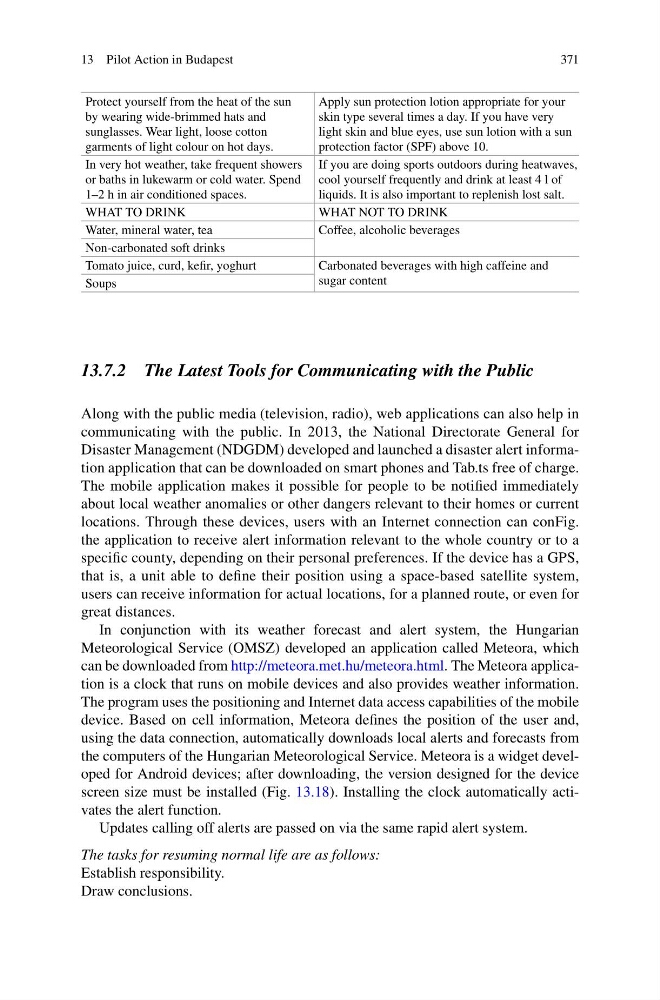
Protect yourself from the heat of the sun
by wearing wide-brimmed hats and
sunglasses. Wear light, loose cotton
garments of light colour on hot days.
Apply sun protection lotion appropriate for your
skin type several times a day. If you have very
light skin and blue eyes, use sun lotion with a sun
protection factor (SPF) above 10.
In very hot weather, take frequent showers
or baths in lukewarm or cold water. Spend
1–2 h in air conditioned spaces.
If you are doing sports outdoors during heatwaves,
cool yourself frequently and drink at least 4 l of
liquids. It is also important to replenish lost salt.
WHAT TO DRINK
WHAT NOT TO DRINK
Water, mineral water, tea
Coffee, alcoholic beverages
Non-carbonated soft drinks
Tomato juice, curd, kefi r, yoghurt
Carbonated beverages with high caffeine and
sugar content
Soups
13.7.2 The Latest Tools for Communicating with the Public
Along with the public media (television, radio), web applications can also help in
communicating with the public. In 2013, the National Directorate General for
Disaster Management (NDGDM) developed and launched a disaster alert information application that can be downloaded on smart phones and Tab.ts free of charge.
The mobile application makes it possible for people to be notifi ed immediately
about local weather anomalies or other dangers relevant to their homes or current
locations. Through these devices, users with an Internet connection can conFig.
the application to receive alert information relevant to the whole country or to a
specifi c county, depending on their personal preferences. If the device has a GPS,
that is, a unit able to defi ne their position using a space-based satellite system,
users can receive information for actual locations, for a planned route, or even for
great distances.
In conjunction with its weather forecast and alert system, the Hungarian
Meteorological Service (OMSZ) developed an application called Meteora, which
can be downloaded from http://meteora.met.hu/meteora.html . The Meteora application is a clock that runs on mobile devices and also provides weather information.
The program uses the positioning and Internet data access capabilities of the mobile
device. Based on cell information, Meteora defi nes the position of the user and,
using the data connection, automatically downloads local alerts and forecasts from
the computers of the Hungarian Meteorological Service. Meteora is a widget developed for Android devices; after downloading, the version designed for the device
screen size must be installed (Fig. 13.18 ). Installing the clock automatically activates the alert function.
Updates calling off alerts are passed on via the same rapid alert system.
The tasks for resuming normal life are as follows:
Establish responsibility.
Draw conclusions.
13 Pilot Action in Budapest
Protect yourself from the heat of the sun
by wearing wide-brimmed hats and
sunglasses. Wear light, loose cotton
garments of light colour on hot days.
Apply sun protection lotion appropriate for your
skin type several times a day. If you have very
light skin and blue eyes, use sun lotion with a sun
protection factor (SPF) above 10.
In very hot weather, take frequent showers
or baths in lukewarm or cold water. Spend
1–2 h in air conditioned spaces.
If you are doing sports outdoors during heatwaves,
cool yourself frequently and drink at least 4 l of
liquids. It is also important to replenish lost salt.
WHAT TO DRINK
WHAT NOT TO DRINK
Water, mineral water, tea
Coffee, alcoholic beverages
Non-carbonated soft drinks
Tomato juice, curd, kefi r, yoghurt
Carbonated beverages with high caffeine and
sugar content
Soups
13.7.2 The Latest Tools for Communicating with the Public
Along with the public media (television, radio), web applications can also help in
communicating with the public. In 2013, the National Directorate General for
Disaster Management (NDGDM) developed and launched a disaster alert information application that can be downloaded on smart phones and Tab.ts free of charge.
The mobile application makes it possible for people to be notifi ed immediately
about local weather anomalies or other dangers relevant to their homes or current
locations. Through these devices, users with an Internet connection can conFig.
the application to receive alert information relevant to the whole country or to a
specifi c county, depending on their personal preferences. If the device has a GPS,
that is, a unit able to defi ne their position using a space-based satellite system,
users can receive information for actual locations, for a planned route, or even for
great distances.
In conjunction with its weather forecast and alert system, the Hungarian
Meteorological Service (OMSZ) developed an application called Meteora, which
can be downloaded from http://meteora.met.hu/meteora.html . The Meteora application is a clock that runs on mobile devices and also provides weather information.
The program uses the positioning and Internet data access capabilities of the mobile
device. Based on cell information, Meteora defi nes the position of the user and,
using the data connection, automatically downloads local alerts and forecasts from
the computers of the Hungarian Meteorological Service. Meteora is a widget developed for Android devices; after downloading, the version designed for the device
screen size must be installed (Fig. 13.18 ). Installing the clock automatically activates the alert function.
Updates calling off alerts are passed on via the same rapid alert system.
The tasks for resuming normal life are as follows:
Establish responsibility.
Draw conclusions.
13 Pilot Action in Budapest