

367
in abiding with the orders issued. The Mayor’s Offi ce will issue a warning to the
institutions of the rapid alert system, as well as the general public, to take preventive
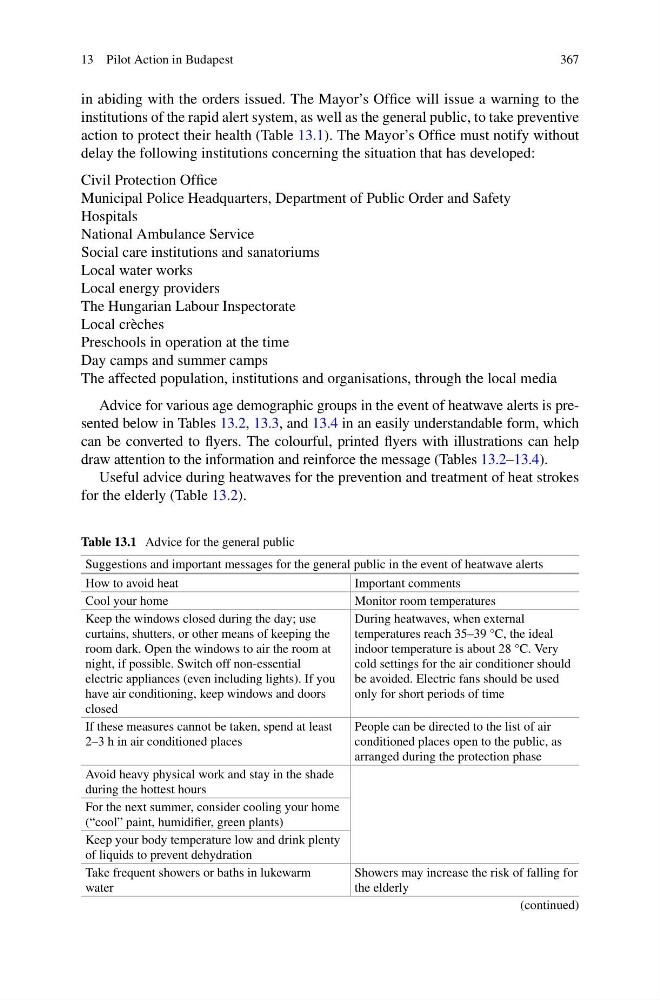
action to protect their health (Table 13.1 ). The Mayor’s Offi ce must notify without
delay the following institutions concerning the situation that has developed:
Civil Protection Offi ce
Municipal Police Headquarters, Department of Public Order and Safety
Hospitals
National Ambulance Service
Social care institutions and sanatoriums
Local water works
Local energy providers
The Hungarian Labour Inspectorate
Local crèches
Preschools in operation at the time
Day camps and summer camps
The affected population, institutions and organisations, through the local media
Advice for various age demographic groups in the event of heatwave alerts is presented below in Tables 13.2 , 13.3 , and 13.4 in an easily understandable form, which
can be converted to fl yers. The colourful, printed fl yers with illustrations can help
draw attention to the information and reinforce the message (Tables 13.2 – 13.4 ).
Useful advice during heatwaves for the prevention and treatment of heat strokes
for the elderly (Table 13.2 ).
Table 13.1 Advice for the general public
Suggestions and important messages for the general public in the event of heatwave alerts
How to avoid heat
Important comments
Cool your home
Monitor room temperatures
Keep the windows closed during the day; use
curtains, shutters, or other means of keeping the
room dark. Open the windows to air the room at
night, if possible. Switch off non-essential
electric appliances (even including lights). If you
have air conditioning, keep windows and doors
closed
During heatwaves, when external
temperatures reach 35–39 °C, the ideal
indoor temperature is about 28 °C. Very
cold settings for the air conditioner should
be avoided. Electric fans should be used
only for short periods of time
If these measures cannot be taken, spend at least
2–3 h in air conditioned places
People can be directed to the list of air
conditioned places open to the public, as
arranged during the protection phase
Avoid heavy physical work and stay in the shade
during the hottest hours
For the next summer, consider cooling your home
(“cool” paint, humidifi er, green plants)
Keep your body temperature low and drink plenty
of liquids to prevent dehydration
Take frequent showers or baths in lukewarm
water
Showers may increase the risk of falling for
the elderly
(continued)
13 Pilot Action in Budapest
in abiding with the orders issued. The Mayor’s Offi ce will issue a warning to the
institutions of the rapid alert system, as well as the general public, to take preventive
action to protect their health (Table 13.1 ). The Mayor’s Offi ce must notify without
delay the following institutions concerning the situation that has developed:
Civil Protection Offi ce
Municipal Police Headquarters, Department of Public Order and Safety
Hospitals
National Ambulance Service
Social care institutions and sanatoriums
Local water works
Local energy providers
The Hungarian Labour Inspectorate
Local crèches
Preschools in operation at the time
Day camps and summer camps
The affected population, institutions and organisations, through the local media
Advice for various age demographic groups in the event of heatwave alerts is presented below in Tables 13.2 , 13.3 , and 13.4 in an easily understandable form, which
can be converted to fl yers. The colourful, printed fl yers with illustrations can help
draw attention to the information and reinforce the message (Tables 13.2 – 13.4 ).
Useful advice during heatwaves for the prevention and treatment of heat strokes
for the elderly (Table 13.2 ).
Table 13.1 Advice for the general public
Suggestions and important messages for the general public in the event of heatwave alerts
How to avoid heat
Important comments
Cool your home
Monitor room temperatures
Keep the windows closed during the day; use
curtains, shutters, or other means of keeping the
room dark. Open the windows to air the room at
night, if possible. Switch off non-essential
electric appliances (even including lights). If you
have air conditioning, keep windows and doors
closed
During heatwaves, when external
temperatures reach 35–39 °C, the ideal
indoor temperature is about 28 °C. Very
cold settings for the air conditioner should
be avoided. Electric fans should be used
only for short periods of time
If these measures cannot be taken, spend at least
2–3 h in air conditioned places
People can be directed to the list of air
conditioned places open to the public, as
arranged during the protection phase
Avoid heavy physical work and stay in the shade
during the hottest hours
For the next summer, consider cooling your home
(“cool” paint, humidifi er, green plants)
Keep your body temperature low and drink plenty
of liquids to prevent dehydration
Take frequent showers or baths in lukewarm
water
Showers may increase the risk of falling for
the elderly
(continued)
13 Pilot Action in Budapest