

312
Concluding, green areas, including both lawns, bushes and trees, play an important
role in creating urban heat stress. The results of experimental research revealed a
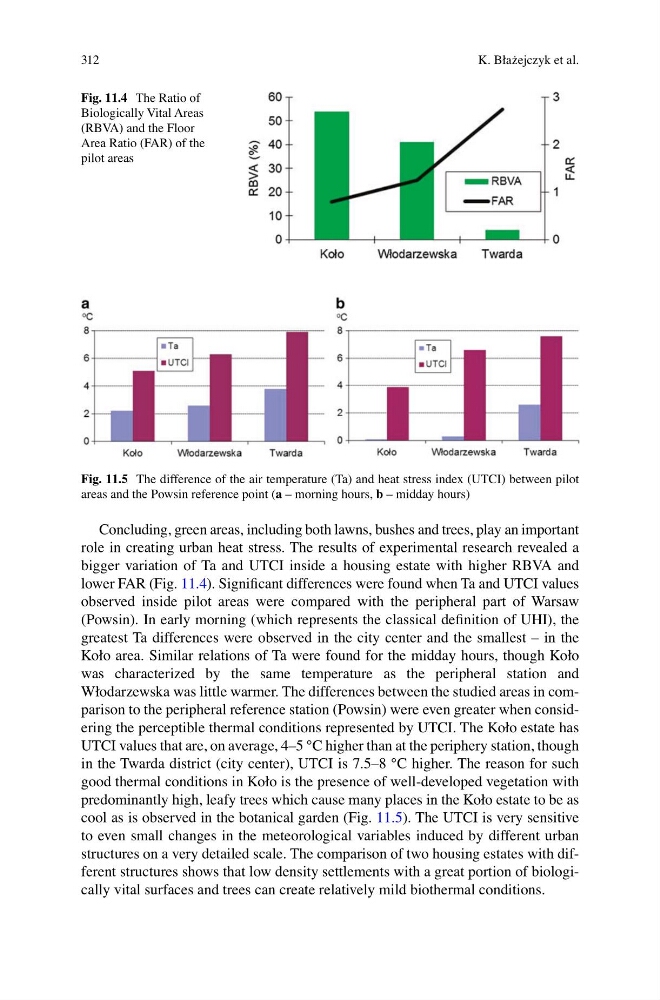
bigger variation of Ta and UTCI inside a housing estate with higher RBVA and
lower FAR (Fig. 11.4 ). Signifi cant differences were found when Ta and UTCI values
observed inside pilot areas were compared with the peripheral part of Warsaw
(Powsin). In early morning (which represents the classical defi nition of UHI), the
greatest Ta differences were observed in the city center and the smallest – in the
Koło area. Similar relations of Ta were found for the midday hours, though Koło
was characterized by the same temperature as the peripheral station and
Włodarzewska was little warmer. The differences between the studied areas in comparison to the peripheral reference station (Powsin) were even greater when considering the perceptible thermal conditions represented by UTCI. The Koło estate has
UTCI values that are, on average, 4–5 °C higher than at the periphery station, though
in the Twarda district (city center), UTCI is 7.5–8 °C higher. The reason for such
good thermal conditions in Koło is the presence of well-developed vegetation with
predominantly high, leafy trees which cause many places in the Koło estate to be as
cool as is observed in the botanical garden (Fig. 11.5 ). The UTCI is very sensitive
to even small changes in the meteorological variables induced by different urban
structures on a very detailed scale. The comparison of two housing estates with different structures shows that low density settlements with a great portion of biologically vital surfaces and trees can create relatively mild biothermal conditions.
Fig. 11.4 The Ratio of
Biologically Vital Areas
(RBVA) and the Floor
Area Ratio (FAR) of the
pilot areas
Fig. 11.5 The difference of the air temperature (Ta) and heat stress index (UTCI) between pilot
areas and the Powsin reference point ( a – morning hours, b – midday hours)
K. Błażejczyk et al.
Concluding, green areas, including both lawns, bushes and trees, play an important
role in creating urban heat stress. The results of experimental research revealed a
bigger variation of Ta and UTCI inside a housing estate with higher RBVA and
lower FAR (Fig. 11.4 ). Signifi cant differences were found when Ta and UTCI values
observed inside pilot areas were compared with the peripheral part of Warsaw
(Powsin). In early morning (which represents the classical defi nition of UHI), the
greatest Ta differences were observed in the city center and the smallest – in the
Koło area. Similar relations of Ta were found for the midday hours, though Koło
was characterized by the same temperature as the peripheral station and
Włodarzewska was little warmer. The differences between the studied areas in comparison to the peripheral reference station (Powsin) were even greater when considering the perceptible thermal conditions represented by UTCI. The Koło estate has
UTCI values that are, on average, 4–5 °C higher than at the periphery station, though
in the Twarda district (city center), UTCI is 7.5–8 °C higher. The reason for such
good thermal conditions in Koło is the presence of well-developed vegetation with
predominantly high, leafy trees which cause many places in the Koło estate to be as
cool as is observed in the botanical garden (Fig. 11.5 ). The UTCI is very sensitive
to even small changes in the meteorological variables induced by different urban
structures on a very detailed scale. The comparison of two housing estates with different structures shows that low density settlements with a great portion of biologically vital surfaces and trees can create relatively mild biothermal conditions.
Fig. 11.4 The Ratio of
Biologically Vital Areas
(RBVA) and the Floor
Area Ratio (FAR) of the
pilot areas
Fig. 11.5 The difference of the air temperature (Ta) and heat stress index (UTCI) between pilot
areas and the Powsin reference point ( a – morning hours, b – midday hours)
K. Błażejczyk et al.