

283
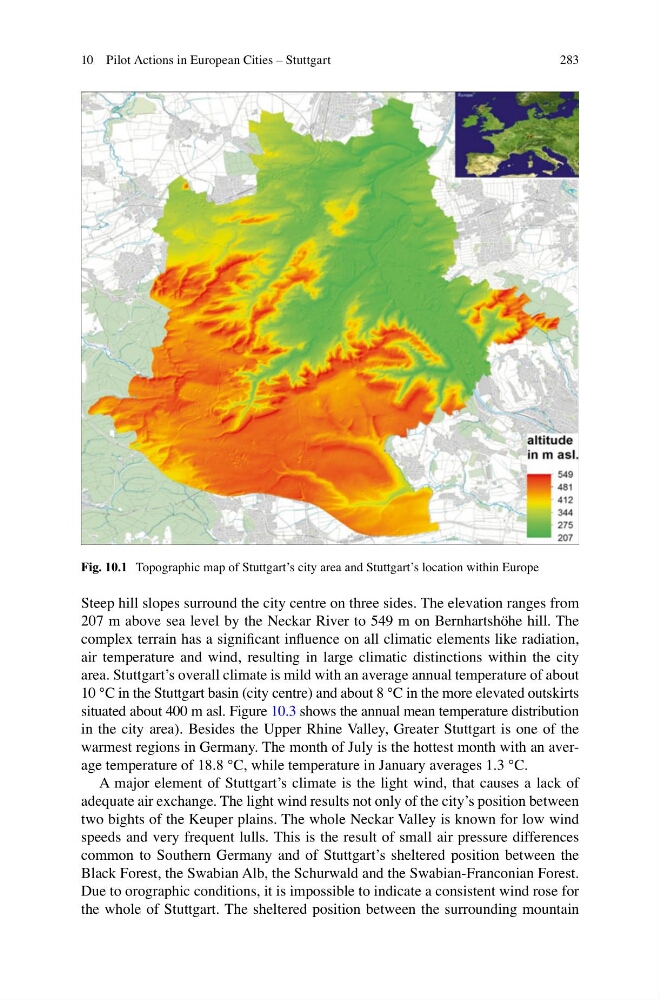
Steep hill slopes surround the city centre on three sides. The elevation ranges from
207 m above sea level by the Neckar River to 549 m on Bernhartshöhe hill. The
complex terrain has a signifi cant infl uence on all climatic elements like radiation,
air temperature and wind, resulting in large climatic distinctions within the city
area. Stuttgart’s overall climate is mild with an average annual temperature of about
10 °C in the Stuttgart basin (city centre) and about 8 °C in the more elevated outskirts
situated about 400 m asl. Figure 10.3 shows the annual mean temperature distribution
in the city area). Besides the Upper Rhine Valley, Greater Stuttgart is one of the
warmest regions in Germany. The month of July is the hottest month with an average temperature of 18.8 °C, while temperature in January averages 1.3 °C.
A major element of Stuttgart’s climate is the light wind, that causes a lack of
adequate air exchange. The light wind results not only of the city’s position between
two bights of the Keuper plains. The whole Neckar Valley is known for low wind
speeds and very frequent lulls. This is the result of small air pressure differences
common to Southern Germany and of Stuttgart’s sheltered position between the
Black Forest, the Swabian Alb, the Schurwald and the Swabian-Franconian Forest.
Due to orographic conditions, it is impossible to indicate a consistent wind rose for
the whole of Stuttgart. The sheltered position between the surrounding mountain
Fig. 10.1 Topographic map of Stuttgart’s city area and Stuttgart’s location within Europe
10 Pilot Actions in European Cities – Stuttgart
Steep hill slopes surround the city centre on three sides. The elevation ranges from
207 m above sea level by the Neckar River to 549 m on Bernhartshöhe hill. The
complex terrain has a signifi cant infl uence on all climatic elements like radiation,
air temperature and wind, resulting in large climatic distinctions within the city
area. Stuttgart’s overall climate is mild with an average annual temperature of about
10 °C in the Stuttgart basin (city centre) and about 8 °C in the more elevated outskirts
situated about 400 m asl. Figure 10.3 shows the annual mean temperature distribution
in the city area). Besides the Upper Rhine Valley, Greater Stuttgart is one of the
warmest regions in Germany. The month of July is the hottest month with an average temperature of 18.8 °C, while temperature in January averages 1.3 °C.
A major element of Stuttgart’s climate is the light wind, that causes a lack of
adequate air exchange. The light wind results not only of the city’s position between
two bights of the Keuper plains. The whole Neckar Valley is known for low wind
speeds and very frequent lulls. This is the result of small air pressure differences
common to Southern Germany and of Stuttgart’s sheltered position between the
Black Forest, the Swabian Alb, the Schurwald and the Swabian-Franconian Forest.
Due to orographic conditions, it is impossible to indicate a consistent wind rose for
the whole of Stuttgart. The sheltered position between the surrounding mountain
Fig. 10.1 Topographic map of Stuttgart’s city area and Stuttgart’s location within Europe
10 Pilot Actions in European Cities – Stuttgart