

274
There was general agreement among staff from the relevant departments that
most UHI-reducing measures at this planning level can be introduced during the
phases of opening and setting the programme for the master plan process. It is
important if not imperative to coin UHI-relevant propositions in the urban development guidelines already. Participatory development during the feasibility study and
cross-agency discussions about chances and restrictions have proven successful.
These negotiating processes can set the frame for addressing confl icting objectives
and challenges and thus support the process of weighing up individual objectives.
Attention also needs to be paid to bringing on board the “implementers”, e.g. Vienna
Public Transport for matters relating to designing and placing bus or tram stops, or
coordinating green and open spaces across construction sites to minimise overheating in a quarter. Listed below are the points and issues that can and ought to be
addressed and fi nalised during this early stage of urban planning and development:
(1) What impact will the planned project have on climate? (2) Which measures for
reducing the UHI effect can be implemented in the urban development scenario
proposed? (3) Who is responsible for implementation? (4) Which tools will be
employed and which planning processes applied to implement the measures? Which
challenges does or may implementation pose?
9.6.2.3 Modelling Measures and Their Impact with the Example
of “Nordbahnstraße – Innstraße”
The Department of Building Physics and Building Ecology at Vienna University of
Technology (Mahdavi et al. 2014 ) was commissioned to simulate the impact of the
master plan on microclimate based on the results of the winner in the competition
inviting ideas for development of the former brownfi eld Nordbahnstraße – Innstraße.
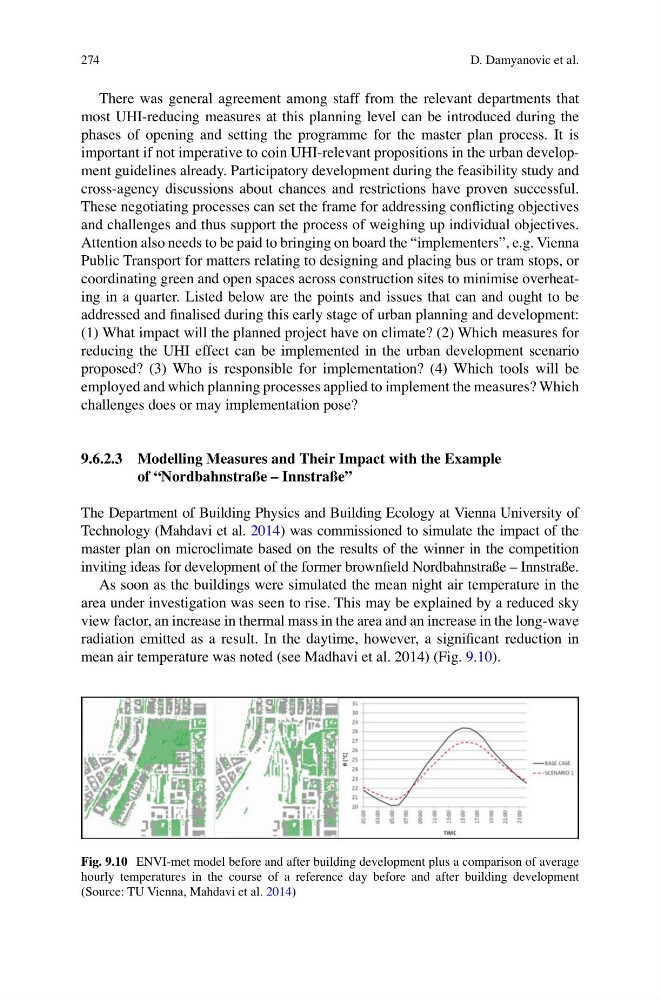
As soon as the buildings were simulated the mean night air temperature in the
area under investigation was seen to rise. This may be explained by a reduced sky
view factor, an increase in thermal mass in the area and an increase in the long-wave
radiation emitted as a result. In the daytime, however, a signifi cant reduction in
mean air temperature was noted (see Madhavi et al. 2014) (Fig. 9.10 ).
Fig. 9.10 ENVI-met model before and after building development plus a comparison of average
hourly temperatures in the course of a reference day before and after building development
(Source: TU Vienna, Mahdavi et al. 2014 )
D. Damyanovic et al.
There was general agreement among staff from the relevant departments that
most UHI-reducing measures at this planning level can be introduced during the
phases of opening and setting the programme for the master plan process. It is
important if not imperative to coin UHI-relevant propositions in the urban development guidelines already. Participatory development during the feasibility study and
cross-agency discussions about chances and restrictions have proven successful.
These negotiating processes can set the frame for addressing confl icting objectives
and challenges and thus support the process of weighing up individual objectives.
Attention also needs to be paid to bringing on board the “implementers”, e.g. Vienna
Public Transport for matters relating to designing and placing bus or tram stops, or
coordinating green and open spaces across construction sites to minimise overheating in a quarter. Listed below are the points and issues that can and ought to be
addressed and fi nalised during this early stage of urban planning and development:
(1) What impact will the planned project have on climate? (2) Which measures for
reducing the UHI effect can be implemented in the urban development scenario
proposed? (3) Who is responsible for implementation? (4) Which tools will be
employed and which planning processes applied to implement the measures? Which
challenges does or may implementation pose?
9.6.2.3 Modelling Measures and Their Impact with the Example
of “Nordbahnstraße – Innstraße”
The Department of Building Physics and Building Ecology at Vienna University of
Technology (Mahdavi et al. 2014 ) was commissioned to simulate the impact of the
master plan on microclimate based on the results of the winner in the competition
inviting ideas for development of the former brownfi eld Nordbahnstraße – Innstraße.
As soon as the buildings were simulated the mean night air temperature in the
area under investigation was seen to rise. This may be explained by a reduced sky
view factor, an increase in thermal mass in the area and an increase in the long-wave
radiation emitted as a result. In the daytime, however, a signifi cant reduction in
mean air temperature was noted (see Madhavi et al. 2014) (Fig. 9.10 ).
Fig. 9.10 ENVI-met model before and after building development plus a comparison of average
hourly temperatures in the course of a reference day before and after building development
(Source: TU Vienna, Mahdavi et al. 2014 )
D. Damyanovic et al.