

177
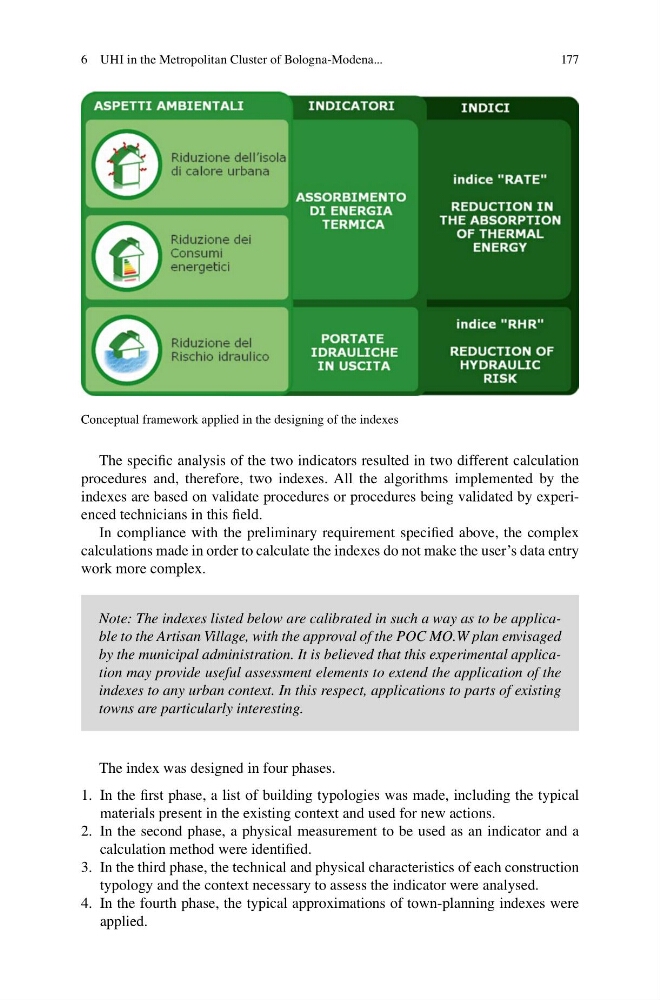
Conceptual framework applied in the designing of the indexes
The specific analysis of the two indicators resulted in two different calculation
procedures and, therefore, two indexes. All the algorithms implemented by the
indexes are based on validate procedures or procedures being validated by experienced technicians in this field.
In compliance with the preliminary requirement specified above, the complex
calculations made in order to calculate the indexes do not make the user’s data entry
work more complex.
Note: The indexes listed below are calibrated in such a way as to be applicable to the Artisan Village, with the approval of the POC MO.W plan envisaged
by the municipal administration. It is believed that this experimental application may provide useful assessment elements to extend the application of the
indexes to any urban context. In this respect, applications to parts of existing
towns are particularly interesting.
The index was designed in four phases.
1. In the first phase, a list of building typologies was made, including the typical
materials present in the existing context and used for new actions.
2. In the second phase, a physical measurement to be used as an indicator and a
calculation method were identified.
3. In the third phase, the technical and physical characteristics of each construction
typology and the context necessary to assess the indicator were analysed.
4. In the fourth phase, the typical approximations of town-planning indexes were
applied.
6 UHI in the Metropolitan Cluster of Bologna-Modena...
Conceptual framework applied in the designing of the indexes
The specific analysis of the two indicators resulted in two different calculation
procedures and, therefore, two indexes. All the algorithms implemented by the
indexes are based on validate procedures or procedures being validated by experienced technicians in this field.
In compliance with the preliminary requirement specified above, the complex
calculations made in order to calculate the indexes do not make the user’s data entry
work more complex.
Note: The indexes listed below are calibrated in such a way as to be applicable to the Artisan Village, with the approval of the POC MO.W plan envisaged
by the municipal administration. It is believed that this experimental application may provide useful assessment elements to extend the application of the
indexes to any urban context. In this respect, applications to parts of existing
towns are particularly interesting.
The index was designed in four phases.
1. In the first phase, a list of building typologies was made, including the typical
materials present in the existing context and used for new actions.
2. In the second phase, a physical measurement to be used as an indicator and a
calculation method were identified.
3. In the third phase, the technical and physical characteristics of each construction
typology and the context necessary to assess the indicator were analysed.
4. In the fourth phase, the typical approximations of town-planning indexes were
applied.
6 UHI in the Metropolitan Cluster of Bologna-Modena...