

151
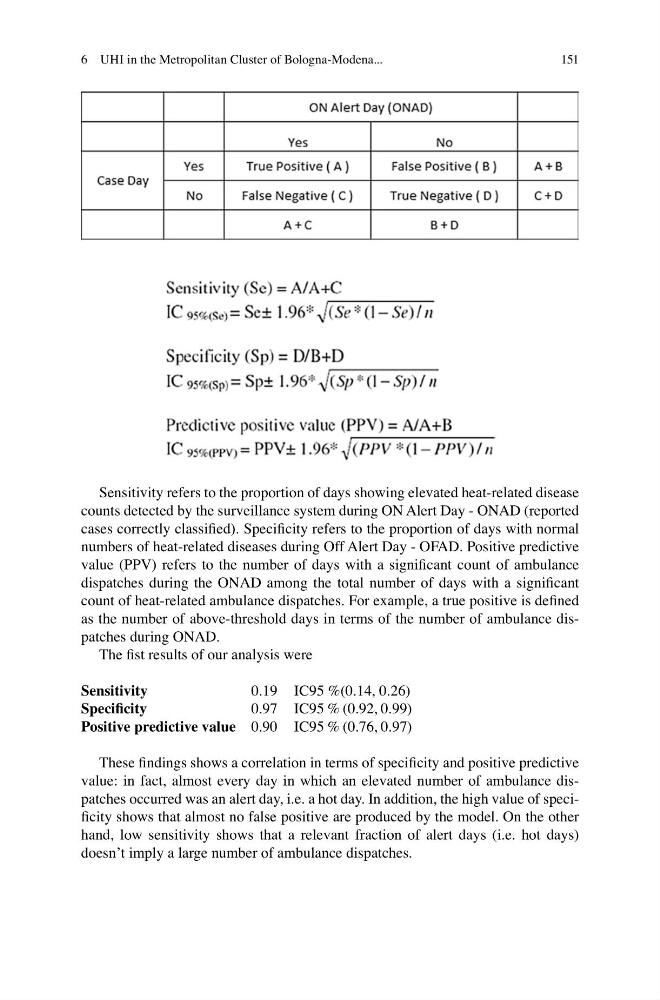
Sensitivity refers to the proportion of days showing elevated heat-related disease
counts detected by the surveillance system during ON Alert Day - ONAD (reported
cases correctly classified). Specificity refers to the proportion of days with normal
numbers of heat-related diseases during Off Alert Day - OFAD. Positive predictive
value (PPV) refers to the number of days with a significant count of ambulance
dispatches during the ONAD among the total number of days with a significant
count of heat-related ambulance dispatches. For example, a true positive is defined
as the number of above-threshold days in terms of the number of ambulance dispatches during ONAD.
The fist results of our analysis were
Sensitivity
0.19 IC95 %(0.14, 0.26)
Specificity
0.97 IC95 % (0.92, 0.99)
Positive predictive value 0.90 IC95 % (0.76, 0.97)
These findings shows a correlation in terms of specificity and positive predictive
value: in fact, almost every day in which an elevated number of ambulance dispatches occurred was an alert day, i.e. a hot day. In addition, the high value of specificity shows that almost no false positive are produced by the model. On the other
hand, low sensitivity shows that a relevant fraction of alert days (i.e. hot days)
doesn’t imply a large number of ambulance dispatches.
6 UHI in the Metropolitan Cluster of Bologna-Modena...
Sensitivity refers to the proportion of days showing elevated heat-related disease
counts detected by the surveillance system during ON Alert Day - ONAD (reported
cases correctly classified). Specificity refers to the proportion of days with normal
numbers of heat-related diseases during Off Alert Day - OFAD. Positive predictive
value (PPV) refers to the number of days with a significant count of ambulance
dispatches during the ONAD among the total number of days with a significant
count of heat-related ambulance dispatches. For example, a true positive is defined
as the number of above-threshold days in terms of the number of ambulance dispatches during ONAD.
The fist results of our analysis were
Sensitivity
0.19 IC95 %(0.14, 0.26)
Specificity
0.97 IC95 % (0.92, 0.99)
Positive predictive value 0.90 IC95 % (0.76, 0.97)
These findings shows a correlation in terms of specificity and positive predictive
value: in fact, almost every day in which an elevated number of ambulance dispatches occurred was an alert day, i.e. a hot day. In addition, the high value of specificity shows that almost no false positive are produced by the model. On the other
hand, low sensitivity shows that a relevant fraction of alert days (i.e. hot days)
doesn’t imply a large number of ambulance dispatches.
6 UHI in the Metropolitan Cluster of Bologna-Modena...