

142
the point of view of thermal comfort, it was quite clear that most effective discomfort reductions were obtained introducing trees in the domain.
The shade from trees produced the largest impact and the mitigation effect was
estimated in around 2 °C in the peak hours. A further point worth of notice is that,
the pervious surface obtained by replacing the asphalt and/or concrete pavement
with grass had a positive impact on the thermal comfort in its turn; however, the
absolute value of this effect was much lower than in the scenario where trees were
introduced, and the temperature reductions were below 0.5°. Modification of building heights showed rather small differences in the values of bio-climatic indices.
The second model used to simulate the impact of different scenarios was ENVImet, a three dimensional, non-hydrostatic model of the atmosphere, based on the
fundamental laws of fluid-dynamics and thermodynamics. ENVI-met is a much
more complex model than Rayman and is able to simulate the tri-dimensional field
of the usual meteorological variables taking into account the interaction between
atmosphere, urban surfaces and vegetation characterizing the complex urban
fabric.
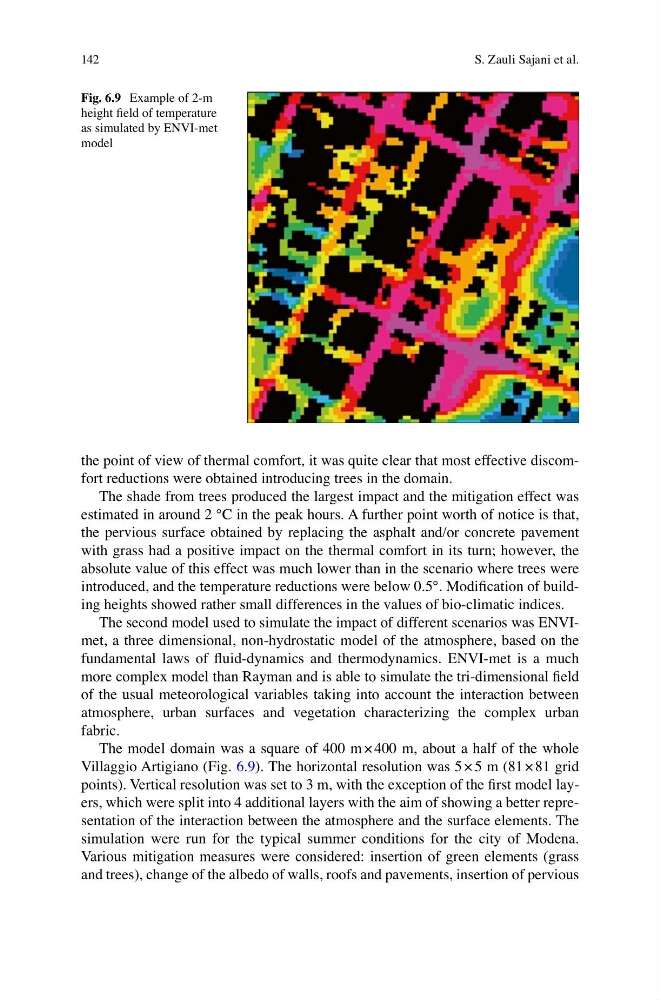
The model domain was a square of 400 m × 400 m, about a half of the whole
Villaggio Artigiano (Fig. 6.9). The horizontal resolution was 5 × 5 m (81 × 81 grid
points). Vertical resolution was set to 3 m, with the exception of the first model layers, which were split into 4 additional layers with the aim of showing a better representation of the interaction between the atmosphere and the surface elements. The
simulation were run for the typical summer conditions for the city of Modena.
Various mitigation measures were considered: insertion of green elements (grass
and trees), change of the albedo of walls, roofs and pavements, insertion of pervious
Fig. 6.9 Example of 2-m
height field of temperature
as simulated by ENVI-met
model
S. Zauli Sajani et al.
the point of view of thermal comfort, it was quite clear that most effective discomfort reductions were obtained introducing trees in the domain.
The shade from trees produced the largest impact and the mitigation effect was
estimated in around 2 °C in the peak hours. A further point worth of notice is that,
the pervious surface obtained by replacing the asphalt and/or concrete pavement
with grass had a positive impact on the thermal comfort in its turn; however, the
absolute value of this effect was much lower than in the scenario where trees were
introduced, and the temperature reductions were below 0.5°. Modification of building heights showed rather small differences in the values of bio-climatic indices.
The second model used to simulate the impact of different scenarios was ENVImet, a three dimensional, non-hydrostatic model of the atmosphere, based on the
fundamental laws of fluid-dynamics and thermodynamics. ENVI-met is a much
more complex model than Rayman and is able to simulate the tri-dimensional field
of the usual meteorological variables taking into account the interaction between
atmosphere, urban surfaces and vegetation characterizing the complex urban
fabric.
The model domain was a square of 400 m × 400 m, about a half of the whole
Villaggio Artigiano (Fig. 6.9). The horizontal resolution was 5 × 5 m (81 × 81 grid
points). Vertical resolution was set to 3 m, with the exception of the first model layers, which were split into 4 additional layers with the aim of showing a better representation of the interaction between the atmosphere and the surface elements. The
simulation were run for the typical summer conditions for the city of Modena.
Various mitigation measures were considered: insertion of green elements (grass
and trees), change of the albedo of walls, roofs and pavements, insertion of pervious
Fig. 6.9 Example of 2-m
height field of temperature
as simulated by ENVI-met
model
S. Zauli Sajani et al.