

136
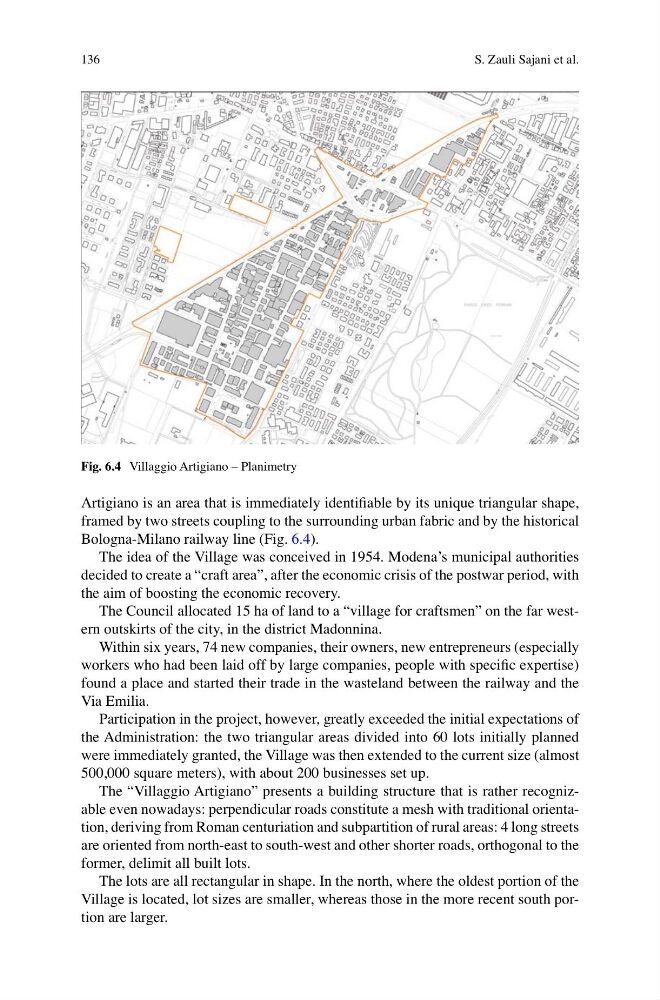
Artigiano is an area that is immediately identifiable by its unique triangular shape,
framed by two streets coupling to the surrounding urban fabric and by the historical
Bologna-Milano railway line (Fig. 6.4).
The idea of the Village was conceived in 1954. Modena’s municipal authorities
decided to create a “craft area”, after the economic crisis of the postwar period, with
the aim of boosting the economic recovery.
The Council allocated 15 ha of land to a “village for craftsmen” on the far western outskirts of the city, in the district Madonnina.
Within six years, 74 new companies, their owners, new entrepreneurs (especially
workers who had been laid off by large companies, people with specific expertise)
found a place and started their trade in the wasteland between the railway and the
Via Emilia.
Participation in the project, however, greatly exceeded the initial expectations of
the Administration: the two triangular areas divided into 60 lots initially planned
were immediately granted, the Village was then extended to the current size (almost
500,000 square meters), with about 200 businesses set up.
The “Villaggio Artigiano” presents a building structure that is rather recognizable even nowadays: perpendicular roads constitute a mesh with traditional orientation, deriving from Roman centuriation and subpartition of rural areas: 4 long streets
are oriented from north-east to south-west and other shorter roads, orthogonal to the
former, delimit all built lots.
The lots are all rectangular in shape. In the north, where the oldest portion of the
Village is located, lot sizes are smaller, whereas those in the more recent south portion are larger.
Fig. 6.4 Villaggio Artigiano – Planimetry
S. Zauli Sajani et al.
Artigiano is an area that is immediately identifiable by its unique triangular shape,
framed by two streets coupling to the surrounding urban fabric and by the historical
Bologna-Milano railway line (Fig. 6.4).
The idea of the Village was conceived in 1954. Modena’s municipal authorities
decided to create a “craft area”, after the economic crisis of the postwar period, with
the aim of boosting the economic recovery.
The Council allocated 15 ha of land to a “village for craftsmen” on the far western outskirts of the city, in the district Madonnina.
Within six years, 74 new companies, their owners, new entrepreneurs (especially
workers who had been laid off by large companies, people with specific expertise)
found a place and started their trade in the wasteland between the railway and the
Via Emilia.
Participation in the project, however, greatly exceeded the initial expectations of
the Administration: the two triangular areas divided into 60 lots initially planned
were immediately granted, the Village was then extended to the current size (almost
500,000 square meters), with about 200 businesses set up.
The “Villaggio Artigiano” presents a building structure that is rather recognizable even nowadays: perpendicular roads constitute a mesh with traditional orientation, deriving from Roman centuriation and subpartition of rural areas: 4 long streets
are oriented from north-east to south-west and other shorter roads, orthogonal to the
former, delimit all built lots.
The lots are all rectangular in shape. In the north, where the oldest portion of the
Village is located, lot sizes are smaller, whereas those in the more recent south portion are larger.
Fig. 6.4 Villaggio Artigiano – Planimetry
S. Zauli Sajani et al.