

56
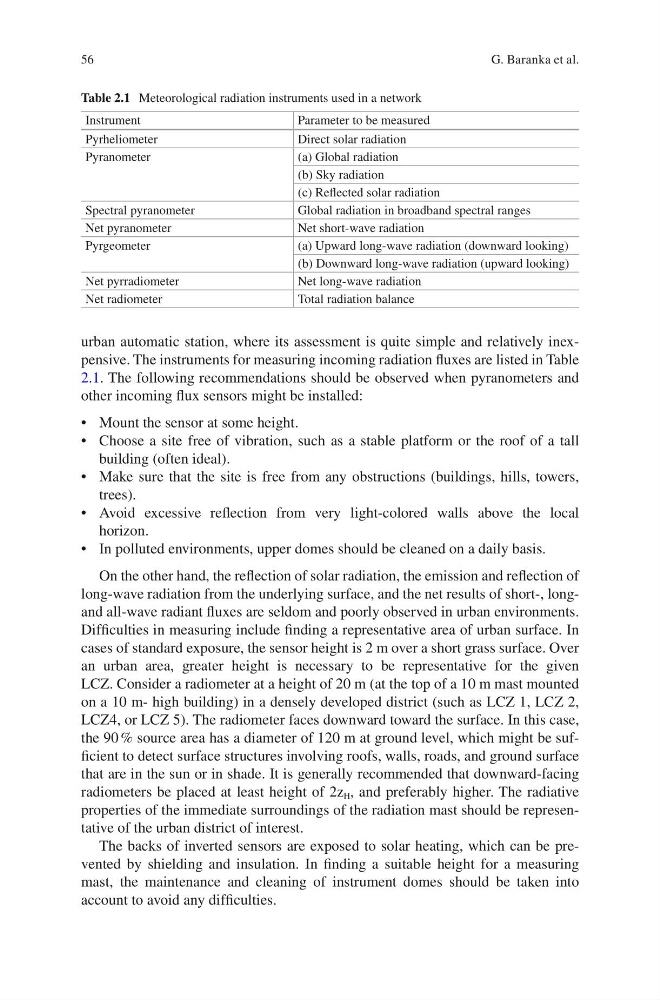
urban automatic station, where its assessment is quite simple and relatively inexpensive. The instruments for measuring incoming radiation fluxes are listed in Table
2.1. The following recommendations should be observed when pyranometers and
other incoming flux sensors might be installed:
• Mount the sensor at some height.
• Choose a site free of vibration, such as a stable platform or the roof of a tall
building (often ideal).
• Make sure that the site is free from any obstructions (buildings, hills, towers,
trees).
• Avoid excessive reflection from very light-colored walls above the local
horizon.
• In polluted environments, upper domes should be cleaned on a daily basis.
On the other hand, the reflection of solar radiation, the emission and reflection of
long-wave radiation from the underlying surface, and the net results of short-, longand all-wave radiant fluxes are seldom and poorly observed in urban environments.
Difficulties in measuring include finding a representative area of urban surface. In
cases of standard exposure, the sensor height is 2 m over a short grass surface. Over
an urban area, greater height is necessary to be representative for the given
LCZ. Consider a radiometer at a height of 20 m (at the top of a 10 m mast mounted
on a 10 m- high building) in a densely developed district (such as LCZ 1, LCZ 2,
LCZ4, or LCZ 5). The radiometer faces downward toward the surface. In this case,
the 90 % source area has a diameter of 120 m at ground level, which might be sufficient to detect surface structures involving roofs, walls, roads, and ground surface
that are in the sun or in shade. It is generally recommended that downward-facing
radiometers be placed at least height of 2z H , and preferably higher. The radiative
properties of the immediate surroundings of the radiation mast should be representative of the urban district of interest.
The backs of inverted sensors are exposed to solar heating, which can be prevented by shielding and insulation. In finding a suitable height for a measuring
mast, the maintenance and cleaning of instrument domes should be taken into
account to avoid any difficulties.
Table 2.1 Meteorological radiation instruments used in a network
Instrument
Parameter to be measured
Pyrheliometer
Direct solar radiation
Pyranometer
(a) Global radiation
(b) Sky radiation
(c) Reflected solar radiation
Spectral pyranometer
Global radiation in broadband spectral ranges
Net pyranometer
Net short-wave radiation
Pyrgeometer
(a) Upward long-wave radiation (downward looking)
(b) Downward long-wave radiation (upward looking)
Net pyrradiometer
Net long-wave radiation
Net radiometer
Total radiation balance
G. Baranka et al.
urban automatic station, where its assessment is quite simple and relatively inexpensive. The instruments for measuring incoming radiation fluxes are listed in Table
2.1. The following recommendations should be observed when pyranometers and
other incoming flux sensors might be installed:
• Mount the sensor at some height.
• Choose a site free of vibration, such as a stable platform or the roof of a tall
building (often ideal).
• Make sure that the site is free from any obstructions (buildings, hills, towers,
trees).
• Avoid excessive reflection from very light-colored walls above the local
horizon.
• In polluted environments, upper domes should be cleaned on a daily basis.
On the other hand, the reflection of solar radiation, the emission and reflection of
long-wave radiation from the underlying surface, and the net results of short-, longand all-wave radiant fluxes are seldom and poorly observed in urban environments.
Difficulties in measuring include finding a representative area of urban surface. In
cases of standard exposure, the sensor height is 2 m over a short grass surface. Over
an urban area, greater height is necessary to be representative for the given
LCZ. Consider a radiometer at a height of 20 m (at the top of a 10 m mast mounted
on a 10 m- high building) in a densely developed district (such as LCZ 1, LCZ 2,
LCZ4, or LCZ 5). The radiometer faces downward toward the surface. In this case,
the 90 % source area has a diameter of 120 m at ground level, which might be sufficient to detect surface structures involving roofs, walls, roads, and ground surface
that are in the sun or in shade. It is generally recommended that downward-facing
radiometers be placed at least height of 2z H , and preferably higher. The radiative
properties of the immediate surroundings of the radiation mast should be representative of the urban district of interest.
The backs of inverted sensors are exposed to solar heating, which can be prevented by shielding and insulation. In finding a suitable height for a measuring
mast, the maintenance and cleaning of instrument domes should be taken into
account to avoid any difficulties.
Table 2.1 Meteorological radiation instruments used in a network
Instrument
Parameter to be measured
Pyrheliometer
Direct solar radiation
Pyranometer
(a) Global radiation
(b) Sky radiation
(c) Reflected solar radiation
Spectral pyranometer
Global radiation in broadband spectral ranges
Net pyranometer
Net short-wave radiation
Pyrgeometer
(a) Upward long-wave radiation (downward looking)
(b) Downward long-wave radiation (upward looking)
Net pyrradiometer
Net long-wave radiation
Net radiometer
Total radiation balance
G. Baranka et al.