

52
• The standard height for rural wind observations is 10 m above ground, at a horizontal distance from obstructions of at least 10 times the height of the obstacle.
Following this guideline is difficult in typical urban districts; where a patch of at
least 100 m radius would be required around 10 m-high buildings and trees.
• In a densely built-up area where the effects of individual roughness elements
persist, the top of roughness sublayer is about 1.5z H , meaning that the recommended anemometer height is at least 15 m if the closest buildings are 10 m high.
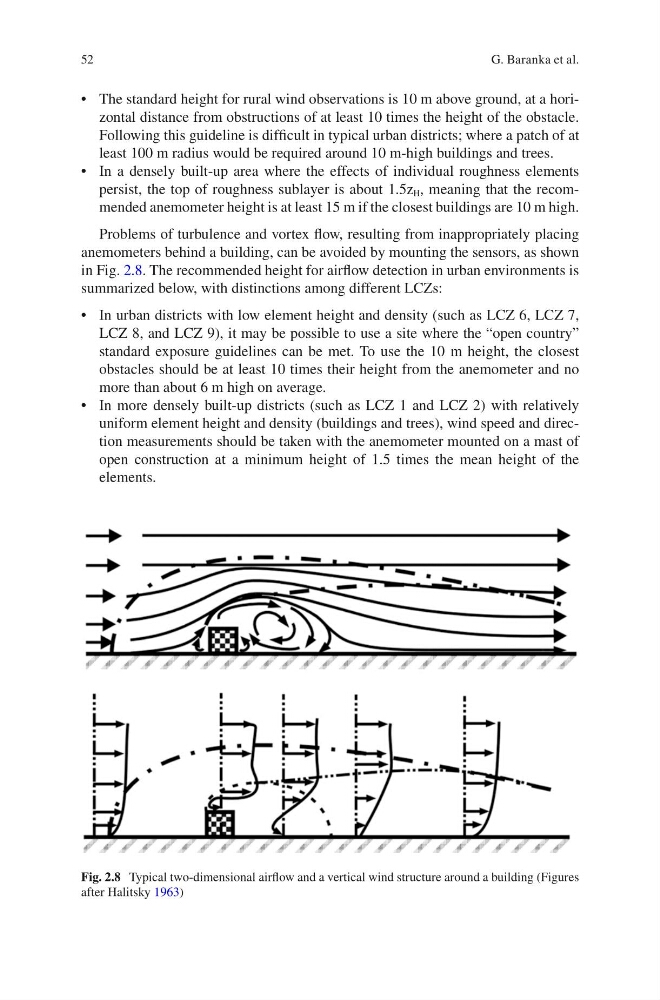
Problems of turbulence and vortex flow, resulting from inappropriately placing
anemometers behind a building, can be avoided by mounting the sensors, as shown
in Fig. 2.8. The recommended height for airflow detection in urban environments is
summarized below, with distinctions among different LCZs:
• In urban districts with low element height and density (such as LCZ 6, LCZ 7,
LCZ 8, and LCZ 9), it may be possible to use a site where the “open country”
standard exposure guidelines can be met. To use the 10 m height, the closest
obstacles should be at least 10 times their height from the anemometer and no
more than about 6 m high on average.
• In more densely built-up districts (such as LCZ 1 and LCZ 2) with relatively
uniform element height and density (buildings and trees), wind speed and direction measurements should be taken with the anemometer mounted on a mast of
open construction at a minimum height of 1.5 times the mean height of the
elements.
Fig. 2.8 Typical two-dimensional airflow and a vertical wind structure around a building (Figures
after Halitsky 1963)
G. Baranka et al.
• The standard height for rural wind observations is 10 m above ground, at a horizontal distance from obstructions of at least 10 times the height of the obstacle.
Following this guideline is difficult in typical urban districts; where a patch of at
least 100 m radius would be required around 10 m-high buildings and trees.
• In a densely built-up area where the effects of individual roughness elements
persist, the top of roughness sublayer is about 1.5z H , meaning that the recommended anemometer height is at least 15 m if the closest buildings are 10 m high.
Problems of turbulence and vortex flow, resulting from inappropriately placing
anemometers behind a building, can be avoided by mounting the sensors, as shown
in Fig. 2.8. The recommended height for airflow detection in urban environments is
summarized below, with distinctions among different LCZs:
• In urban districts with low element height and density (such as LCZ 6, LCZ 7,
LCZ 8, and LCZ 9), it may be possible to use a site where the “open country”
standard exposure guidelines can be met. To use the 10 m height, the closest
obstacles should be at least 10 times their height from the anemometer and no
more than about 6 m high on average.
• In more densely built-up districts (such as LCZ 1 and LCZ 2) with relatively
uniform element height and density (buildings and trees), wind speed and direction measurements should be taken with the anemometer mounted on a mast of
open construction at a minimum height of 1.5 times the mean height of the
elements.
Fig. 2.8 Typical two-dimensional airflow and a vertical wind structure around a building (Figures
after Halitsky 1963)
G. Baranka et al.