

6.4 Answers for Problems from Chap. 4
143
6.4 Answers for Problems from Chap. 4
4.2 Finite difference approximation of a beam fixed at both ends
(a) Single force case
u Z (0.5L) =
32E I Y + k s AG L
2
L F 0
2k s AG
k s AG L 2 + 64E I Y
(5 nodes) ,
(6.174)
u Z (0.5L) =
512E I Y + 11k s AG L
2
L F 0
2k s AG
k s AG L 2 + 1024E I Y
(17 nodes) .
(6.175)
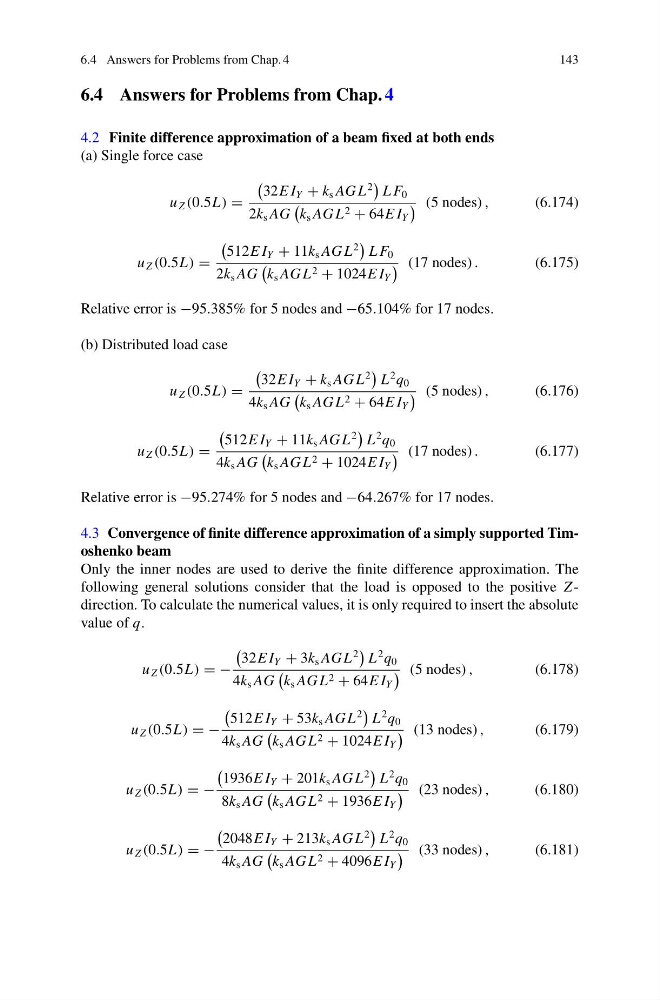
Relative error is −95.385% for 5 nodes and −65.104% for 17 nodes.
(b) Distributed load case
u Z (0.5L) =
32E I Y + k s AG L
2
L
2 q 0
4k s AG
k s AG L 2 + 64E I Y
(5 nodes) ,
(6.176)
u Z (0.5L) =
512E I Y + 11k s AG L
2
L
2 q 0
4k s AG
k s AG L 2 + 1024E I Y
(17 nodes) .
(6.177)
Relative error is −95.274% for 5 nodes and −64.267% for 17 nodes.
4.3 Convergence of finite difference approximation of a simply supported Timoshenko beam
Only the inner nodes are used to derive the finite difference approximation. The
following general solutions consider that the load is opposed to the positive Z -
direction. To calculate the numerical values, it is only required to insert the absolute
value of q.
u Z (0.5L) = −
32E I Y + 3k s AG L
2
L
2 q 0
4k s AG
k s AG L 2 + 64E I Y
(5 nodes) ,
(6.178)
u Z (0.5L) = −
512E I Y + 53k s AG L
2
L
2 q 0
4k s AG
k s AG L 2 + 1024E I Y
(13 nodes) ,
(6.179)
u Z (0.5L) = −
1936E I Y + 201k s AG L
2
L
2 q 0
8k s AG
k s AG L 2 + 1936E I Y
(23 nodes) ,
(6.180)
u Z (0.5L) = −
2048E I Y + 213k s AG L
2
L
2 q 0
4k s AG
k s AG L 2 + 4096E I Y
(33 nodes) ,
(6.181)
143
6.4 Answers for Problems from Chap. 4
4.2 Finite difference approximation of a beam fixed at both ends
(a) Single force case
u Z (0.5L) =
32E I Y + k s AG L
2
L F 0
2k s AG
k s AG L 2 + 64E I Y
(5 nodes) ,
(6.174)
u Z (0.5L) =
512E I Y + 11k s AG L
2
L F 0
2k s AG
k s AG L 2 + 1024E I Y
(17 nodes) .
(6.175)
Relative error is −95.385% for 5 nodes and −65.104% for 17 nodes.
(b) Distributed load case
u Z (0.5L) =
32E I Y + k s AG L
2
L
2 q 0
4k s AG
k s AG L 2 + 64E I Y
(5 nodes) ,
(6.176)
u Z (0.5L) =
512E I Y + 11k s AG L
2
L
2 q 0
4k s AG
k s AG L 2 + 1024E I Y
(17 nodes) .
(6.177)
Relative error is −95.274% for 5 nodes and −64.267% for 17 nodes.
4.3 Convergence of finite difference approximation of a simply supported Timoshenko beam
Only the inner nodes are used to derive the finite difference approximation. The
following general solutions consider that the load is opposed to the positive Z -
direction. To calculate the numerical values, it is only required to insert the absolute
value of q.
u Z (0.5L) = −
32E I Y + 3k s AG L
2
L
2 q 0
4k s AG
k s AG L 2 + 64E I Y
(5 nodes) ,
(6.178)
u Z (0.5L) = −
512E I Y + 53k s AG L
2
L
2 q 0
4k s AG
k s AG L 2 + 1024E I Y
(13 nodes) ,
(6.179)
u Z (0.5L) = −
1936E I Y + 201k s AG L
2
L
2 q 0
8k s AG
k s AG L 2 + 1936E I Y
(23 nodes) ,
(6.180)
u Z (0.5L) = −
2048E I Y + 213k s AG L
2
L
2 q 0
4k s AG
k s AG L 2 + 4096E I Y
(33 nodes) ,
(6.181)