

during Andisol formation were reported as a function of Al o and Si o (Nanzyo et al.
2002). To discuss the mechanism of the changes in element concentration during the
process of Andisol formation, we constructed Fig. 4.30 (Nanzyo et al. 2007).
Horizontal axes show an index of the weight ratio (W p ÀW s )/W s ¼ W p /W s À1,
where W p is the weight of parent volcanic ash, and W s the weight of Andisol.
Vertical axes show the concentrations of the elements, although the absolute concentration range depends on the individual element. The element concentration (E j )
at W p /W s À1 ¼ 0, with rearrangement W p ¼ W s , is the element concentration present
in the parent volcanic ash (E j,p ). The element concentration at W p /W s À1 ¼ 2, which
is the same as W p ¼ 3W s , is the element concentration when the weight of the
Andisol has been reduced to one-third of the weight of the parent volcanic ash. If an
element j is immobile during Andisol formation, Ej at W p /W s À1 ¼ 2 is 3E j,p .
Two analyses were performed before constructing Fig. 4.30. One was a principal
component analysis of element concentration data of 46 elements using 95 Andisol
samples from 18 pedons with different rock types. The first principal component was
suggested to be depletion and enrichment of elements, and the second principal
component (PC2) was suggested to be related to rock type. Then, andesitic Andisols,
for which the variation in PC2 scores was relatively small, was used for Fig. 4.30.
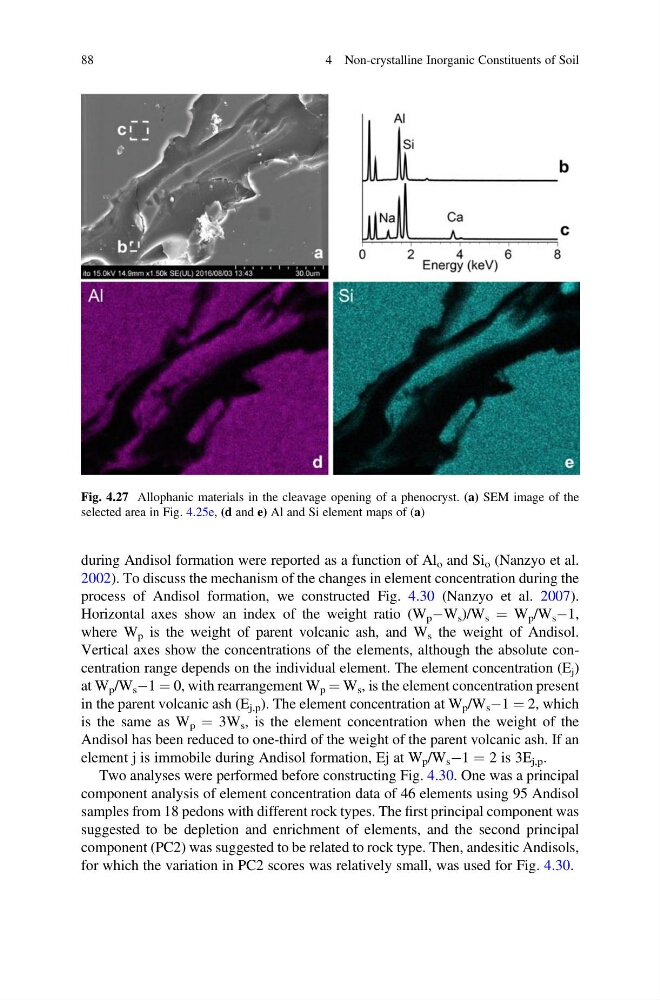
Fig. 4.27 Allophanic materials in the cleavage opening of a phenocryst. (a) SEM image of the
selected area in Fig. 4.25e, (d and e) Al and Si element maps of (a)
88
4 Non-crystalline Inorganic Constituents of Soil
2002). To discuss the mechanism of the changes in element concentration during the
process of Andisol formation, we constructed Fig. 4.30 (Nanzyo et al. 2007).
Horizontal axes show an index of the weight ratio (W p ÀW s )/W s ¼ W p /W s À1,
where W p is the weight of parent volcanic ash, and W s the weight of Andisol.
Vertical axes show the concentrations of the elements, although the absolute concentration range depends on the individual element. The element concentration (E j )
at W p /W s À1 ¼ 0, with rearrangement W p ¼ W s , is the element concentration present
in the parent volcanic ash (E j,p ). The element concentration at W p /W s À1 ¼ 2, which
is the same as W p ¼ 3W s , is the element concentration when the weight of the
Andisol has been reduced to one-third of the weight of the parent volcanic ash. If an
element j is immobile during Andisol formation, Ej at W p /W s À1 ¼ 2 is 3E j,p .
Two analyses were performed before constructing Fig. 4.30. One was a principal
component analysis of element concentration data of 46 elements using 95 Andisol
samples from 18 pedons with different rock types. The first principal component was
suggested to be depletion and enrichment of elements, and the second principal
component (PC2) was suggested to be related to rock type. Then, andesitic Andisols,
for which the variation in PC2 scores was relatively small, was used for Fig. 4.30.
Fig. 4.27 Allophanic materials in the cleavage opening of a phenocryst. (a) SEM image of the
selected area in Fig. 4.25e, (d and e) Al and Si element maps of (a)
88
4 Non-crystalline Inorganic Constituents of Soil