

4.4.2 Partially Weathered Pumice Particle
In the Central Plain of Luzon, the ash from the 1991 eruption (C horizon) deposited
on the previous volcanic ash soil (2A1 or below) (Fig. 4.16a). A partially weathered
pumice from the 2Bw horizon was sampled and a polished section (Fig. 4.16b) was
prepared. The particle is brownish all the way through, suggesting oxidation and
weathering of iron within the pumice. The primary land use type around the pedon is
pasture (Fig. 4.16c), and the grass vegetation on the new ash had recovered by 1993,
because the depth of the new ash at this site was only 13 cm.
Figure 4.17a, b shows element maps for Fig. 4.16b. The Al concentration,
indicated by the magenta color, appears to be high for the phenocrysts, suggesting
that these may be feldspars. Phenocrysts aside, the Al concentration at the rim of the
pumice particle appears to be higher than the sponge-like inside of the pumice
particle. The intensity of the cyan color, which indicates Si, appears nearly identical
to the fresh pumice particle. Figure 4.17c shows a magnified SEM image of the
upper part of the pumice. Sponge-like or highly vesicular structures can be found
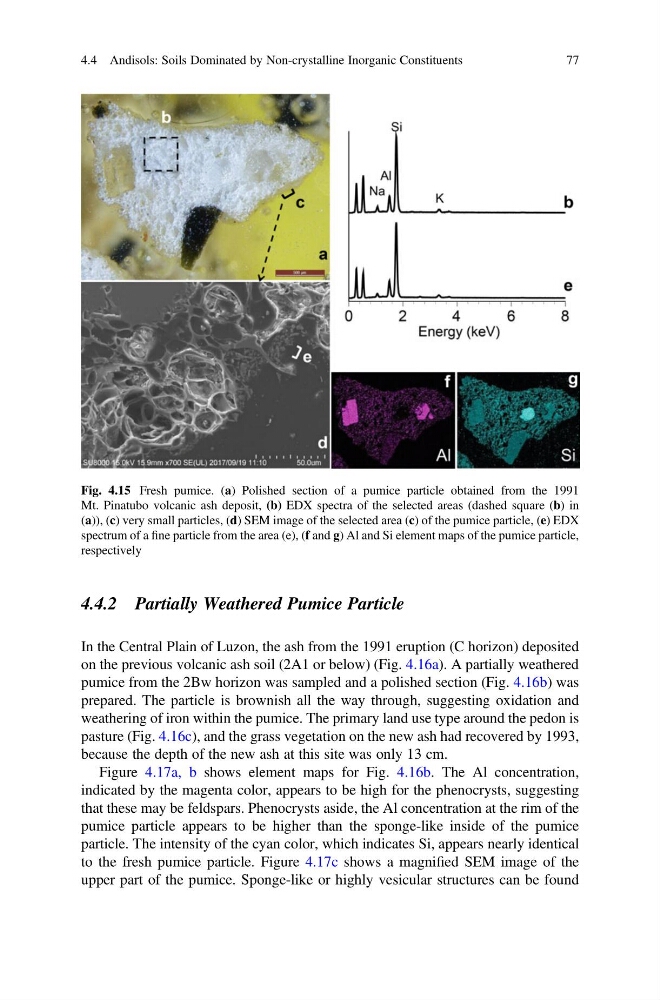
Fig. 4.15 Fresh pumice. (a) Polished section of a pumice particle obtained from the 1991
Mt. Pinatubo volcanic ash deposit, (b) EDX spectra of the selected areas (dashed square (b) in
(a)), (c) very small particles, (d) SEM image of the selected area (c) of the pumice particle, (e) EDX
spectrum of a fine particle from the area (e), (f and g) Al and Si element maps of the pumice particle,
respectively
4.4 Andisols: Soils Dominated by Non-crystalline Inorganic Constituents
77
In the Central Plain of Luzon, the ash from the 1991 eruption (C horizon) deposited
on the previous volcanic ash soil (2A1 or below) (Fig. 4.16a). A partially weathered
pumice from the 2Bw horizon was sampled and a polished section (Fig. 4.16b) was
prepared. The particle is brownish all the way through, suggesting oxidation and
weathering of iron within the pumice. The primary land use type around the pedon is
pasture (Fig. 4.16c), and the grass vegetation on the new ash had recovered by 1993,
because the depth of the new ash at this site was only 13 cm.
Figure 4.17a, b shows element maps for Fig. 4.16b. The Al concentration,
indicated by the magenta color, appears to be high for the phenocrysts, suggesting
that these may be feldspars. Phenocrysts aside, the Al concentration at the rim of the
pumice particle appears to be higher than the sponge-like inside of the pumice
particle. The intensity of the cyan color, which indicates Si, appears nearly identical
to the fresh pumice particle. Figure 4.17c shows a magnified SEM image of the
upper part of the pumice. Sponge-like or highly vesicular structures can be found
Fig. 4.15 Fresh pumice. (a) Polished section of a pumice particle obtained from the 1991
Mt. Pinatubo volcanic ash deposit, (b) EDX spectra of the selected areas (dashed square (b) in
(a)), (c) very small particles, (d) SEM image of the selected area (c) of the pumice particle, (e) EDX
spectrum of a fine particle from the area (e), (f and g) Al and Si element maps of the pumice particle,
respectively
4.4 Andisols: Soils Dominated by Non-crystalline Inorganic Constituents
77