

smaller and more sub-round platy particles than those in Fig. 3.4. The XRD patterns
of the kaolinite in Fig. 3.5e show the major diffraction peak at 0.7 nm, the basal
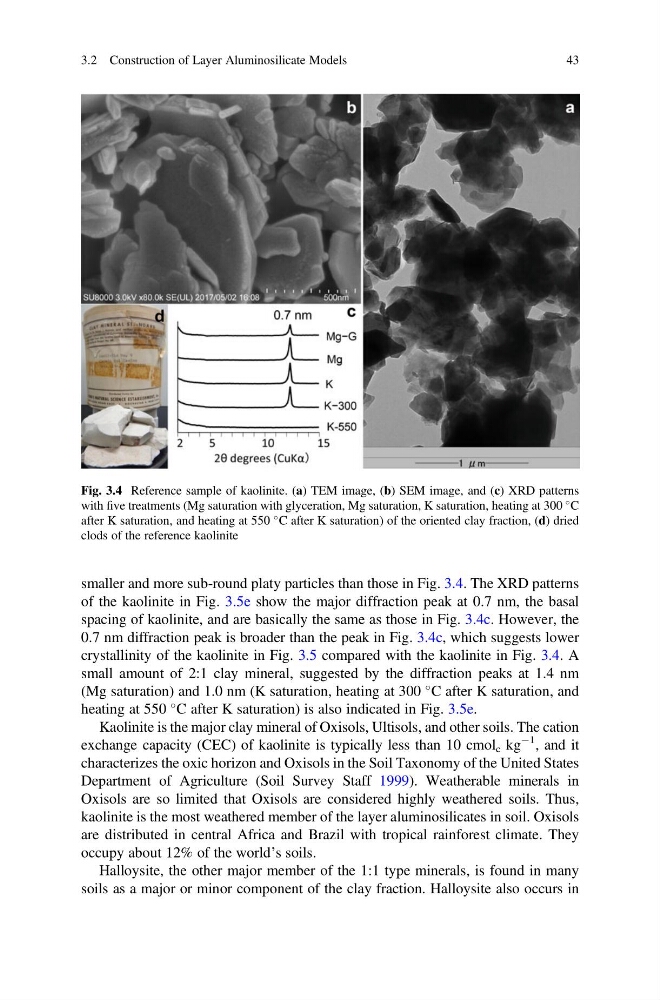
spacing of kaolinite, and are basically the same as those in Fig. 3.4c. However, the
0.7 nm diffraction peak is broader than the peak in Fig. 3.4c, which suggests lower
crystallinity of the kaolinite in Fig. 3.5 compared with the kaolinite in Fig. 3.4. A
small amount of 2:1 clay mineral, suggested by the diffraction peaks at 1.4 nm
(Mg saturation) and 1.0 nm (K saturation, heating at 300
C after K saturation, and
heating at 550
C after K saturation) is also indicated in Fig. 3.5e.
Kaolinite is the major clay mineral of Oxisols, Ultisols, and other soils. The cation
exchange capacity (CEC) of kaolinite is typically less than 10 cmol c kg
À1 , and it
characterizes the oxic horizon and Oxisols in the Soil Taxonomy of the United States
Department of Agriculture (Soil Survey Staff 1999). Weatherable minerals in
Oxisols are so limited that Oxisols are considered highly weathered soils. Thus,
kaolinite is the most weathered member of the layer aluminosilicates in soil. Oxisols
are distributed in central Africa and Brazil with tropical rainforest climate. They
occupy about 12% of the world’s soils.
Halloysite, the other major member of the 1:1 type minerals, is found in many
soils as a major or minor component of the clay fraction. Halloysite also occurs in
Fig. 3.4 Reference sample of kaolinite. (a) TEM image, (b) SEM image, and (c) XRD patterns
with five treatments (Mg saturation with glyceration, Mg saturation, K saturation, heating at 300
C
after K saturation, and heating at 550
C after K saturation) of the oriented clay fraction, (d) dried
clods of the reference kaolinite
3.2 Construction of Layer Aluminosilicate Models
43
of the kaolinite in Fig. 3.5e show the major diffraction peak at 0.7 nm, the basal
spacing of kaolinite, and are basically the same as those in Fig. 3.4c. However, the
0.7 nm diffraction peak is broader than the peak in Fig. 3.4c, which suggests lower
crystallinity of the kaolinite in Fig. 3.5 compared with the kaolinite in Fig. 3.4. A
small amount of 2:1 clay mineral, suggested by the diffraction peaks at 1.4 nm
(Mg saturation) and 1.0 nm (K saturation, heating at 300
C after K saturation, and
heating at 550
C after K saturation) is also indicated in Fig. 3.5e.
Kaolinite is the major clay mineral of Oxisols, Ultisols, and other soils. The cation
exchange capacity (CEC) of kaolinite is typically less than 10 cmol c kg
À1 , and it
characterizes the oxic horizon and Oxisols in the Soil Taxonomy of the United States
Department of Agriculture (Soil Survey Staff 1999). Weatherable minerals in
Oxisols are so limited that Oxisols are considered highly weathered soils. Thus,
kaolinite is the most weathered member of the layer aluminosilicates in soil. Oxisols
are distributed in central Africa and Brazil with tropical rainforest climate. They
occupy about 12% of the world’s soils.
Halloysite, the other major member of the 1:1 type minerals, is found in many
soils as a major or minor component of the clay fraction. Halloysite also occurs in
Fig. 3.4 Reference sample of kaolinite. (a) TEM image, (b) SEM image, and (c) XRD patterns
with five treatments (Mg saturation with glyceration, Mg saturation, K saturation, heating at 300
C
after K saturation, and heating at 550
C after K saturation) of the oriented clay fraction, (d) dried
clods of the reference kaolinite
3.2 Construction of Layer Aluminosilicate Models
43