

compositions of the alkali feldspars. With slow cooling, the alkali feldspars tend to
convert to the two areas near orthoclase and albite. Plagioclase (shaded area of
Fig. 2.12) is regarded as a solid solution of two end members, albite and anorthite,
and is divided into four general categories. These are oligoclase (Albite: 90–70%),
andesine (Albite: 70–50%), labradorite (Albite: 50–30%), and bytownite (Albite:
30–10%). No feldspar exists in the white area. When high-temperature feldspars are
cooled rapidly, they may retain the high-temperature phase at ambient temperature.
The low-temperature type occurs in the plutonic rock that cools slowly at deeper
sites. Feldspars are often colorless but are generally less transparent than quartz.
Feldspars in soil tend to have various shapes with broken edges and some parallel
cleavage surfaces within or bounding the particles.
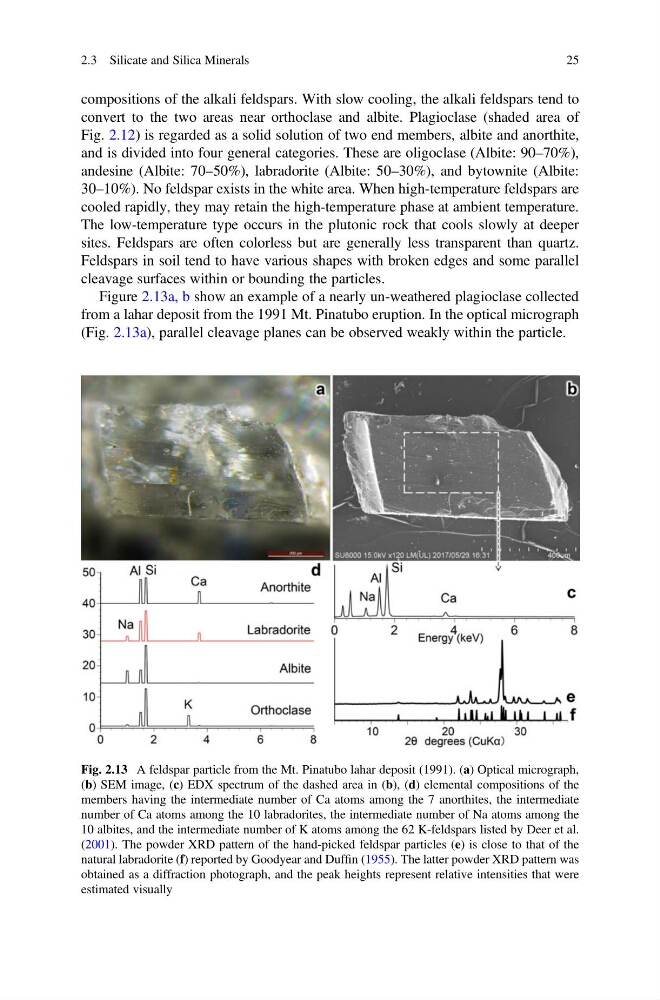
Figure 2.13a, b show an example of a nearly un-weathered plagioclase collected
from a lahar deposit from the 1991 Mt. Pinatubo eruption. In the optical micrograph
(Fig. 2.13a), parallel cleavage planes can be observed weakly within the particle.
Fig. 2.13 A feldspar particle from the Mt. Pinatubo lahar deposit (1991). (a) Optical micrograph,
(b) SEM image, (c) EDX spectrum of the dashed area in (b), (d) elemental compositions of the
members having the intermediate number of Ca atoms among the 7 anorthites, the intermediate
number of Ca atoms among the 10 labradorites, the intermediate number of Na atoms among the
10 albites, and the intermediate number of K atoms among the 62 K-feldspars listed by Deer et al.
(2001). The powder XRD pattern of the hand-picked feldspar particles (e) is close to that of the
natural labradorite (f) reported by Goodyear and Duffin (1955). The latter powder XRD pattern was
obtained as a diffraction photograph, and the peak heights represent relative intensities that were
estimated visually
2.3 Silicate and Silica Minerals
25
convert to the two areas near orthoclase and albite. Plagioclase (shaded area of
Fig. 2.12) is regarded as a solid solution of two end members, albite and anorthite,
and is divided into four general categories. These are oligoclase (Albite: 90–70%),
andesine (Albite: 70–50%), labradorite (Albite: 50–30%), and bytownite (Albite:
30–10%). No feldspar exists in the white area. When high-temperature feldspars are
cooled rapidly, they may retain the high-temperature phase at ambient temperature.
The low-temperature type occurs in the plutonic rock that cools slowly at deeper
sites. Feldspars are often colorless but are generally less transparent than quartz.
Feldspars in soil tend to have various shapes with broken edges and some parallel
cleavage surfaces within or bounding the particles.
Figure 2.13a, b show an example of a nearly un-weathered plagioclase collected
from a lahar deposit from the 1991 Mt. Pinatubo eruption. In the optical micrograph
(Fig. 2.13a), parallel cleavage planes can be observed weakly within the particle.
Fig. 2.13 A feldspar particle from the Mt. Pinatubo lahar deposit (1991). (a) Optical micrograph,
(b) SEM image, (c) EDX spectrum of the dashed area in (b), (d) elemental compositions of the
members having the intermediate number of Ca atoms among the 7 anorthites, the intermediate
number of Ca atoms among the 10 labradorites, the intermediate number of Na atoms among the
10 albites, and the intermediate number of K atoms among the 62 K-feldspars listed by Deer et al.
(2001). The powder XRD pattern of the hand-picked feldspar particles (e) is close to that of the
natural labradorite (f) reported by Goodyear and Duffin (1955). The latter powder XRD pattern was
obtained as a diffraction photograph, and the peak heights represent relative intensities that were
estimated visually
2.3 Silicate and Silica Minerals
25