

spectrum (Fig. 2.11c) suggests that the chemical composition is between those of the
maximum and intermediate Mg members. Although the color is close to black, the
chemical composition is not uniform. Partial weathering might have already started
because a portion of the K
+ was exchanged with Ca
2+ during transportation from the
original site of deposition by rain and river water.
According to quantitative analyses of several particles similar to the one in
Fig. 2.11a, the Mg/(Mg + Fe) atomic ratio ranges between 60 and 70%, indicating
that these particles are a Mg-biotite close to phlogopite (Nanzyo et al. 1999). The
powder XRD pattern (Fig. 2.11g) is close to that for phlogopite (1 M), Fig. 2.11h
(Brindley and Brown 1980).
Further readings for micas are Funning et al. (1989), Thompson and
Ukarainczyk (2002).
Feldspars
Feldspars, including plagioclase and alkali feldspar, account for half of the minerals
of the Earth’s crust (Fig. 2.1). Feldspars are tectosilicates (Table 2.1) and their three
end-members are orthoclase, albite, and anorthite (Fig. 2.12). Depending on their
formation temperature, feldspars are divided into high- and low-temperature types
(Dear et al. 2013). The dotted area of the triangle (Fig. 2.12) shows elemental
0
2
4
6
8
10
0
2
4
6
8
Energy, keV
0
2
4
6
8
Al Si
K
Al Si
K
Fe
Mg
10
20
30
40
50
60
2θ degrees (CuKα)
a
b
c
d
e
f
g
h
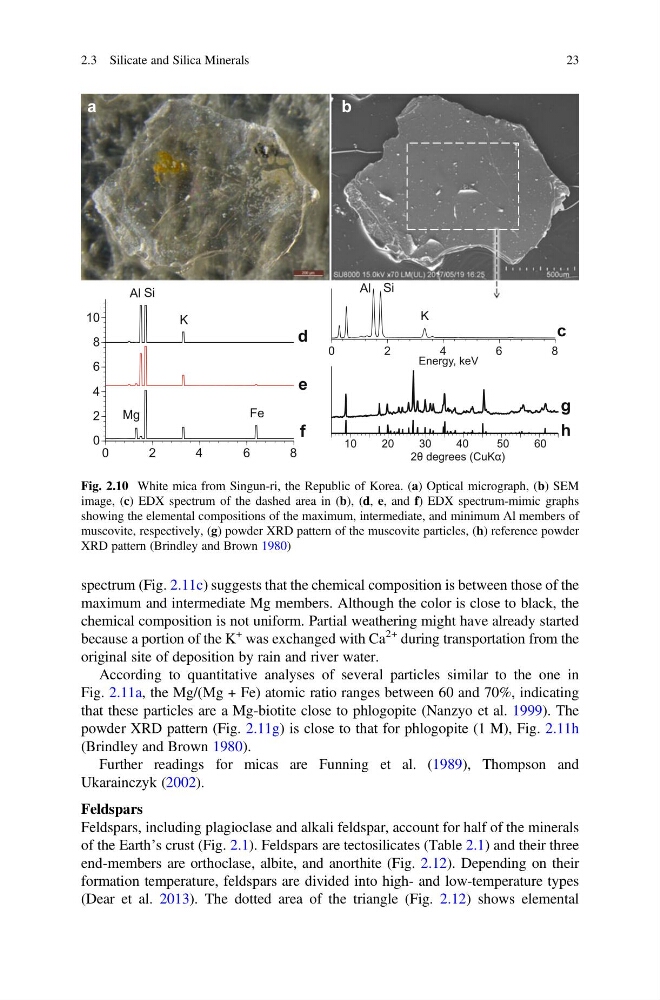
Fig. 2.10 White mica from Singun-ri, the Republic of Korea. (a) Optical micrograph, (b) SEM
image, (c) EDX spectrum of the dashed area in (b), (d, e, and f) EDX spectrum-mimic graphs
showing the elemental compositions of the maximum, intermediate, and minimum Al members of
muscovite, respectively, (g) powder XRD pattern of the muscovite particles, (h) reference powder
XRD pattern (Brindley and Brown 1980)
2.3 Silicate and Silica Minerals
23
maximum and intermediate Mg members. Although the color is close to black, the
chemical composition is not uniform. Partial weathering might have already started
because a portion of the K
+ was exchanged with Ca
2+ during transportation from the
original site of deposition by rain and river water.
According to quantitative analyses of several particles similar to the one in
Fig. 2.11a, the Mg/(Mg + Fe) atomic ratio ranges between 60 and 70%, indicating
that these particles are a Mg-biotite close to phlogopite (Nanzyo et al. 1999). The
powder XRD pattern (Fig. 2.11g) is close to that for phlogopite (1 M), Fig. 2.11h
(Brindley and Brown 1980).
Further readings for micas are Funning et al. (1989), Thompson and
Ukarainczyk (2002).
Feldspars
Feldspars, including plagioclase and alkali feldspar, account for half of the minerals
of the Earth’s crust (Fig. 2.1). Feldspars are tectosilicates (Table 2.1) and their three
end-members are orthoclase, albite, and anorthite (Fig. 2.12). Depending on their
formation temperature, feldspars are divided into high- and low-temperature types
(Dear et al. 2013). The dotted area of the triangle (Fig. 2.12) shows elemental
0
2
4
6
8
10
0
2
4
6
8
Energy, keV
0
2
4
6
8
Al Si
K
Al Si
K
Fe
Mg
10
20
30
40
50
60
2θ degrees (CuKα)
a
b
c
d
e
f
g
h
Fig. 2.10 White mica from Singun-ri, the Republic of Korea. (a) Optical micrograph, (b) SEM
image, (c) EDX spectrum of the dashed area in (b), (d, e, and f) EDX spectrum-mimic graphs
showing the elemental compositions of the maximum, intermediate, and minimum Al members of
muscovite, respectively, (g) powder XRD pattern of the muscovite particles, (h) reference powder
XRD pattern (Brindley and Brown 1980)
2.3 Silicate and Silica Minerals
23