

Olivine
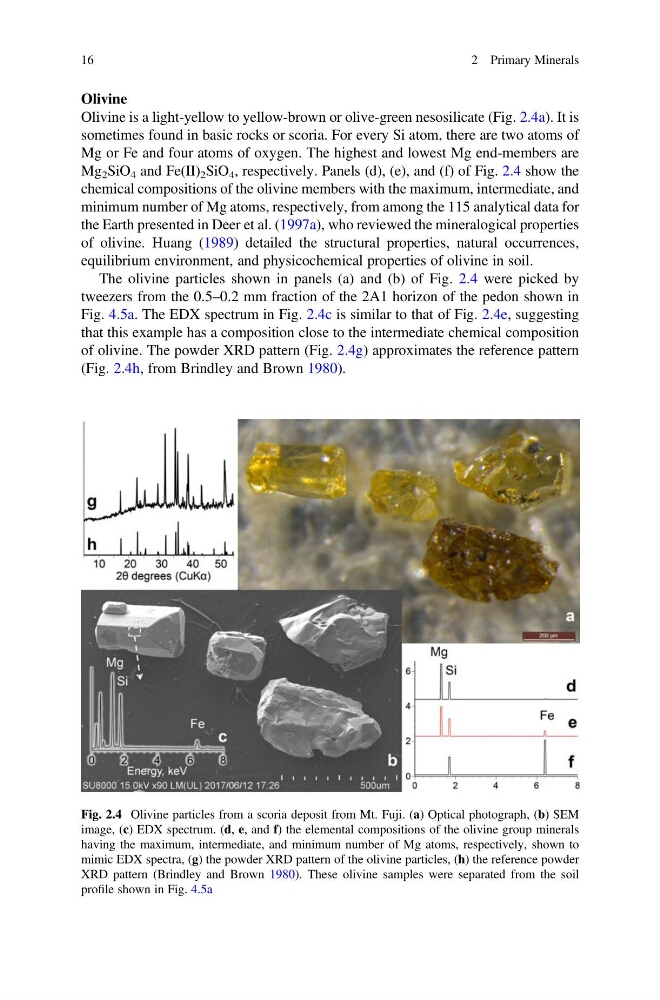
Olivine is a light-yellow to yellow-brown or olive-green nesosilicate (Fig. 2.4a). It is
sometimes found in basic rocks or scoria. For every Si atom, there are two atoms of
Mg or Fe and four atoms of oxygen. The highest and lowest Mg end-members are
Mg 2 SiO 4 and Fe(II) 2 SiO 4 , respectively. Panels (d), (e), and (f) of Fig. 2.4 show the
chemical compositions of the olivine members with the maximum, intermediate, and
minimum number of Mg atoms, respectively, from among the 115 analytical data for
the Earth presented in Deer et al. (1997a), who reviewed the mineralogical properties
of olivine. Huang (1989) detailed the structural properties, natural occurrences,
equilibrium environment, and physicochemical properties of olivine in soil.
The olivine particles shown in panels (a) and (b) of Fig. 2.4 were picked by
tweezers from the 0.5–0.2 mm fraction of the 2A1 horizon of the pedon shown in
Fig. 4.5a. The EDX spectrum in Fig. 2.4c is similar to that of Fig. 2.4e, suggesting
that this example has a composition close to the intermediate chemical composition
of olivine. The powder XRD pattern (Fig. 2.4g) approximates the reference pattern
(Fig. 2.4h, from Brindley and Brown 1980).
Fig. 2.4 Olivine particles from a scoria deposit from Mt. Fuji. (a) Optical photograph, (b) SEM
image, (c) EDX spectrum. (d, e, and f) the elemental compositions of the olivine group minerals
having the maximum, intermediate, and minimum number of Mg atoms, respectively, shown to
mimic EDX spectra, (g) the powder XRD pattern of the olivine particles, (h) the reference powder
XRD pattern (Brindley and Brown 1980). These olivine samples were separated from the soil
profile shown in Fig. 4.5a
16
2 Primary Minerals
Olivine is a light-yellow to yellow-brown or olive-green nesosilicate (Fig. 2.4a). It is
sometimes found in basic rocks or scoria. For every Si atom, there are two atoms of
Mg or Fe and four atoms of oxygen. The highest and lowest Mg end-members are
Mg 2 SiO 4 and Fe(II) 2 SiO 4 , respectively. Panels (d), (e), and (f) of Fig. 2.4 show the
chemical compositions of the olivine members with the maximum, intermediate, and
minimum number of Mg atoms, respectively, from among the 115 analytical data for
the Earth presented in Deer et al. (1997a), who reviewed the mineralogical properties
of olivine. Huang (1989) detailed the structural properties, natural occurrences,
equilibrium environment, and physicochemical properties of olivine in soil.
The olivine particles shown in panels (a) and (b) of Fig. 2.4 were picked by
tweezers from the 0.5–0.2 mm fraction of the 2A1 horizon of the pedon shown in
Fig. 4.5a. The EDX spectrum in Fig. 2.4c is similar to that of Fig. 2.4e, suggesting
that this example has a composition close to the intermediate chemical composition
of olivine. The powder XRD pattern (Fig. 2.4g) approximates the reference pattern
(Fig. 2.4h, from Brindley and Brown 1980).
Fig. 2.4 Olivine particles from a scoria deposit from Mt. Fuji. (a) Optical photograph, (b) SEM
image, (c) EDX spectrum. (d, e, and f) the elemental compositions of the olivine group minerals
having the maximum, intermediate, and minimum number of Mg atoms, respectively, shown to
mimic EDX spectra, (g) the powder XRD pattern of the olivine particles, (h) the reference powder
XRD pattern (Brindley and Brown 1980). These olivine samples were separated from the soil
profile shown in Fig. 4.5a
16
2 Primary Minerals