

5.3.5 P Cycle in Irrigated Lowland Paddy Field Soil
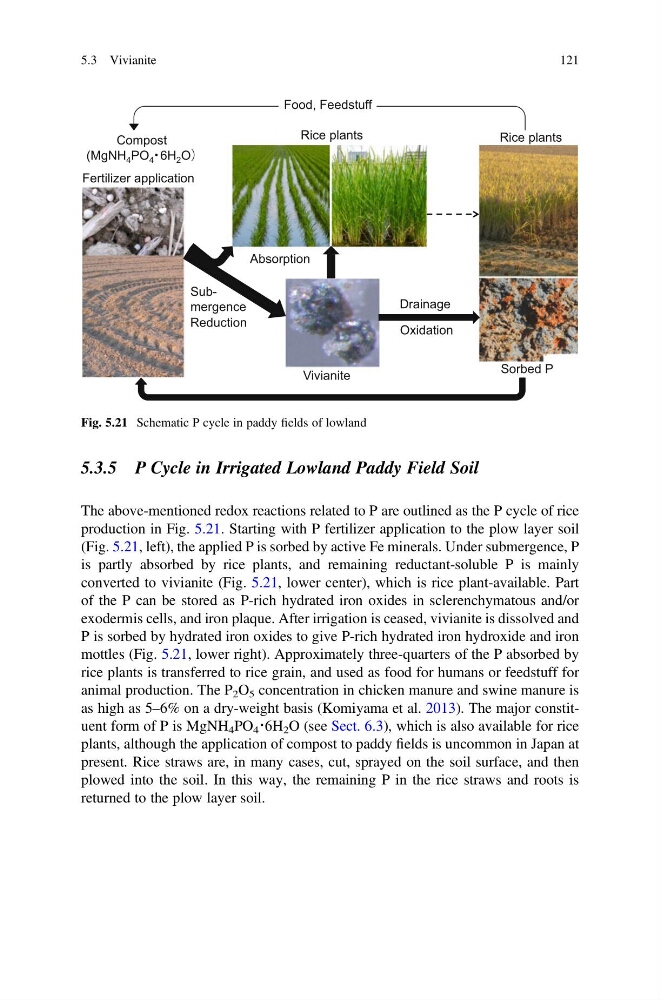
The above-mentioned redox reactions related to P are outlined as the P cycle of rice
production in Fig. 5.21. Starting with P fertilizer application to the plow layer soil
(Fig. 5.21, left), the applied P is sorbed by active Fe minerals. Under submergence, P
is partly absorbed by rice plants, and remaining reductant-soluble P is mainly
converted to vivianite (Fig. 5.21, lower center), which is rice plant-available. Part
of the P can be stored as P-rich hydrated iron oxides in sclerenchymatous and/or
exodermis cells, and iron plaque. After irrigation is ceased, vivianite is dissolved and
P is sorbed by hydrated iron oxides to give P-rich hydrated iron hydroxide and iron
mottles (Fig. 5.21, lower right). Approximately three-quarters of the P absorbed by
rice plants is transferred to rice grain, and used as food for humans or feedstuff for
animal production. The P 2 O 5 concentration in chicken manure and swine manure is
as high as 5–6% on a dry-weight basis (Komiyama et al. 2013). The major constituent form of P is MgNH 4 PO 4 Á6H 2 O (see Sect. 6.3), which is also available for rice
plants, although the application of compost to paddy fields is uncommon in Japan at
present. Rice straws are, in many cases, cut, sprayed on the soil surface, and then
plowed into the soil. In this way, the remaining P in the rice straws and roots is
returned to the plow layer soil.
Fertilizer application
Vivianite
Rice plants
Sorbed P
Compost
(MgNH 4 PO 4 6H 2 O
Rice plants
Drainage
Reduction
Food, Feedstuff
Absorption
Oxidation
Submergence
Fig. 5.21 Schematic P cycle in paddy fields of lowland
5.3 Vivianite
121
The above-mentioned redox reactions related to P are outlined as the P cycle of rice
production in Fig. 5.21. Starting with P fertilizer application to the plow layer soil
(Fig. 5.21, left), the applied P is sorbed by active Fe minerals. Under submergence, P
is partly absorbed by rice plants, and remaining reductant-soluble P is mainly
converted to vivianite (Fig. 5.21, lower center), which is rice plant-available. Part
of the P can be stored as P-rich hydrated iron oxides in sclerenchymatous and/or
exodermis cells, and iron plaque. After irrigation is ceased, vivianite is dissolved and
P is sorbed by hydrated iron oxides to give P-rich hydrated iron hydroxide and iron
mottles (Fig. 5.21, lower right). Approximately three-quarters of the P absorbed by
rice plants is transferred to rice grain, and used as food for humans or feedstuff for
animal production. The P 2 O 5 concentration in chicken manure and swine manure is
as high as 5–6% on a dry-weight basis (Komiyama et al. 2013). The major constituent form of P is MgNH 4 PO 4 Á6H 2 O (see Sect. 6.3), which is also available for rice
plants, although the application of compost to paddy fields is uncommon in Japan at
present. Rice straws are, in many cases, cut, sprayed on the soil surface, and then
plowed into the soil. In this way, the remaining P in the rice straws and roots is
returned to the plow layer soil.
Fertilizer application
Vivianite
Rice plants
Sorbed P
Compost
(MgNH 4 PO 4 6H 2 O
Rice plants
Drainage
Reduction
Food, Feedstuff
Absorption
Oxidation
Submergence
Fig. 5.21 Schematic P cycle in paddy fields of lowland
5.3 Vivianite
121