

dominantly consists of Fe and P. Element maps of P (Fig. 5.12c) and Fe (Fig. 5.12d)
compare closely to the SEM image (Fig. 5.12a), indicating that the crystal aggregate
surrounding the root in Fig. 5.12a is dominantly composed of vivianite.
Although the surfaces of rice roots in the reduced paddy field soil are covered
with oxidized iron plaque, some of this plaque may be reduced with aging. During
plaque formation on rice roots, P released by reduction of hydrated iron oxides in the
soil can be sorbed and accumulated on the iron plaque, as described later in Sect.
5.3.3. With an increase in reducing conditions to the iron plaque, vivianite is formed.
Since new rice roots develop in succession with an increase in tillering, and the redox
conditions in the soil around roots may likely vary, for example, with depletion of
easily decomposable organic matter, some iron plaque may remain until after the rice
harvest.
As a result, considering that rice roots comprise a mixture of young and old
specimens, the ratio of P in the vivianite form is only half of the P contained in rice
roots (Nanzyo et al. 2013). The other half may be iron phosphate material that exists
at the redox interface cells shown in Figs. 5.17 and 5.19, possibly the root sclerenchymatous layer and/or exodermis.
Under reducing conditions in soil, the content of ferrous salts other than vivianite
may be considerable. The other ferrous salts are Fe(OH) 2 , siderite, and noncrystalline
ferrous sulfide. Figure 5.13 compares the stability of these four ferrous salts in an
approximately neutral pH range under hypothetical conditions (Nanzyo et al. 2010).
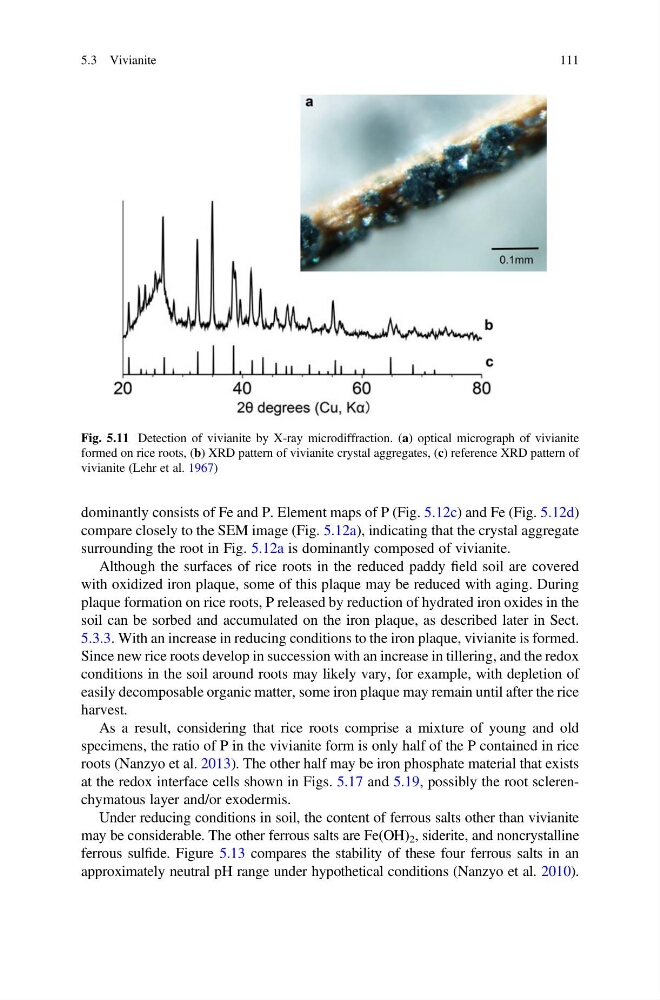
Fig. 5.11 Detection of vivianite by X-ray microdiffraction. (a) optical micrograph of vivianite
formed on rice roots, (b) XRD pattern of vivianite crystal aggregates, (c) reference XRD pattern of
vivianite (Lehr et al. 1967)
5.3 Vivianite
111
compare closely to the SEM image (Fig. 5.12a), indicating that the crystal aggregate
surrounding the root in Fig. 5.12a is dominantly composed of vivianite.
Although the surfaces of rice roots in the reduced paddy field soil are covered
with oxidized iron plaque, some of this plaque may be reduced with aging. During
plaque formation on rice roots, P released by reduction of hydrated iron oxides in the
soil can be sorbed and accumulated on the iron plaque, as described later in Sect.
5.3.3. With an increase in reducing conditions to the iron plaque, vivianite is formed.
Since new rice roots develop in succession with an increase in tillering, and the redox
conditions in the soil around roots may likely vary, for example, with depletion of
easily decomposable organic matter, some iron plaque may remain until after the rice
harvest.
As a result, considering that rice roots comprise a mixture of young and old
specimens, the ratio of P in the vivianite form is only half of the P contained in rice
roots (Nanzyo et al. 2013). The other half may be iron phosphate material that exists
at the redox interface cells shown in Figs. 5.17 and 5.19, possibly the root sclerenchymatous layer and/or exodermis.
Under reducing conditions in soil, the content of ferrous salts other than vivianite
may be considerable. The other ferrous salts are Fe(OH) 2 , siderite, and noncrystalline
ferrous sulfide. Figure 5.13 compares the stability of these four ferrous salts in an
approximately neutral pH range under hypothetical conditions (Nanzyo et al. 2010).
Fig. 5.11 Detection of vivianite by X-ray microdiffraction. (a) optical micrograph of vivianite
formed on rice roots, (b) XRD pattern of vivianite crystal aggregates, (c) reference XRD pattern of
vivianite (Lehr et al. 1967)
5.3 Vivianite
111