

1.3 Solutions
81
(b) B(x) =
N ! p
x q
N −x
x!(N − x)!
=
N (N − 1) . . . (N − x − 1) p
x (1 − p)
N −x
x!
=
N (N − 1) . . . (N − x + 1)(N p)
x (1 − p)
N −x
N x x!
=
m
x
x!
1 −
1
N
1 −
2
N
· · ·
1 −
x − 1
N
(1 − p)
N −x
=
m
x
x!
1 −
1
N
1 −
2
N
· · ·
1 −
x−1
N
(1 − p)
N
(1 − p) x
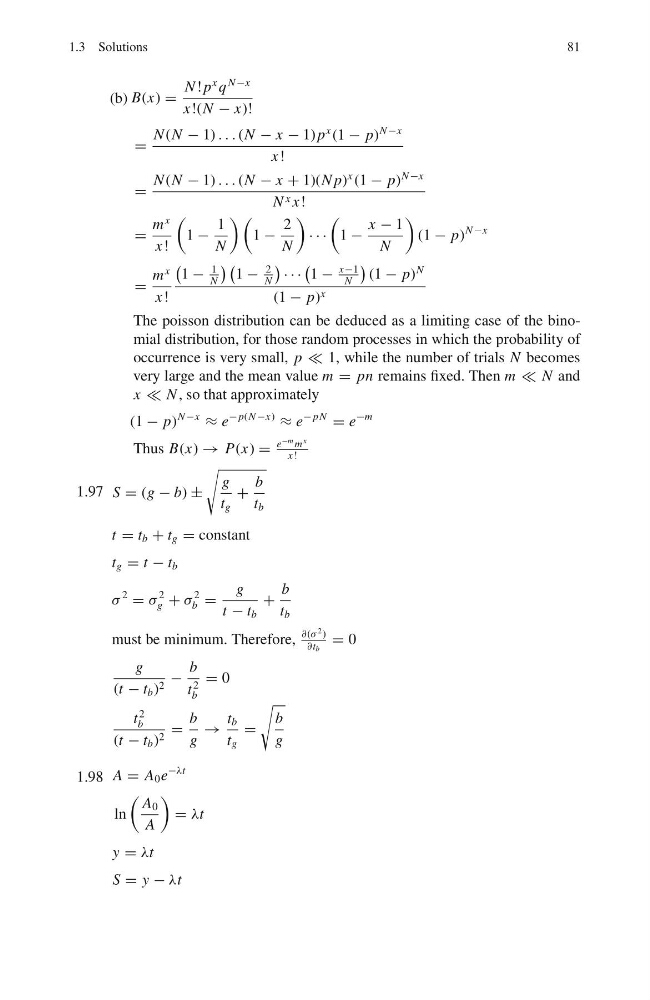
The poisson distribution can be deduced as a limiting case of the binomial distribution, for those random processes in which the probability of
occurrence is very small, p 1, while the number of trials N becomes
very large and the mean value m = pn remains fixed. Then m N and
x N , so that approximately
(1 − p)
N −x
≈ e
− p(N −x)
≈ e
− pN
= e
−m
Thus B(x) → P(x) =
e
−m m
x
x!
1.97 S = (g − b) ±
g
t g
+
b
t b
t = t b + t g = constant
t g = t − t b
σ
2
= σ
2
g + σ
2
b =
g
t − t b
+
b
t b
must be minimum. Therefore,
∂(σ
2 )
∂tb
= 0
g
(t − t b ) 2 −
b
t
2
b
= 0
t
2
b
(t − t b ) 2 =
b
g
→
t b
t g
=
b
g
1.98 A = A 0 e
−λt
ln
A 0
A
= λt
y = λt
S = y − λt
81
(b) B(x) =
N ! p
x q
N −x
x!(N − x)!
=
N (N − 1) . . . (N − x − 1) p
x (1 − p)
N −x
x!
=
N (N − 1) . . . (N − x + 1)(N p)
x (1 − p)
N −x
N x x!
=
m
x
x!
1 −
1
N
1 −
2
N
· · ·
1 −
x − 1
N
(1 − p)
N −x
=
m
x
x!
1 −
1
N
1 −
2
N
· · ·
1 −
x−1
N
(1 − p)
N
(1 − p) x
The poisson distribution can be deduced as a limiting case of the binomial distribution, for those random processes in which the probability of
occurrence is very small, p 1, while the number of trials N becomes
very large and the mean value m = pn remains fixed. Then m N and
x N , so that approximately
(1 − p)
N −x
≈ e
− p(N −x)
≈ e
− pN
= e
−m
Thus B(x) → P(x) =
e
−m m
x
x!
1.97 S = (g − b) ±
g
t g
+
b
t b
t = t b + t g = constant
t g = t − t b
σ
2
= σ
2
g + σ
2
b =
g
t − t b
+
b
t b
must be minimum. Therefore,
∂(σ
2 )
∂tb
= 0
g
(t − t b ) 2 −
b
t
2
b
= 0
t
2
b
(t − t b ) 2 =
b
g
→
t b
t g
=
b
g
1.98 A = A 0 e
−λt
ln
A 0
A
= λt
y = λt
S = y − λt