

1.3 Solutions
75
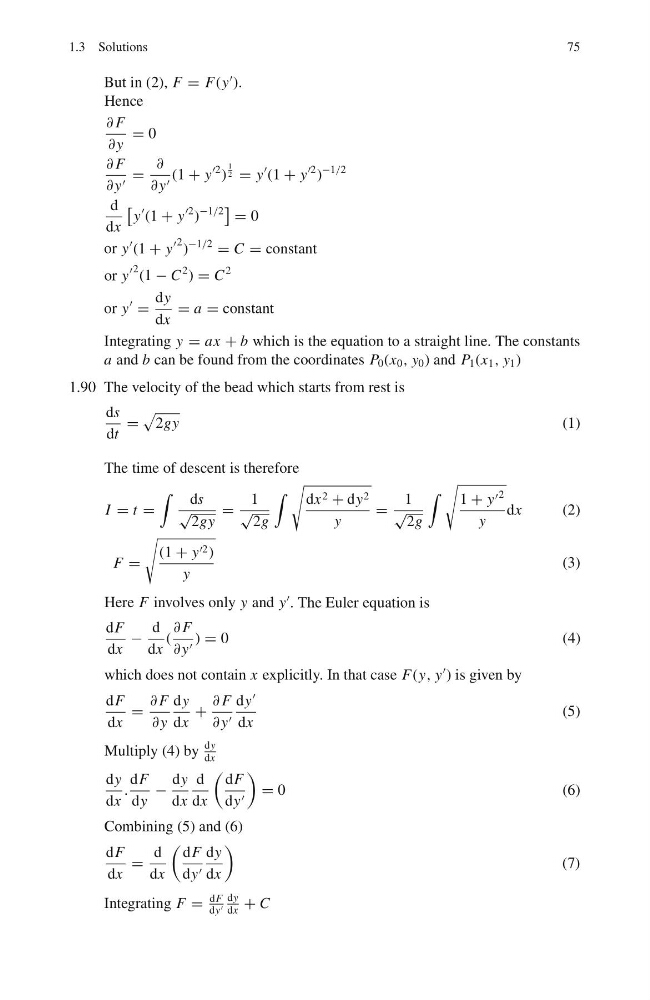
But in (2), F = F(y
).
Hence
∂ F
∂ y
= 0
∂ F
∂ y =
∂
∂ y (1 + y
2 )
1
2 = y
(1 + y
2 )
−1/2
d
dx
y
(1 + y
2 )
−1/2
= 0
or y
(1 + y
2 )
−1/2
= C = constant
or y
2 (1 − C
2 ) = C
2
or y
=
dy
dx
= a = constant
Integrating y = ax + b which is the equation to a straight line. The constants
a and b can be found from the coordinates P 0 (x 0 , y 0 ) and P 1 (x 1 , y 1 )
1.90 The velocity of the bead which starts from rest is
ds
dt
=
2gy
(1)
The time of descent is therefore
I = t =
ds
√
2gy
=
1
√
2g
dx 2 + dy 2
y
=
1
√
2g
1 + y 2
y
dx
(2)
F =
(1 + y 2 )
y
(3)
Here F involves only y and y
. The Euler equation is
dF
dx
−
d
dx
(
∂ F
∂ y ) = 0
( 4 )
which does not contain x explicitly. In that case F(y, y
) is given by
dF
dx
=
∂ F
∂ y
dy
dx
+
∂ F
∂ y
dy
dx
(5)
Multiply (4) by
dy
dx
dy
dx
.
dF
dy
−
dy
dx
d
dx
dF
dy
= 0
( 6 )
Combining (5) and (6)
dF
dx
=
d
dx
dF
dy
dy
dx
(7)
Integrating F =
dF
dy
dy
dx
+ C
75
But in (2), F = F(y
).
Hence
∂ F
∂ y
= 0
∂ F
∂ y =
∂
∂ y (1 + y
2 )
1
2 = y
(1 + y
2 )
−1/2
d
dx
y
(1 + y
2 )
−1/2
= 0
or y
(1 + y
2 )
−1/2
= C = constant
or y
2 (1 − C
2 ) = C
2
or y
=
dy
dx
= a = constant
Integrating y = ax + b which is the equation to a straight line. The constants
a and b can be found from the coordinates P 0 (x 0 , y 0 ) and P 1 (x 1 , y 1 )
1.90 The velocity of the bead which starts from rest is
ds
dt
=
2gy
(1)
The time of descent is therefore
I = t =
ds
√
2gy
=
1
√
2g
dx 2 + dy 2
y
=
1
√
2g
1 + y 2
y
dx
(2)
F =
(1 + y 2 )
y
(3)
Here F involves only y and y
. The Euler equation is
dF
dx
−
d
dx
(
∂ F
∂ y ) = 0
( 4 )
which does not contain x explicitly. In that case F(y, y
) is given by
dF
dx
=
∂ F
∂ y
dy
dx
+
∂ F
∂ y
dy
dx
(5)
Multiply (4) by
dy
dx
dy
dx
.
dF
dy
−
dy
dx
d
dx
dF
dy
= 0
( 6 )
Combining (5) and (6)
dF
dx
=
d
dx
dF
dy
dy
dx
(7)
Integrating F =
dF
dy
dy
dx
+ C