

1.3 Solutions
73
c
dz
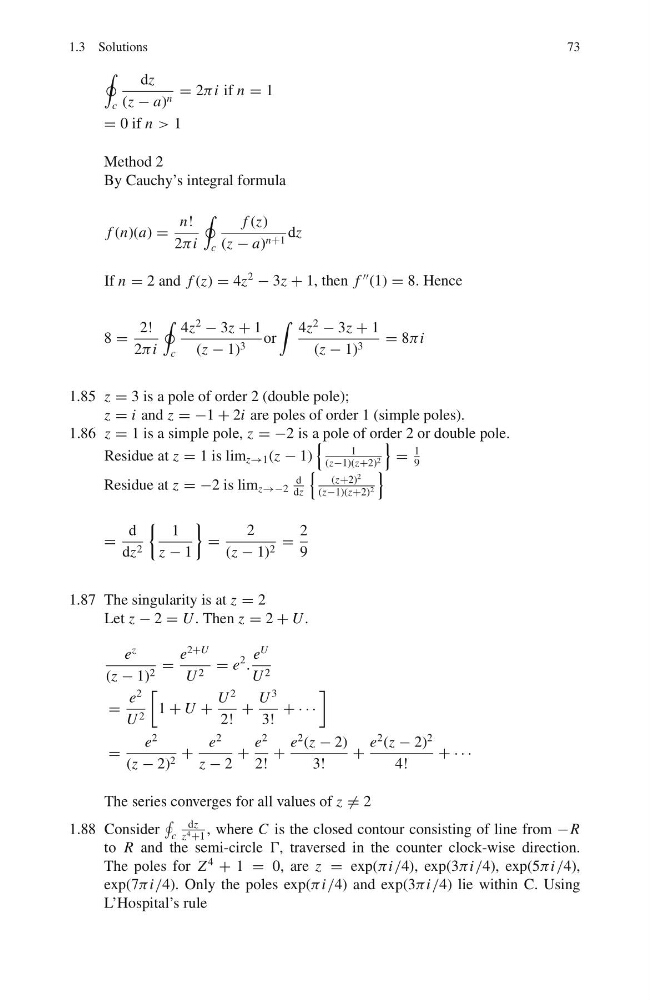
(z − a) n = 2πi if n = 1
= 0 if n > 1
Method 2
By Cauchy’s integral formula
f (n)(a) =
n!
2πi
c
f (z)
(z − a) n+1 dz
If n = 2 and f (z) = 4z
2
− 3z + 1, then f
(1) = 8. Hence
8 =
2!
2πi
c
4z
2
− 3z + 1
(z − 1) 3 or
4z
2
− 3z + 1
(z − 1) 3 = 8πi
1.85 z = 3 is a pole of order 2 (double pole);
z = i and z = −1 + 2i are poles of order 1 (simple poles).
1.86 z = 1 is a simple pole, z = −2 is a pole of order 2 or double pole.
Residue at z = 1 is lim z→1 (z − 1)
1
(z−1)(z+2) 2
=
1
9
Residue at z = −2 is lim z→−2
d
dz
(z+2)
2
(z−1)(z+2) 2
=
d
dz 2
1
z − 1
=
2
(z − 1) 2 =
2
9
1.87 The singularity is at z = 2
Let z − 2 = U . Then z = 2 + U .
e
z
(z − 1) 2 =
e
2+U
U 2 = e
2
.
e
U
U 2
=
e
2
U 2
1 + U +
U
2
2!
+
U
3
3!
+ · · ·
=
e
2
(z − 2) 2 +
e
2
z − 2
+
e
2
2!
+
e
2 (z − 2)
3!
+
e
2 (z − 2)
2
4!
+ · · ·
The series converges for all values of z = 2
1.88 Consider
c
dz
z 4 +1
, where C is the closed contour consisting of line from −R
to R and the semi-circle Γ, traversed in the counter clock-wise direction.
The poles for Z
4
+ 1 = 0, are z = exp(πi/4), exp(3πi/4), exp(5πi/4),
exp(7πi/4). Only the poles exp(πi/4) and exp(3πi/4) lie within C. Using
L’Hospital’s rule
73
c
dz
(z − a) n = 2πi if n = 1
= 0 if n > 1
Method 2
By Cauchy’s integral formula
f (n)(a) =
n!
2πi
c
f (z)
(z − a) n+1 dz
If n = 2 and f (z) = 4z
2
− 3z + 1, then f
(1) = 8. Hence
8 =
2!
2πi
c
4z
2
− 3z + 1
(z − 1) 3 or
4z
2
− 3z + 1
(z − 1) 3 = 8πi
1.85 z = 3 is a pole of order 2 (double pole);
z = i and z = −1 + 2i are poles of order 1 (simple poles).
1.86 z = 1 is a simple pole, z = −2 is a pole of order 2 or double pole.
Residue at z = 1 is lim z→1 (z − 1)
1
(z−1)(z+2) 2
=
1
9
Residue at z = −2 is lim z→−2
d
dz
(z+2)
2
(z−1)(z+2) 2
=
d
dz 2
1
z − 1
=
2
(z − 1) 2 =
2
9
1.87 The singularity is at z = 2
Let z − 2 = U . Then z = 2 + U .
e
z
(z − 1) 2 =
e
2+U
U 2 = e
2
.
e
U
U 2
=
e
2
U 2
1 + U +
U
2
2!
+
U
3
3!
+ · · ·
=
e
2
(z − 2) 2 +
e
2
z − 2
+
e
2
2!
+
e
2 (z − 2)
3!
+
e
2 (z − 2)
2
4!
+ · · ·
The series converges for all values of z = 2
1.88 Consider
c
dz
z 4 +1
, where C is the closed contour consisting of line from −R
to R and the semi-circle Γ, traversed in the counter clock-wise direction.
The poles for Z
4
+ 1 = 0, are z = exp(πi/4), exp(3πi/4), exp(5πi/4),
exp(7πi/4). Only the poles exp(πi/4) and exp(3πi/4) lie within C. Using
L’Hospital’s rule