

70
1 Mathematical Physics
=
2
π x
1 −
x
2
2!
+
x
4
4!
− · · ·
=
2
π x
cos x
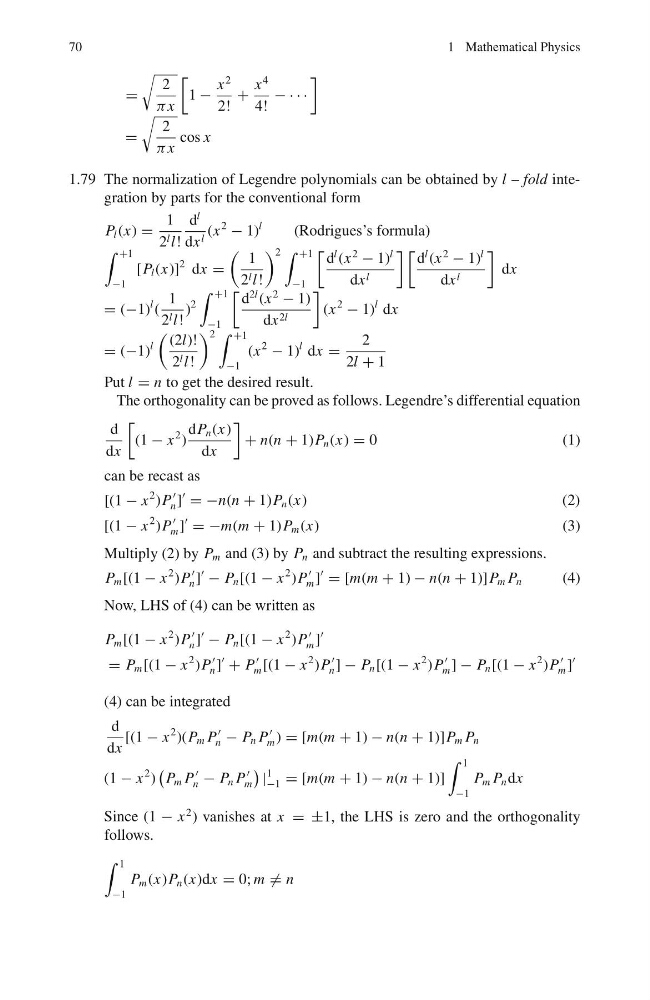
1.79 The normalization of Legendre polynomials can be obtained by l – fold integration by parts for the conventional form
P l (x) =
1
2 l l!
d
l
dx l (x
2
− 1)
l
(Rodrigues’s formula)
+1
−1
[P l (x)]
2 dx =
1
2 l l!
2 +1
−1
d
l (x
2
− 1)
l
dx l
d
l (x
2
− 1)
l
dx l
dx
= (−1)
l (
1
2 l l!
)
2
+1
−1
d
2l (x
2
− 1)
dx 2l
(x
2
− 1)
l dx
= (−1)
l
(2l)!
2 l l!
2 +1
−1
(x
2
− 1)
l dx =
2
2l + 1
Put l = n to get the desired result.
The orthogonality can be proved as follows. Legendre’s differential equation
d
dx
(1 − x
2 )
dP n (x)
dx
+ n(n + 1)P n (x) = 0
( 1 )
can be recast as
[(1 − x
2 )P
n ]
= −n(n + 1)P n (x)
( 2 )
[(1 − x
2 )P
m ]
= −m(m + 1)P m (x)
( 3 )
Multiply (2) by P m and (3) by P n and subtract the resulting expressions.
P m [(1 − x
2 )P
n ]
− P n [(1 − x
2 )P
m ]
= [m(m + 1) − n(n + 1)]P m P n
(4)
Now, LHS of (4) can be written as
P m [(1 − x
2 )P
n ]
− P n [(1 − x
2 )P
m ]
= P m [(1 − x
2 )P
n ]
+ P
m [(1 − x
2 )P
n ] − P n [(1 − x
2 )P
m ] − P n [(1 − x
2 )P
m ]
(4) can be integrated
d
dx
[(1 − x
2 )(P m P
n − P n P
m ) = [m(m + 1) − n(n + 1)]P m P n
(1 − x
2 )
P m P
n − P n P
m
|
1
−1 = [m(m + 1) − n(n + 1)]
1
−1
P m P n dx
Since (1 − x
2 ) vanishes at x = ±1, the LHS is zero and the orthogonality
follows.
1
−1
P m (x)P n (x)dx = 0; m = n
1 Mathematical Physics
=
2
π x
1 −
x
2
2!
+
x
4
4!
− · · ·
=
2
π x
cos x
1.79 The normalization of Legendre polynomials can be obtained by l – fold integration by parts for the conventional form
P l (x) =
1
2 l l!
d
l
dx l (x
2
− 1)
l
(Rodrigues’s formula)
+1
−1
[P l (x)]
2 dx =
1
2 l l!
2 +1
−1
d
l (x
2
− 1)
l
dx l
d
l (x
2
− 1)
l
dx l
dx
= (−1)
l (
1
2 l l!
)
2
+1
−1
d
2l (x
2
− 1)
dx 2l
(x
2
− 1)
l dx
= (−1)
l
(2l)!
2 l l!
2 +1
−1
(x
2
− 1)
l dx =
2
2l + 1
Put l = n to get the desired result.
The orthogonality can be proved as follows. Legendre’s differential equation
d
dx
(1 − x
2 )
dP n (x)
dx
+ n(n + 1)P n (x) = 0
( 1 )
can be recast as
[(1 − x
2 )P
n ]
= −n(n + 1)P n (x)
( 2 )
[(1 − x
2 )P
m ]
= −m(m + 1)P m (x)
( 3 )
Multiply (2) by P m and (3) by P n and subtract the resulting expressions.
P m [(1 − x
2 )P
n ]
− P n [(1 − x
2 )P
m ]
= [m(m + 1) − n(n + 1)]P m P n
(4)
Now, LHS of (4) can be written as
P m [(1 − x
2 )P
n ]
− P n [(1 − x
2 )P
m ]
= P m [(1 − x
2 )P
n ]
+ P
m [(1 − x
2 )P
n ] − P n [(1 − x
2 )P
m ] − P n [(1 − x
2 )P
m ]
(4) can be integrated
d
dx
[(1 − x
2 )(P m P
n − P n P
m ) = [m(m + 1) − n(n + 1)]P m P n
(1 − x
2 )
P m P
n − P n P
m
|
1
−1 = [m(m + 1) − n(n + 1)]
1
−1
P m P n dx
Since (1 − x
2 ) vanishes at x = ±1, the LHS is zero and the orthogonality
follows.
1
−1
P m (x)P n (x)dx = 0; m = n