

1.3 Solutions
63
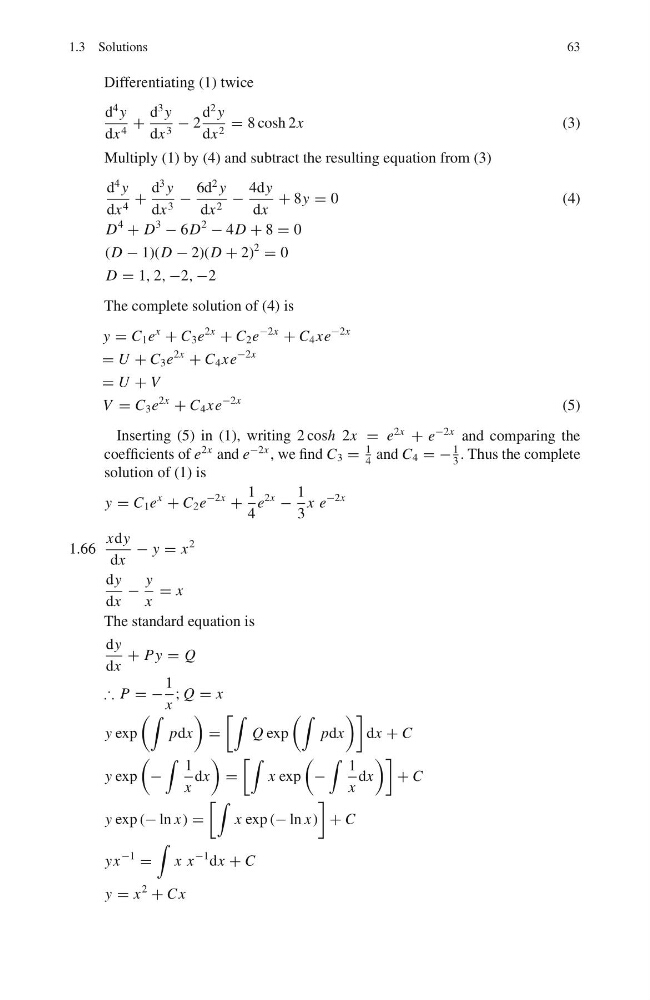
Differentiating (1) twice
d
4 y
dx 4 +
d
3 y
dx 3 − 2
d
2 y
dx 2 = 8 cosh 2x
(3)
Multiply (1) by (4) and subtract the resulting equation from (3)
d
4 y
dx 4 +
d
3 y
dx 3 −
6d
2 y
dx 2 −
4dy
dx
+ 8y = 0
( 4 )
D
4
+ D
3
− 6D
2
− 4D + 8 = 0
(D − 1)(D − 2)(D + 2)
2
= 0
D = 1, 2, −2, −2
The complete solution of (4) is
y = C 1 e
x
+ C 3 e
2x
+ C 2 e
−2x
+ C 4 xe
−2x
= U + C 3 e
2x
+ C 4 xe
−2x
= U + V
V = C 3 e
2x
+ C 4 xe
−2x
(5)
Inserting (5) in (1), writing 2 cosh 2x = e
2x
+ e
−2x and comparing the
coefficients of e
2x and e
−2x , we find C 3 =
1
4
and C 4 = −
1
3
. Thus the complete
solution of (1) is
y = C 1 e
x
+ C 2 e
−2x
+
1
4
e
2x
−
1
3
x e
−2x
1.66
xdy
dx
− y = x
2
dy
dx
−
y
x
= x
The standard equation is
dy
dx
+ Py = Q
∴ P = −
1
x
; Q = x
y exp
pdx
=
Q exp
pdx
dx + C
y exp
−
1
x
dx
=
x exp
−
1
x
dx
+ C
y exp (− ln x) =
x exp (− ln x)
+ C
yx
−1
=
x x
−1 dx + C
y = x
2
+ C x
63
Differentiating (1) twice
d
4 y
dx 4 +
d
3 y
dx 3 − 2
d
2 y
dx 2 = 8 cosh 2x
(3)
Multiply (1) by (4) and subtract the resulting equation from (3)
d
4 y
dx 4 +
d
3 y
dx 3 −
6d
2 y
dx 2 −
4dy
dx
+ 8y = 0
( 4 )
D
4
+ D
3
− 6D
2
− 4D + 8 = 0
(D − 1)(D − 2)(D + 2)
2
= 0
D = 1, 2, −2, −2
The complete solution of (4) is
y = C 1 e
x
+ C 3 e
2x
+ C 2 e
−2x
+ C 4 xe
−2x
= U + C 3 e
2x
+ C 4 xe
−2x
= U + V
V = C 3 e
2x
+ C 4 xe
−2x
(5)
Inserting (5) in (1), writing 2 cosh 2x = e
2x
+ e
−2x and comparing the
coefficients of e
2x and e
−2x , we find C 3 =
1
4
and C 4 = −
1
3
. Thus the complete
solution of (1) is
y = C 1 e
x
+ C 2 e
−2x
+
1
4
e
2x
−
1
3
x e
−2x
1.66
xdy
dx
− y = x
2
dy
dx
−
y
x
= x
The standard equation is
dy
dx
+ Py = Q
∴ P = −
1
x
; Q = x
y exp
pdx
=
Q exp
pdx
dx + C
y exp
−
1
x
dx
=
x exp
−
1
x
dx
+ C
y exp (− ln x) =
x exp (− ln x)
+ C
yx
−1
=
x x
−1 dx + C
y = x
2
+ C x