

1.3 Solutions
61
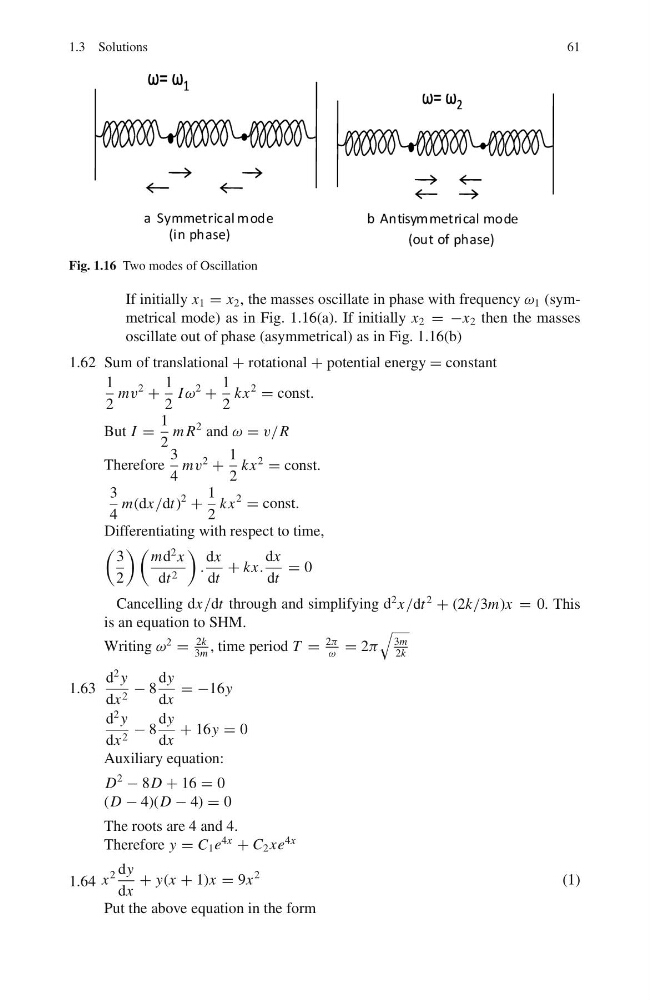
Fig. 1.16 Two modes of Oscillation
If initially x 1 = x 2 , the masses oscillate in phase with frequency ω 1 (symmetrical mode) as in Fig. 1.16(a). If initially x 2 = −x 2 then the masses
oscillate out of phase (asymmetrical) as in Fig. 1.16(b)
1.62 Sum of translational + rotational + potential energy = constant
1
2
mv
2
+
1
2
I ω
2
+
1
2
kx
2
= const.
But I =
1
2
m R
2 and ω = v/R
Therefore
3
4
mv
2
+
1
2
kx
2
= const.
3
4
m(dx/dt)
2
+
1
2
kx
2
= const.
Differentiating with respect to time,
3
2
md
2 x
dt 2
.
dx
dt
+ kx.
dx
dt
= 0
Cancelling dx/dt through and simplifying d
2 x/dt
2
+ (2k/3m)x = 0. This
is an equation to SHM.
Writing ω
2
=
2k
3m
, time period T =
2π
ω
= 2π
3m
2k
1.63
d
2 y
dx 2 − 8
dy
dx
= −16y
d
2 y
dx 2 − 8
dy
dx
+ 16y = 0
Auxiliary equation:
D
2
− 8D + 16 = 0
(D − 4)(D − 4) = 0
The roots are 4 and 4.
Therefore y = C 1 e
4x
+ C 2 xe
4x
1.64 x
2 dy
dx
+ y(x + 1)x = 9x
2
(1)
Put the above equation in the form
61
Fig. 1.16 Two modes of Oscillation
If initially x 1 = x 2 , the masses oscillate in phase with frequency ω 1 (symmetrical mode) as in Fig. 1.16(a). If initially x 2 = −x 2 then the masses
oscillate out of phase (asymmetrical) as in Fig. 1.16(b)
1.62 Sum of translational + rotational + potential energy = constant
1
2
mv
2
+
1
2
I ω
2
+
1
2
kx
2
= const.
But I =
1
2
m R
2 and ω = v/R
Therefore
3
4
mv
2
+
1
2
kx
2
= const.
3
4
m(dx/dt)
2
+
1
2
kx
2
= const.
Differentiating with respect to time,
3
2
md
2 x
dt 2
.
dx
dt
+ kx.
dx
dt
= 0
Cancelling dx/dt through and simplifying d
2 x/dt
2
+ (2k/3m)x = 0. This
is an equation to SHM.
Writing ω
2
=
2k
3m
, time period T =
2π
ω
= 2π
3m
2k
1.63
d
2 y
dx 2 − 8
dy
dx
= −16y
d
2 y
dx 2 − 8
dy
dx
+ 16y = 0
Auxiliary equation:
D
2
− 8D + 16 = 0
(D − 4)(D − 4) = 0
The roots are 4 and 4.
Therefore y = C 1 e
4x
+ C 2 xe
4x
1.64 x
2 dy
dx
+ y(x + 1)x = 9x
2
(1)
Put the above equation in the form