

1.3 Solutions
57
1.3.8 Ordinary Differential Equations
1.55
dy
dx
=
x
3
+ y
3
3x y 2
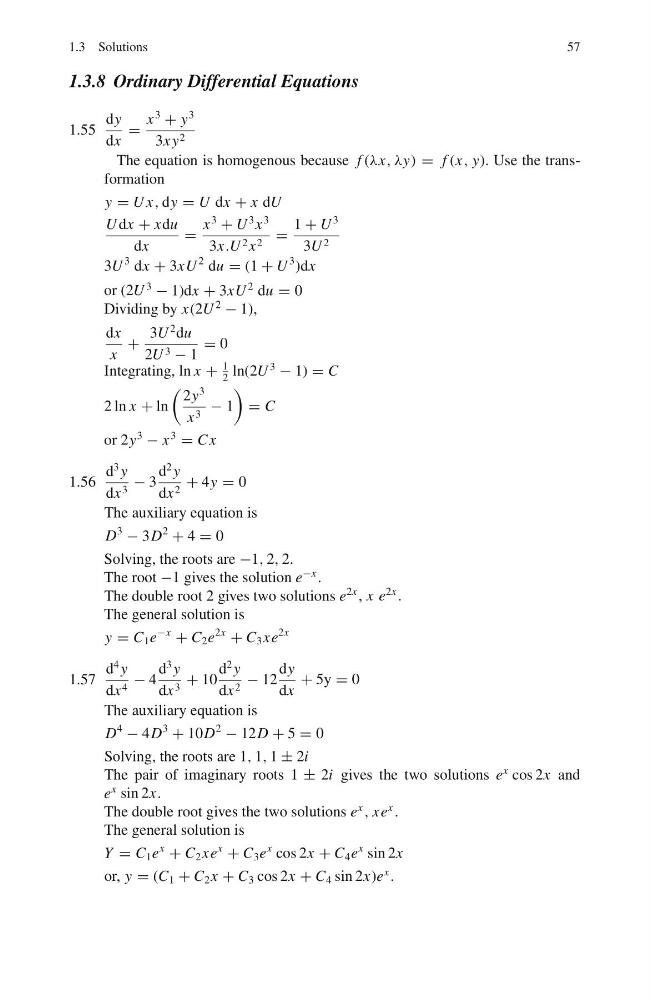
The equation is homogenous because f (λx, λy) = f (x, y). Use the transformation
y = U x, dy = U dx + x dU
U dx + xdu
dx
=
x
3
+ U
3 x
3
3x.U 2 x 2 =
1 + U
3
3U 2
3U
3 dx + 3xU
2 du = (1 + U
3 )dx
or (2U
3
− 1)dx + 3xU
2 du = 0
Dividing by x(2U
2
− 1),
dx
x
+
3U
2 du
2U 3 − 1
= 0
Integrating, ln x +
1
2
ln(2U
3
− 1) = C
2 ln x + ln
2y
3
x 3 − 1
= C
or 2y
3
− x
3
= C x
1.56
d
3 y
dx 3 − 3
d
2 y
dx 2 + 4y = 0
The auxiliary equation is
D
3
− 3D
2
+ 4 = 0
Solving, the roots are −1, 2, 2.
The root −1 gives the solution e
−x .
The double root 2 gives two solutions e
2x , x e
2x .
The general solution is
y = C 1 e
−x
+ C 2 e
2x
+ C 3 xe
2x
1.57
d
4 y
dx 4 − 4
d
3 y
dx 3 + 10
d
2 y
dx 2 − 12
dy
dx
+ 5y = 0
The auxiliary equation is
D
4
− 4D
3
+ 10D
2
− 12D + 5 = 0
Solving, the roots are 1, 1, 1 ± 2i
The pair of imaginary roots 1 ± 2i gives the two solutions e
x cos 2x and
e
x sin 2x.
The double root gives the two solutions e
x
, xe
x .
The general solution is
Y = C 1 e
x
+ C 2 xe
x
+ C 3 e
x cos 2x + C 4 e
x sin 2x
or, y = (C 1 + C 2 x + C 3 cos 2x + C 4 sin 2x)e
x .
57
1.3.8 Ordinary Differential Equations
1.55
dy
dx
=
x
3
+ y
3
3x y 2
The equation is homogenous because f (λx, λy) = f (x, y). Use the transformation
y = U x, dy = U dx + x dU
U dx + xdu
dx
=
x
3
+ U
3 x
3
3x.U 2 x 2 =
1 + U
3
3U 2
3U
3 dx + 3xU
2 du = (1 + U
3 )dx
or (2U
3
− 1)dx + 3xU
2 du = 0
Dividing by x(2U
2
− 1),
dx
x
+
3U
2 du
2U 3 − 1
= 0
Integrating, ln x +
1
2
ln(2U
3
− 1) = C
2 ln x + ln
2y
3
x 3 − 1
= C
or 2y
3
− x
3
= C x
1.56
d
3 y
dx 3 − 3
d
2 y
dx 2 + 4y = 0
The auxiliary equation is
D
3
− 3D
2
+ 4 = 0
Solving, the roots are −1, 2, 2.
The root −1 gives the solution e
−x .
The double root 2 gives two solutions e
2x , x e
2x .
The general solution is
y = C 1 e
−x
+ C 2 e
2x
+ C 3 xe
2x
1.57
d
4 y
dx 4 − 4
d
3 y
dx 3 + 10
d
2 y
dx 2 − 12
dy
dx
+ 5y = 0
The auxiliary equation is
D
4
− 4D
3
+ 10D
2
− 12D + 5 = 0
Solving, the roots are 1, 1, 1 ± 2i
The pair of imaginary roots 1 ± 2i gives the two solutions e
x cos 2x and
e
x sin 2x.
The double root gives the two solutions e
x
, xe
x .
The general solution is
Y = C 1 e
x
+ C 2 xe
x
+ C 3 e
x cos 2x + C 4 e
x sin 2x
or, y = (C 1 + C 2 x + C 3 cos 2x + C 4 sin 2x)e
x .