

1.3 Solutions
53
1.45 (a)
tan
6 x sec
4 xdx =
tan
6 x(tan
2 x + 1) sec
2 xdx
=
(tan x)
8 sec
2 xdx +
tan
6 x sec
2 xdx
=
(tan x)
8 d(tan x) +
(tan x)
6 d(tan x)
=
tan
9 x
9
+
tan
7 x
7
+ C
(b)
tan
5 x sec
3 xdx =
tan
4 x sec
2 x sec x tan x dx
=
(sec
2 x − 1)
2 sec
2 x sec x tan x dx
=
(sec
6 x − 2 sec
4 x + sec
2 x)d(sec x)
=
sec
7 x
7
− 2
sec
5 x
5
+
sec
3 x
3
+ C
1.46
4
2
2x + 4
x 2 − 4x + 8
dx =
4
2
2x − 4 + 8
(x − 2) 2 + 4
dx
=
4
2
2x − 4
(x − 2) 2 + 4
dx + 8
4
2
dx
(x − 2) 2 + 4
= ln [(x − 2)
2
+ 4]
4
2 + (8/2) tan
−1 1
= ln 2 + π
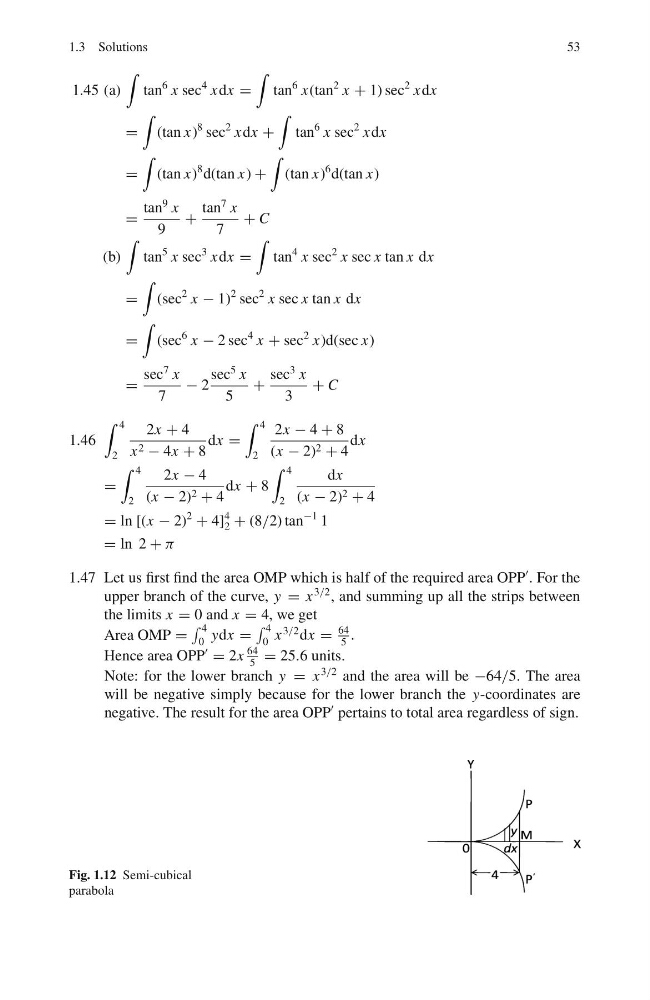
1.47 Let us first find the area OMP which is half of the required area OPP
. For the
upper branch of the curve, y = x
3/2 , and summing up all the strips between
the limits x = 0 and x = 4, we get
Area OMP =
4
0 ydx =
4
0 x
3/2 dx =
64
5
.
Hence area OPP
= 2x
64
5
= 25.6 units.
Note: for the lower branch y = x
3/2 and the area will be −64/5. The area
will be negative simply because for the lower branch the y-coordinates are
negative. The result for the area OPP
pertains to total area regardless of sign.
Fig. 1.12 Semi-cubical
parabola
53
1.45 (a)
tan
6 x sec
4 xdx =
tan
6 x(tan
2 x + 1) sec
2 xdx
=
(tan x)
8 sec
2 xdx +
tan
6 x sec
2 xdx
=
(tan x)
8 d(tan x) +
(tan x)
6 d(tan x)
=
tan
9 x
9
+
tan
7 x
7
+ C
(b)
tan
5 x sec
3 xdx =
tan
4 x sec
2 x sec x tan x dx
=
(sec
2 x − 1)
2 sec
2 x sec x tan x dx
=
(sec
6 x − 2 sec
4 x + sec
2 x)d(sec x)
=
sec
7 x
7
− 2
sec
5 x
5
+
sec
3 x
3
+ C
1.46
4
2
2x + 4
x 2 − 4x + 8
dx =
4
2
2x − 4 + 8
(x − 2) 2 + 4
dx
=
4
2
2x − 4
(x − 2) 2 + 4
dx + 8
4
2
dx
(x − 2) 2 + 4
= ln [(x − 2)
2
+ 4]
4
2 + (8/2) tan
−1 1
= ln 2 + π
1.47 Let us first find the area OMP which is half of the required area OPP
. For the
upper branch of the curve, y = x
3/2 , and summing up all the strips between
the limits x = 0 and x = 4, we get
Area OMP =
4
0 ydx =
4
0 x
3/2 dx =
64
5
.
Hence area OPP
= 2x
64
5
= 25.6 units.
Note: for the lower branch y = x
3/2 and the area will be −64/5. The area
will be negative simply because for the lower branch the y-coordinates are
negative. The result for the area OPP
pertains to total area regardless of sign.
Fig. 1.12 Semi-cubical
parabola