

1.3 Solutions
49
h = −
f (v)
f (v)
; f (v) = f (−2.1)
f
(v) =
dy
dx
| v ; f
(v) = 10.23
h = −
0.039
10.23
= −0.0038
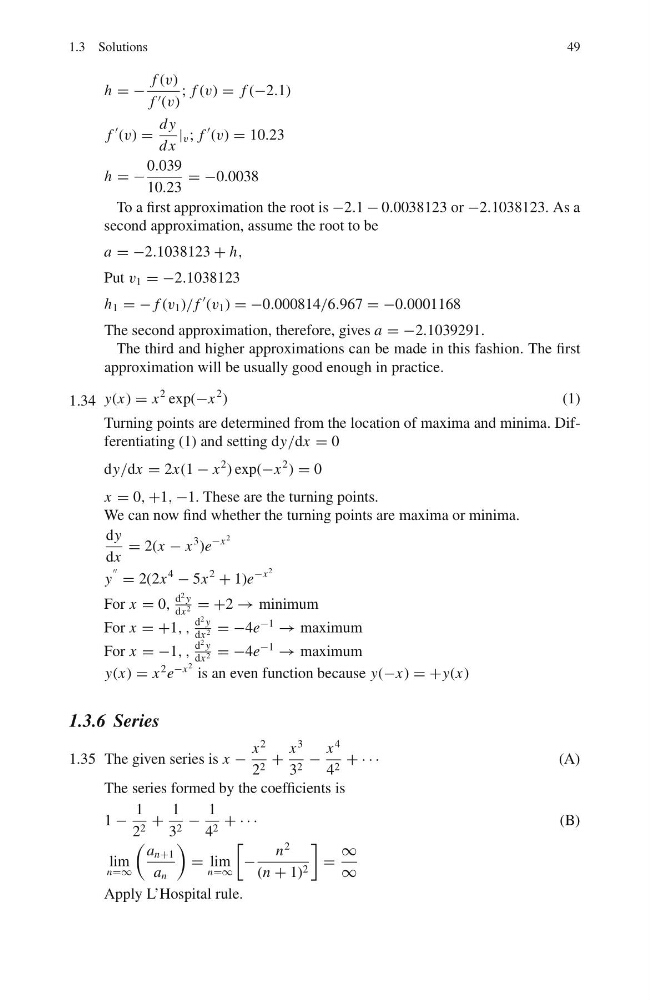
To a first approximation the root is −2.1 − 0.0038123 or −2.1038123. As a
second approximation, assume the root to be
a = −2.1038123 + h,
Put v 1 = −2.1038123
h 1 = − f (v 1 )/ f
(v 1 ) = −0.000814/6.967 = −0.0001168
The second approximation, therefore, gives a = −2.1039291.
The third and higher approximations can be made in this fashion. The first
approximation will be usually good enough in practice.
1.34 y(x) = x
2 exp(−x
2 )
( 1 )
Turning points are determined from the location of maxima and minima. Differentiating (1) and setting dy/dx = 0
dy/dx = 2x(1 − x
2 ) exp(−x
2 ) = 0
x = 0, +1, −1. These are the turning points.
We can now find whether the turning points are maxima or minima.
dy
dx
= 2(x − x
3 )e
−x
2
y
= 2(2x
4
− 5x
2
+ 1)e
−x
2
For x = 0,
d
2 y
dx 2 = +2 → minimum
For x = +1, ,
d
2 y
dx 2 = −4e
−1
→ maximum
For x = −1, ,
d
2 y
dx 2 = −4e
−1
→ maximum
y(x) = x
2 e
−x
2 is an even function because y(−x) = +y(x)
1.3.6 Series
1.35 The given series is x −
x
2
2 2 +
x
3
3 2 −
x
4
4 2 + · · ·
(A)
The series formed by the coefficients is
1 −
1
2 2 +
1
3 2 −
1
4 2 + · · ·
(B)
lim
n=∞
a n+1
a n
= lim
n=∞
−
n
2
(n + 1) 2
=
∞
∞
Apply L’Hospital rule.
49
h = −
f (v)
f (v)
; f (v) = f (−2.1)
f
(v) =
dy
dx
| v ; f
(v) = 10.23
h = −
0.039
10.23
= −0.0038
To a first approximation the root is −2.1 − 0.0038123 or −2.1038123. As a
second approximation, assume the root to be
a = −2.1038123 + h,
Put v 1 = −2.1038123
h 1 = − f (v 1 )/ f
(v 1 ) = −0.000814/6.967 = −0.0001168
The second approximation, therefore, gives a = −2.1039291.
The third and higher approximations can be made in this fashion. The first
approximation will be usually good enough in practice.
1.34 y(x) = x
2 exp(−x
2 )
( 1 )
Turning points are determined from the location of maxima and minima. Differentiating (1) and setting dy/dx = 0
dy/dx = 2x(1 − x
2 ) exp(−x
2 ) = 0
x = 0, +1, −1. These are the turning points.
We can now find whether the turning points are maxima or minima.
dy
dx
= 2(x − x
3 )e
−x
2
y
= 2(2x
4
− 5x
2
+ 1)e
−x
2
For x = 0,
d
2 y
dx 2 = +2 → minimum
For x = +1, ,
d
2 y
dx 2 = −4e
−1
→ maximum
For x = −1, ,
d
2 y
dx 2 = −4e
−1
→ maximum
y(x) = x
2 e
−x
2 is an even function because y(−x) = +y(x)
1.3.6 Series
1.35 The given series is x −
x
2
2 2 +
x
3
3 2 −
x
4
4 2 + · · ·
(A)
The series formed by the coefficients is
1 −
1
2 2 +
1
3 2 −
1
4 2 + · · ·
(B)
lim
n=∞
a n+1
a n
= lim
n=∞
−
n
2
(n + 1) 2
=
∞
∞
Apply L’Hospital rule.